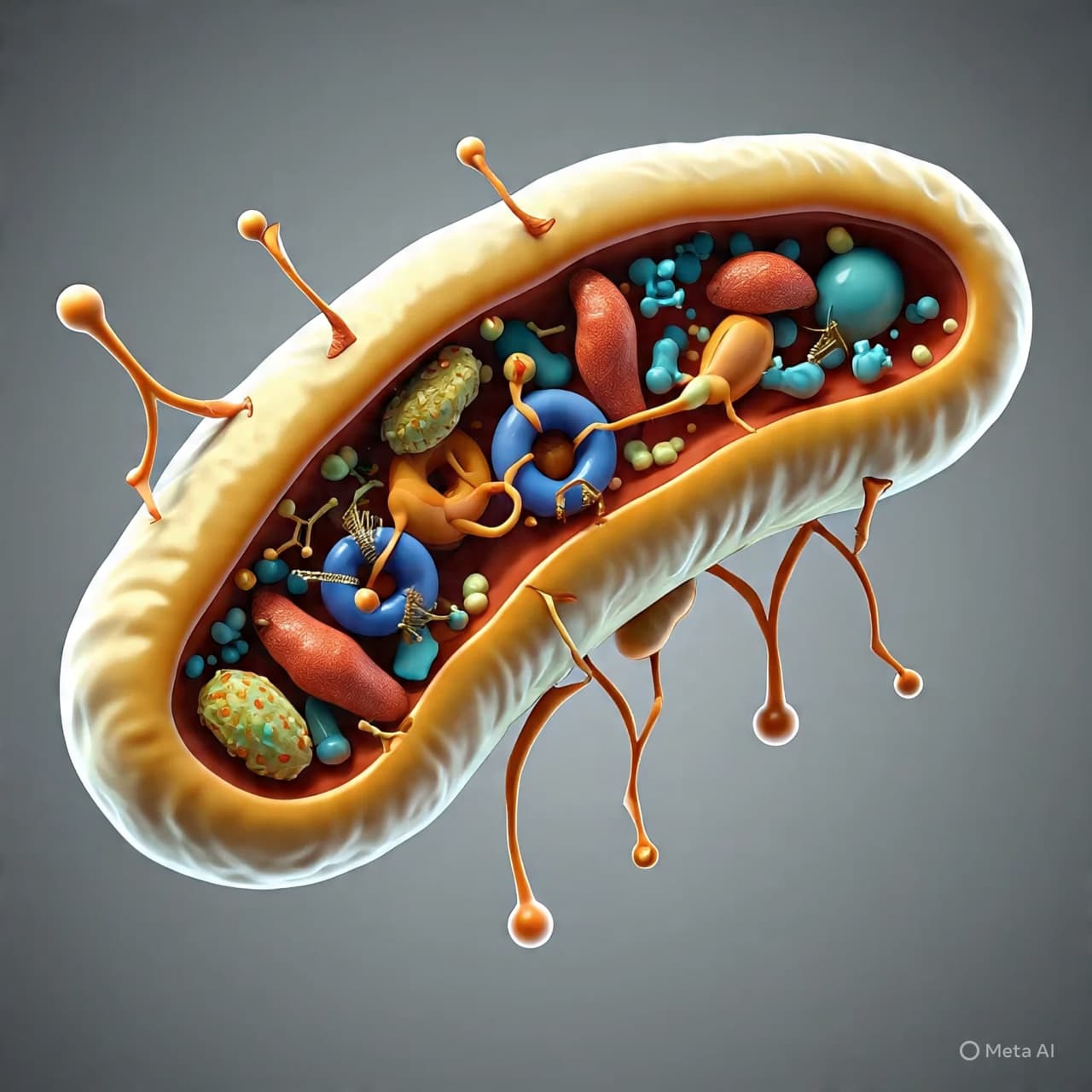
In laboratories and data centers, the smallest forms of life are beginning to acquire a second existence—one not in glass dishes or nutrient broth, but in patterns of code and light. Here, inside clusters of processors and streams of numerical calculations, a cell can unfold its quiet routine: growing, copying its DNA, assembling proteins, and dividing, as if the rhythms of biology had been translated into a language of mathematics.
The latest step in that unfolding arrives with the simulation of a living bacterium rendered not only in three dimensions, but across time as well. Scientists have constructed a four-dimensional whole-cell model of a genetically minimal organism, capturing its complete life cycle—from DNA replication and metabolism to protein production and cell division. In this digital reconstruction, the cell lives its full existence inside a computer, each molecule moving and interacting as it would in the crowded interior of real biology.
The organism at the center of this work is known as JCVI-syn3A, a bacterium engineered to contain only the genes essential for life. With fewer than five hundred genes arranged on a single circular strand of DNA, it represents one of the simplest living systems known. Its stripped-down genome makes it an ideal subject for scientists attempting to answer one of biology’s oldest questions: what does life look like when reduced to its most fundamental parts.
To simulate that simplicity required an extraordinary accumulation of complexity. Researchers accounted for every gene, protein, RNA molecule, and chemical reaction occurring inside the cell. The model tracks how thousands of molecular components diffuse through the cytoplasm, assemble into structures, and respond to changes in metabolism as the cell grows. Even the twisting motion of the chromosome during replication had to be calculated.
Unlike earlier models that treated cells as uniform chemical mixtures, this simulation recreates the spatial organization of life. The interior of the bacterium appears as a dense and dynamic environment where molecules collide, react, and drift through a microscopic landscape. Over roughly one hundred minutes of simulated time—the length of the organism’s natural cell cycle—the virtual cell doubles in size and divides into two daughter cells.
The scale of the computation reflects the scale of the ambition. Running a single full simulation required multiple graphics processing units and days of calculation, as algorithms traced the interactions of thousands of molecules at nanoscale resolution. Yet the reward is a window into life that conventional experiments cannot easily provide: the ability to observe many cellular processes simultaneously, revealing how metabolism, genetics, and physical structure intertwine inside a living system.
For scientists, such models promise more than visualizations. They offer a testing ground where hypotheses about biology can be explored before experiments begin. By altering genes, metabolic pathways, or environmental conditions in the simulation, researchers can watch how the cell responds, turning the computer into a laboratory of possibilities.
In the quiet logic of this digital bacterium, life appears as both fragile and remarkably organized—a choreography of molecules unfolding over time. The model does not replace the living cell it represents, but it reflects something essential about it: that even the simplest organism is a universe of interactions, now slowly becoming visible in the language of computation.
Published by Banx Network. This article is part of the Banx decentralized media programme, powered by the BXE token on the XRP Ledger.