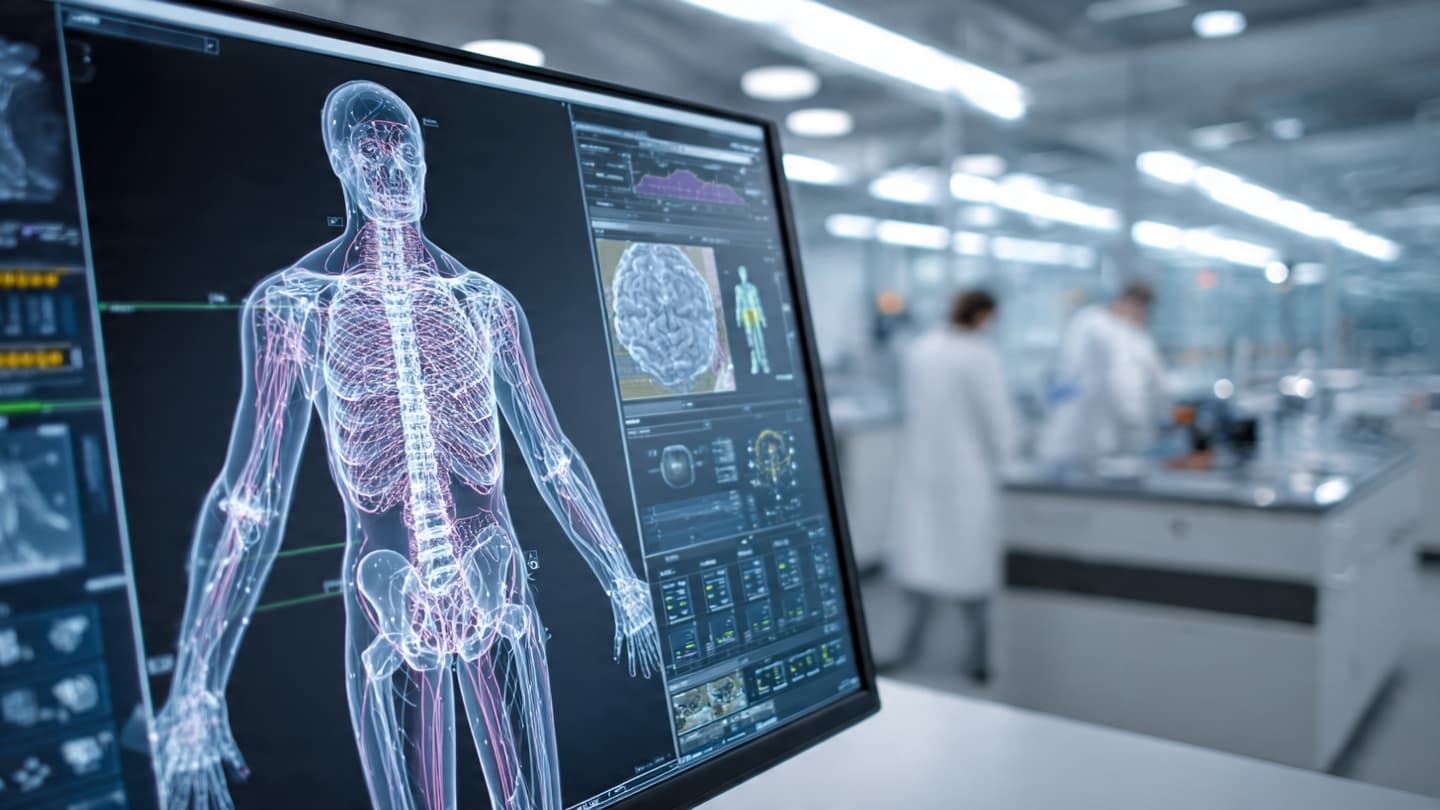
Medicine has always moved between what can be observed and what must still be imagined. Before a treatment reaches a patient, researchers spend years studying its effects, testing possibilities and trying to understand how different bodies might respond. Now, inside laboratories and research centers, another kind of patient is beginning to appear: a virtual one, created through data and artificial intelligence.
French researchers and medical experts are increasingly examining how artificial intelligence, virtual patients and digital twins could contribute to clinical research. These technologies allow researchers to create computational representations that can be used to explore medical scenarios before, or alongside, traditional clinical testing.
A digital twin is essentially a computer-based representation of a real object or system. In medicine, the concept can be adapted to represent aspects of an individual patient, potentially incorporating information such as medical history, biological measurements and other available health data.
Virtual patients can serve a related purpose. Instead of immediately relying on a physical participant for every research scenario, scientists can use computer models to explore how a theoretical patient might respond under different conditions.
The potential advantage lies partly in the ability to test numerous scenarios. Researchers can adjust variables within a model and observe possible outcomes, creating a broader picture of how a treatment might behave before moving further into conventional testing.
Artificial intelligence adds another layer to this process. Modern AI systems can analyze large volumes of medical information and identify patterns that may be difficult to detect through traditional approaches alone. The resulting models can then help researchers examine relationships between treatments, patient characteristics and potential outcomes.
However, these technologies are not intended to simply replace human participants. Clinical trials still require real-world evidence because biological systems are complex and cannot always be perfectly represented by a computer model.
Instead, virtual patients and digital twins are being considered as additional tools. They may help researchers design trials more efficiently, identify questions that deserve further investigation and explore possibilities before resources are committed to larger studies.
The development also reflects a broader transformation in healthcare, where increasingly large amounts of information are being generated through medical records, imaging, genetic research and monitoring technologies. Turning those data into useful knowledge has become one of the central challenges of modern medicine.
For French researchers, the emerging technology offers another way to look at clinical research: not as a choice between computers and patients, but as a gradual combination of digital modeling and traditional medical practice.
The virtual patient remains only a representation, but its presence signals a changing research landscape. Somewhere between laboratory screens and hospital rooms, medicine is beginning to experiment with digital versions of the people it hopes to understand better.
AI Image Disclaimer The illustrations accompanying this article were created with AI technology and are conceptual representations, not photographs of actual clinical trials or patients.
Sources Le Monde
Published by Banx Network. This article is part of the Banx decentralized media programme, powered by the BXE token on the XRP Ledger.