The universe carries its history quietly. From the faint glow of distant galaxies to the whisper of cosmic radiation drifting through space, traces of the earliest moments after the Big Bang still linger. Scientists have spent decades searching for those clues, hoping to understand how matter behaved in the first seconds of existence.
Now researchers believe that a rare and extreme state of matter—one thought to have existed only moments after the —may still survive today, hidden deep inside one of the universe’s most extraordinary objects.
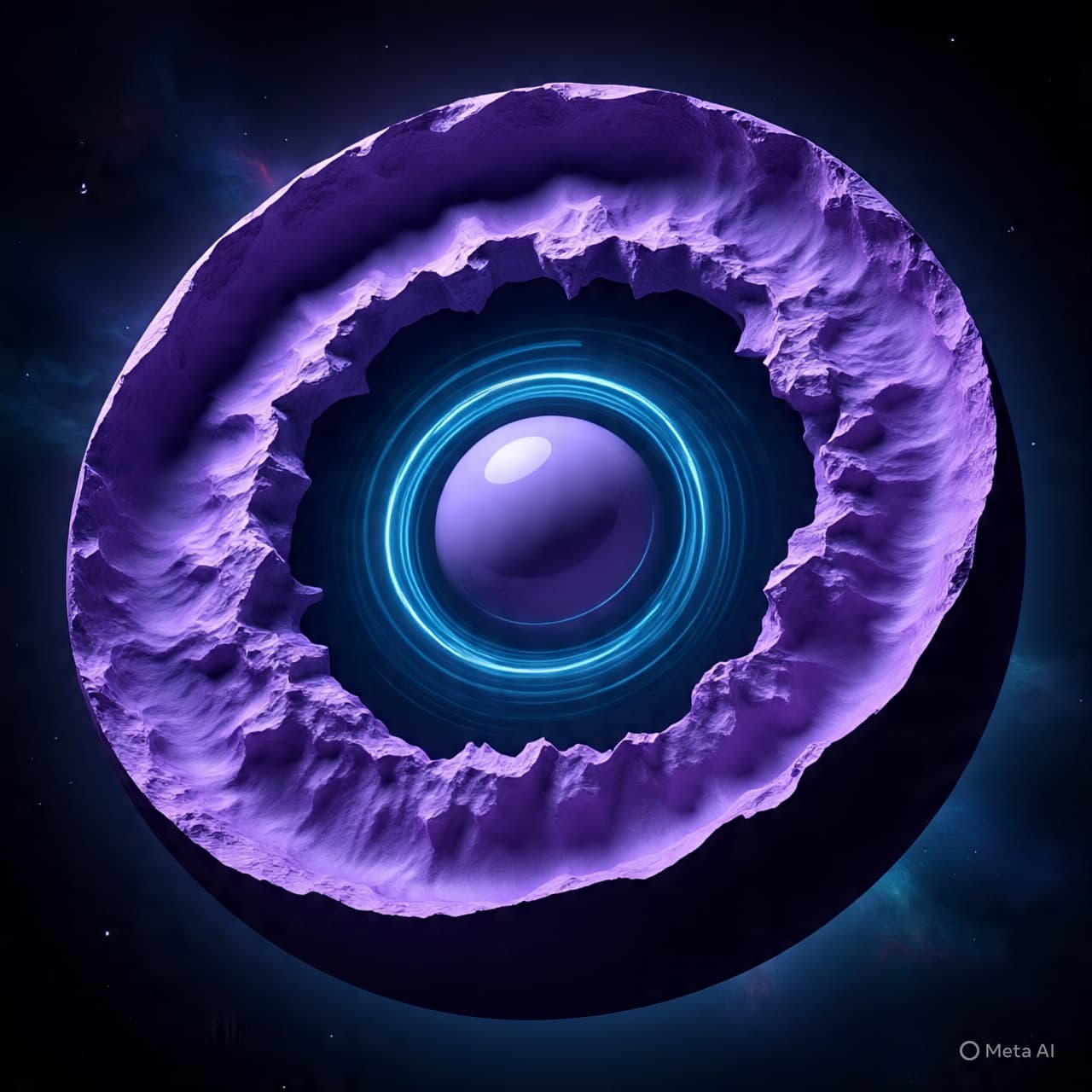
The potential location is within cores, where matter is compressed to densities so extreme that atoms themselves are forced to collapse.
Neutron stars form when massive stars exhaust their fuel and explode in supernovae, leaving behind an incredibly dense core. A single teaspoon of neutron star material would weigh billions of tons on Earth. Under such crushing pressure, the familiar structure of atoms cannot survive.
Instead, scientists suspect that matter may transform into something even more fundamental—a form known as . In this exotic state, the building blocks normally locked inside protons and neutrons—quarks and gluons—become free to move in a dense, energetic fluid.
Physicists believe this strange plasma filled the universe during the first microseconds after the Big Bang, before cooling allowed ordinary particles to form. Since then, recreating such conditions has been nearly impossible outside of powerful particle accelerators.
But neutron stars may provide a natural laboratory for this primordial physics. At their centers, gravity compresses matter to densities far beyond anything found on Earth. Theoretical models suggest that this pressure could break apart protons and neutrons, allowing quarks to exist in a new phase sometimes called “quark matter.”
Detecting that state directly is extraordinarily difficult. Scientists cannot simply look inside a neutron star. Instead, they rely on indirect clues—measurements of the star’s mass, radius, and behavior when it collides with another neutron star.
Recent advances in gravitational-wave astronomy may offer a path forward. When neutron stars merge, they produce ripples in space-time that can reveal details about the structure of their interiors. Subtle differences in these signals may indicate whether exotic quark matter exists at their cores.
Future observations from gravitational-wave detectors and next-generation telescopes could help scientists test these predictions. By studying how neutron stars deform and vibrate under immense pressure, researchers hope to uncover signs of the mysterious matter hidden within.
If confirmed, the discovery would connect the present universe to its earliest moments in a remarkable way. Inside these dense stellar remnants, matter forged in the aftermath of dying stars might briefly return to a state that once filled the cosmos itself.
In that sense, neutron stars could serve as cosmic archives—dense, silent records of physics that first appeared just after the birth of the universe.
And by studying them, scientists may be learning not only how stars die, but also how everything began.
AI Image Disclaimer Illustrations were produced with AI and serve as conceptual depictions.
Source Check Credible sources covering the topic “A state of matter last seen just after the Big Bang may exist inside neutron stars”:
Nature Scientific American New Scientist Space.com Live Science
Published by Banx Network. This article is part of the Banx decentralized media programme, powered by the BXE token on the XRP Ledger.