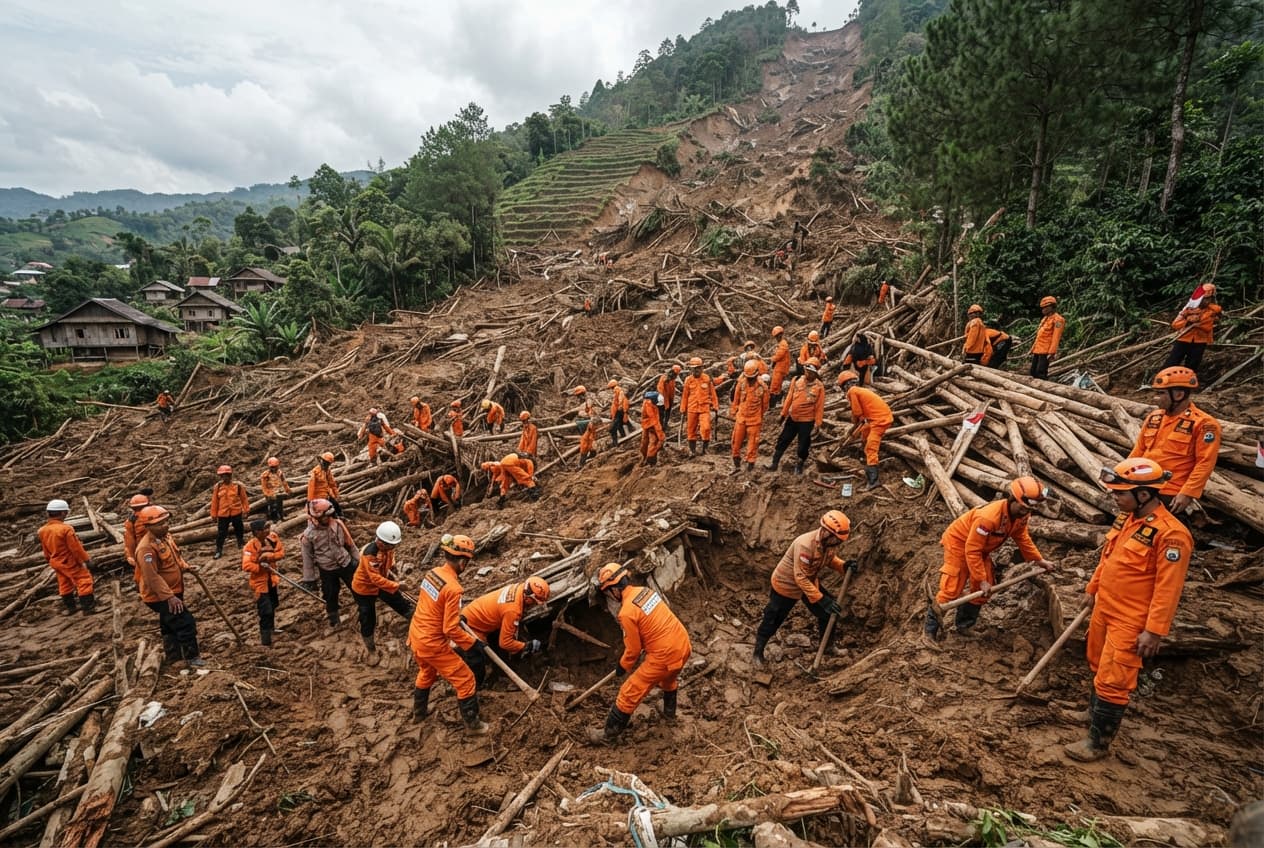
Takengen, Indonesia—Emergency excavation teams pushed deep into the rugged highlands of Central Aceh late Monday evening following a series of massive hillside landslides that buried rural homesteads and severed primary regional transportation arteries. The catastrophic soil failures were triggered by hours of relentless, torrential rainfall that saturated steep mountain slopes already weakened by previous seasonal weathering and deforestation.
Local village leaders reported that entire sections of hillsides collapsed without warning shortly before midnight, sweeping away wooden structures and trapping sleeping families beneath tons of mud, rock, and uprooted forest debris. Survivors stumbled through rain-soaked pathways to reach neighboring settlements, raising the alarm and initiating grassroots rescue efforts long before government heavy machinery could navigate blocked mountain passes.
Disaster management officials confirmed that multiple bridges connecting isolated agricultural communities were washed away or crushed by rolling boulders, turning the disaster zone into an inaccessible pocket. "We are facing severe logistical hurdles getting heavy excavators and medical supplies past blocked mountain roads choked with debris," stated local disaster agency coordinator Budi Santoso via satellite radio from the forward command post.
Rescue personnel armed with manual shovels, chainsaws, and rescue dogs worked through heavy downpours along the fringe of the primary landslide scar, searching for signs of life among the tangled wreckage of homes. Makeshift field clinics were established under plastic tarpaulins near the base of the valley to triage injured residents suffering from trauma, hypothermia, and lacerations sustained during the sudden collapse.
Displaced villagers crowded into community mosques and school buildings situated on higher ground, sharing blankets and meager food supplies while awaiting government relief convoys. Local health workers distributed clean drinking water purification tablets and emergency medical kits to prevent waterborne disease outbreaks among populations stranded without sanitation facilities.
Provincial authorities in Banda Aceh dispatched military engineering units equipped with bulldozers and portable bridge-building kits to clear the main highway blocked by multiple mudslide points. Aerial reconnaissance helicopters circled overhead through breaks in the cloud cover, capturing high-resolution imagery of the scarred terrain to direct ground crews toward high-priority rescue targets.
Environmental analysts pointed to decades of uncontrolled land conversion and unmitigated hillside farming as primary compounding factors that accelerated soil erosion across the vulnerable topography. Past warnings regarding slope stability in the densely populated valley had routinely clashed with local agricultural expansion needs, leaving mountain communities dangerously exposed to extreme weather events.
As night fell once more over the darkened highlands, the steady hum of diesel generators and the sweeping beams of searchlights illuminated the ongoing excavation zone where tired rescue workers refused to halt their search. The immediate future of the displaced mountain families remains entirely uncertain as unstable soil conditions threaten further mudslides with every passing rain shower.
Published by Banx Network. This article is part of the Banx decentralized media programme, powered by the BXE token on the XRP Ledger.