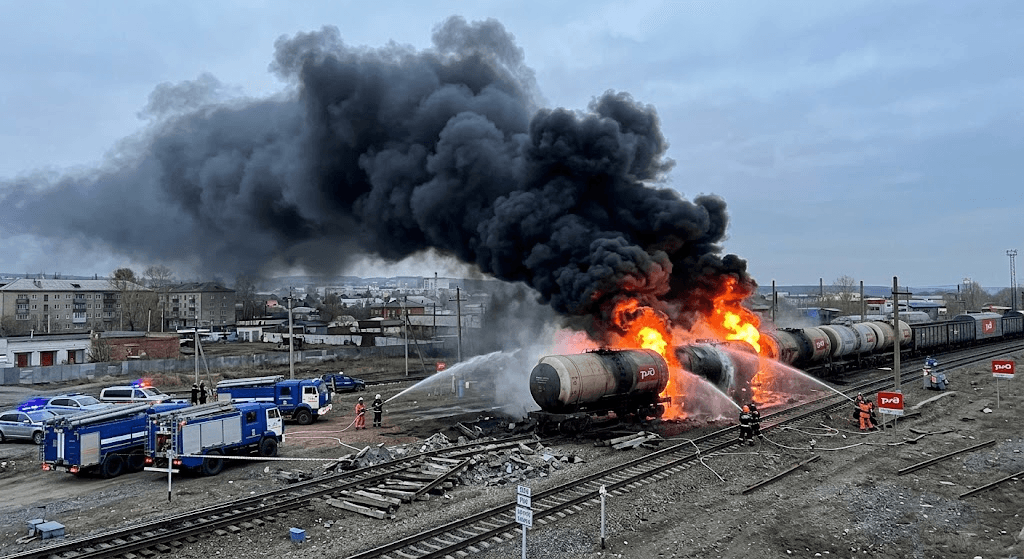
SVERDLOVSK OBLAST, Russia — A massive railway accident triggered a fiery emergency in Russia's Urals region early Monday morning, October 26, 2026 after a freight train derailed on the The derailment, which involved dozens of freight cars, ignited seven fuel tanker cars and sent thick black smoke billowing across the region. Witnesses reported hearing a powerful explosion prior to seeing a massive wall of fire erupt into the night sky.
The fire quickly expanded, covering an estimated area of 1,500 square meters. Emergency responders rushed to decouple unburned railcars and move them to a safe distance while specialized firefighting teams battled the raging oil fires.
More than 100 emergency personnel along with dozens of specialized vehicles and emergency trains were deployed to manage the containment effort. Open flames on the seven burning tank cars were successfully extinguished after hours of high-intensity efforts by emergency crews.
According to initial reports from Russia's Ministry of Emergency Situations (EMERCOM), no injuries or casualties have been reported. However, the accident caused severe damage to the track infrastructure, prompting regional rail authorities to temporarily suspend train services on the affected section while recovery and air quality monitoring operations continue.
Regional law enforcement officials and forensic investigators have arrived at the site to determine the precise cause of the derailment. Authorities have not yet disclosed the full details regarding potential technical failures, track maintenance issues, or external factors that may have caused the initial train collapse.
Environmental safety monitoring teams were quickly dispatched to test ambient air quality and evaluate potential soil contamination near nearby residential settlements. Environmental specialists warned that the combustion of petroleum products poses localized risks, though preliminary measurements indicated that hazardous gas concentrations in populated areas remained within acceptable safety thresholds.
The temporary closure of the damaged rail artery has forced regional logistics managers to reroute several commercial freight lines through alternative Ural transit hubs. Technical crews remain on the ground repairing twisted tracks and clearing twisted metal debris, with full restoration of normal rail schedules expected to take several days.
Published by Banx Network. This article is part of the Banx decentralized media programme, powered by the BXE token on the XRP Ledger.