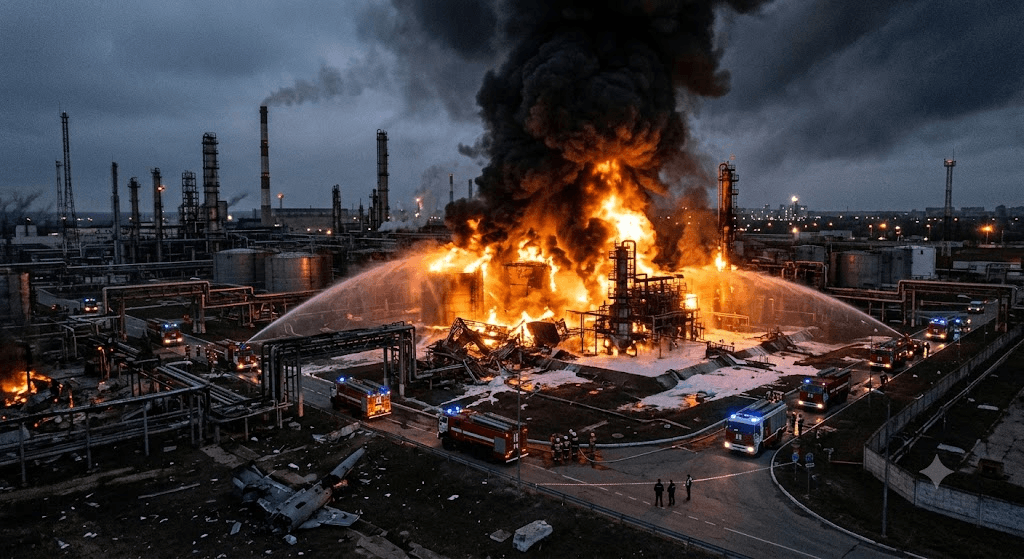
SAMARA REGION, RUSSIA — A major fire broke out at Rosneft’s Syzran Oil Refinery following an overnight Ukrainian drone strike, sending thick columns of black smoke over the industrial facility located more than 800 kilometers inside Russian territory.
Air raid and drone threat alerts were declared across the Samara region in the early hours of the morning, shortly before local residents reported a series of loud explosions emanating from the refinery grounds.
Eyewitness footage shared on social media confirmed a massive blaze engulfed portions of the complex, with flames visible across the skyline.
The Syzran refinery serves as a critical asset in Rosneft's regional operations, boasting an annual crude oil processing capacity of approximately 8.5 to 8.9 million metric tons. The facility processes crude into vital petroleum products—including motor gasoline, diesel fuel, aviation kerosene, and bitumen—which play a key role in supplying military units across Russia's Central and Southern Military Districts. Because of its strategic importance to front-line logistics, the refinery has become a repeated target for long-range drone strikes aimed at disrupting Russian energy supply lines.
"Ukrainian long-range strikes continue to systematically target critical Russian refining infrastructure and energy supply lines supplying frontline operations."
The strike reflects a broader strategy by Ukrainian forces to target key nodes in Russia’s energy infrastructure, aiming to constrain domestic fuel supplies and squeeze revenue streams that fund military operations. Analysts note that disrupting secondary processing units at refineries like Syzran can cause prolonged operational slowdowns, as specialized equipment is often difficult and time-consuming to repair or replace under ongoing economic sanctions.
In response to the growing frequency of long-range aerial threats, Russian regional authorities have reportedly increased air defense deployments around major industrial hubs. However, the expansive geographical distribution of Russia’s energy sector presents continuous defensive challenges, leaving distant facilities vulnerable to low-altitude, long-range unmanned aerial vehicles.
Emergency response teams were dispatched to contain the flames and prevent further destruction across adjacent processing units. Ukrainian defense forces have increasingly focused deep-strike capabilities on key Russian industrial targets, while authorities in Samara continue to evaluate the full extent of structural damage and operational disruptions at the plant.
Published by Banx Network. This article is part of the Banx decentralized media programme, powered by the BXE token on the XRP Ledger.