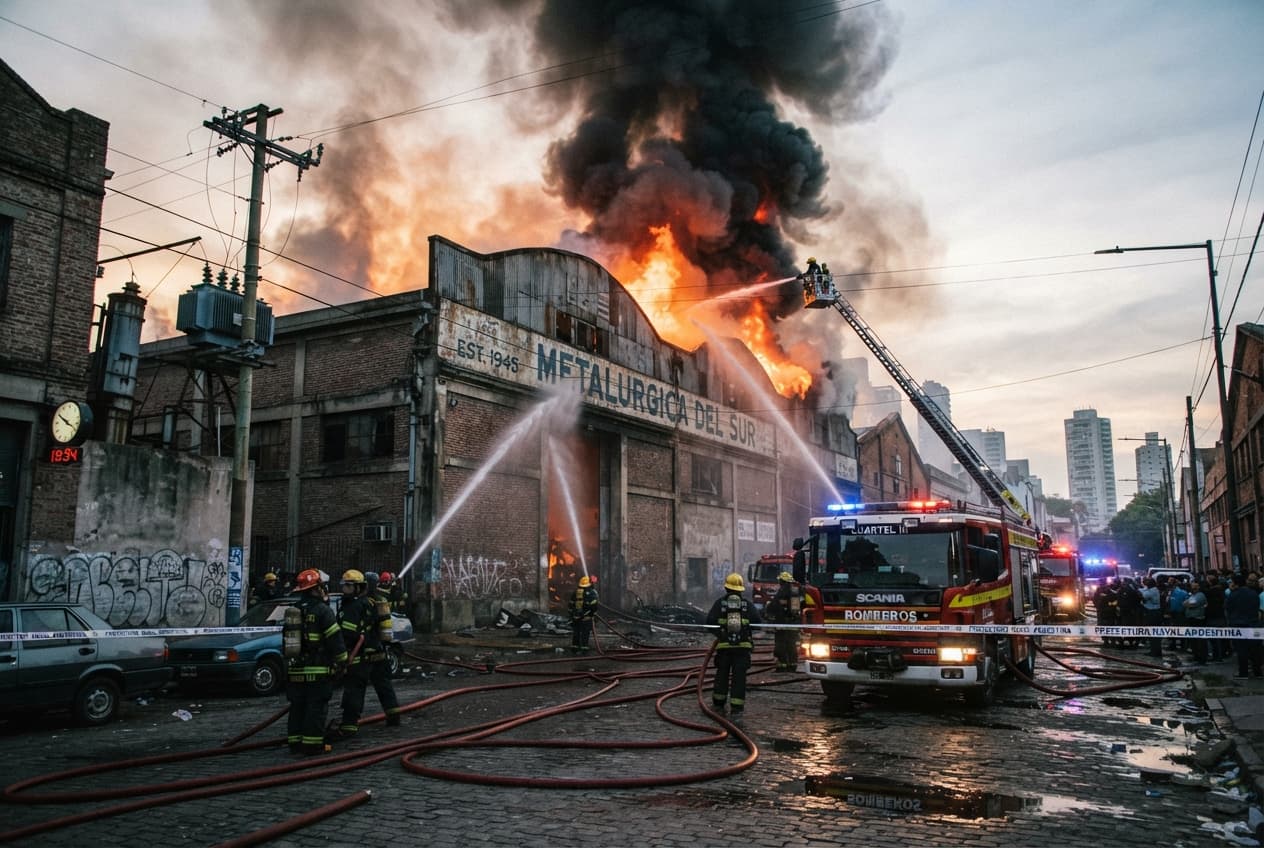
Buenos Aires, Argentina—Flames tore through a sprawling commercial complex during the afternoon hours, trapping employees inside as thick black smoke blanketed the surrounding industrial district. Emergency dispatchers received dozens of urgent calls reporting loud detonations originating from the main storage sector before the entire structure became engulfed. First responders arrived within minutes to find intense heat preventing immediate entry into the primary burning zone.
Local municipal health authorities confirmed that seven factory workers suffered varying degrees of smoke inhalation and thermal burns during the sudden escalation. Ambulances rushed the wounded to nearby regional hospitals for urgent medical intervention while triage units set up temporary stations on the adjacent street corners. Medical teams noted that two of the hospitalized individuals remain under close observation due to severe respiratory complications.
Fire crews from multiple districts deployed heavy suppression lines to keep the roaring blaze from jumping to adjacent chemical storage facilities and fuel depots. Firefighters struggled against erratic wind gusts that repeatedly pushed toxic fumes back toward residential neighborhoods bordering the manufacturing zone. Utility companies cut power grids across three city blocks to prevent secondary electrical arcs while suppression operations continued.
Factory representatives declined to provide immediate statements regarding safety protocols or internal inventory logs stored inside the gutted structure. Witnesses reported hearing a sharp hiss followed by a thunderous blast moments before the roof structure gave way completely. Investigators from the municipal fire marshal division established a command perimeter to secure the site once the active flames are subdued.
Municipal safety inspectors have faced mounting criticism from labor unions regarding the lax enforcement of industrial fire codes across aging regional complexes. Factory owners routinely postpone mandatory system upgrades while local regulatory agencies struggle with chronic understaffing and outdated inspection equipment. Labor representatives pointed out that emergency exits in the affected sector were partially obstructed by pallet storage at the time of the incident.
Environmental monitoring units deployed mobile labs to test particulate concentration levels across the densely populated neighborhoods downwind from the industrial park. Technicians advised residents to keep windows shut tightly and avoid outdoor physical activity while the smoke plume drifted slowly toward the southern outskirts. Public health officials warned that prolonged exposure to the combustion byproducts could trigger acute respiratory distress in vulnerable populations.
As evening shadows fell across the disaster zone, heavy excavators began clearing crushed metal roofing sheets to give fire crews direct access to remaining hot spots. Water tankers shuttled back and forth continuously to maintain adequate pressure as municipal mains strained under the extraordinary demand. Small flare-ups continued to break out periodically among the charred debris piles, keeping firefighters on high alert.
The structural integrity of the main warehouse frame remains deeply compromised, with engineers predicting the entire remaining facade will require controlled demolition. Police cordoned off a wide exclusion zone around the complex to keep curious onlookers and looters away from the dangerous rubble. Federal prosecutors opened a preliminary inquiry to determine whether criminal negligence contributed to the rapid spread of the fire.
Published by Banx Network. This article is part of the Banx decentralized media programme, powered by the BXE token on the XRP Ledger.