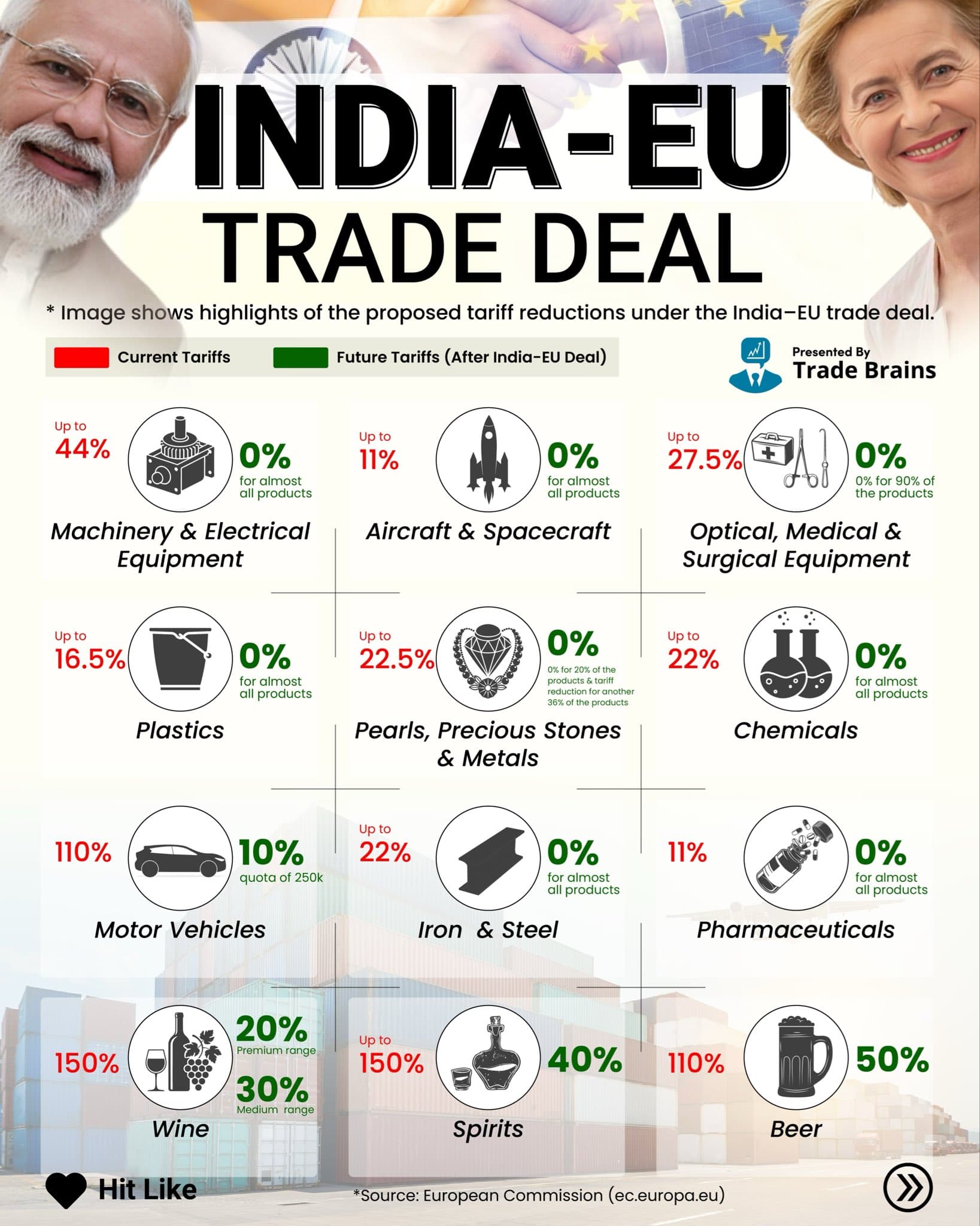
India and the European Union have finalized one of the largest free trade agreements in modern history, widely described as the “mother of all deals.” After nearly two decades of negotiations, the pact is set to transform trade between two of the world’s biggest economic blocs, representing close to one-third of global trade and over 2 billion people. At the core of the agreement is a massive reduction in tariffs. More than 96% of goods traded by value will see tariffs eliminated or sharply reduced over time. This opens India’s traditionally protected market to European exporters while giving Indian manufacturers wider, cheaper access to EU markets. One of the most high-impact changes is in the automotive sector. Import duties on European cars, which previously reached as high as 110%, will be gradually cut to around 10% under quota limits. This move is expected to significantly lower prices for premium European vehicles in India and intensify competition in the auto market. Food and beverage products also see major changes. Tariffs on European wine will drop from around 150% to as low as 20–30%, while duties on spirits and beer will also be reduced. This makes European products more competitive and expands consumer choice in India’s fast-growing premium market. Industrial and medical sectors are among the biggest winners. Tariffs on machinery, chemicals, pharmaceuticals, and medical equipment will be reduced or removed on most product lines. This is expected to lower input costs for Indian businesses and improve access to advanced European technology and healthcare equipment. For India, the deal unlocks stronger access to the EU for key export sectors such as textiles, leather, gems and jewellery, chemicals, and engineering goods. Reduced EU tariffs on Indian products are expected to boost exports, support manufacturing jobs, and strengthen India’s position in global supply chains. Beyond goods, the agreement also expands cooperation in services, including financial and maritime services, along with simplified customs procedures and stronger intellectual property frameworks. These measures aim to make cross-border business faster, cheaper, and more predictable. Strategically, the deal reflects a shift toward deeper economic partnerships as global trade tensions rise. Rather than relying on a single major partner, both India and the EU are diversifying trade relationships to strengthen long-term economic resilience. As ratification and implementation move forward, the India–EU trade deal is set to reshape pricing, competition, and investment flows across multiple industries marking a major step toward a more interconnected global economy.
Published by Banx Network. This article is part of the Banx decentralized media programme, powered by the BXE token on the XRP Ledger.