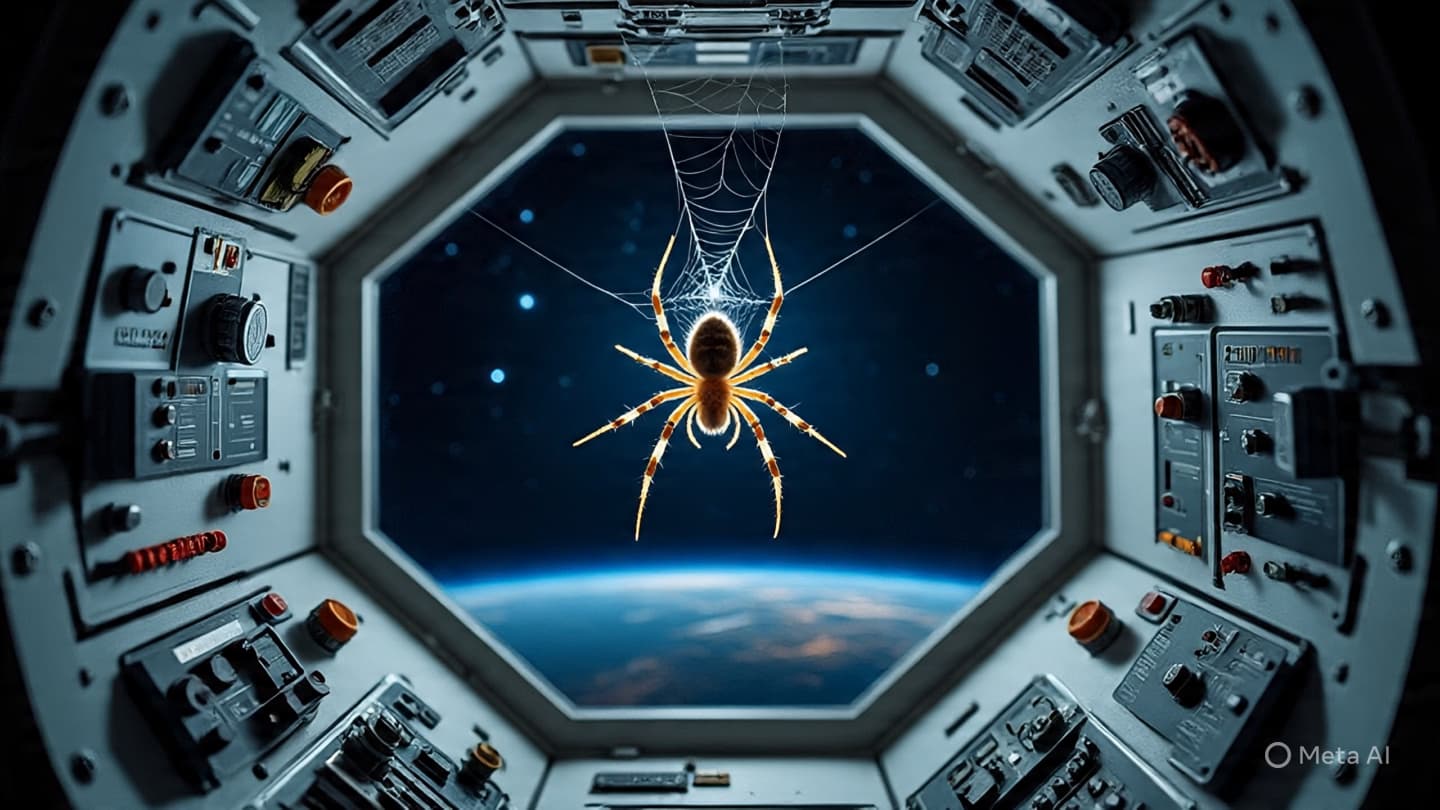
High above Earth, where gravity loosens its hold, even the simplest acts begin to change. When two spiders were sent to the International Space Station, scientists expected some variation in behavior—but the results offered a deeper look into adaptation.
Spiders rely on gravity to guide the structure of their webs, typically orienting threads with a clear sense of up and down. In microgravity, that reference disappears, creating a unique environment for observing instinct under altered conditions.
Early observations showed that the spiders initially produced irregular webs, lacking the symmetry commonly seen on Earth. The absence of gravitational cues appeared to disrupt their usual construction patterns.
Over time, however, the spiders began to adjust. Their webs grew more organized, suggesting that other factors—such as light direction—could serve as alternative guides in the absence of gravity.
This adaptability highlights the resilience of biological systems. Even with a fundamental environmental constant removed, the spiders found ways to recalibrate their behavior.
Researchers also noted differences between the two spiders, indicating that adaptation may vary from one organism to another. These variations provide valuable data on how living systems respond to unfamiliar conditions.
The experiment contributes to a broader understanding of how life functions in space, an area of increasing interest as long-duration missions become more common.
Studying such small organisms can offer insights that scale upward, informing how humans and other species might cope with extended periods in microgravity.
In the quiet environment of orbit, the spiders’ webs became more than structures—they became records of adjustment, tracing how life reshapes itself when the familiar rules no longer apply.
AI Image Disclaimer: Illustrations in this article are AI-generated depictions of space experiments and are not actual photographs from the mission.
Sources: NASA Smithsonian Magazine BBC Science National Geographic
Published by Banx Network. This article is part of the Banx decentralized media programme, powered by the BXE token on the XRP Ledger.