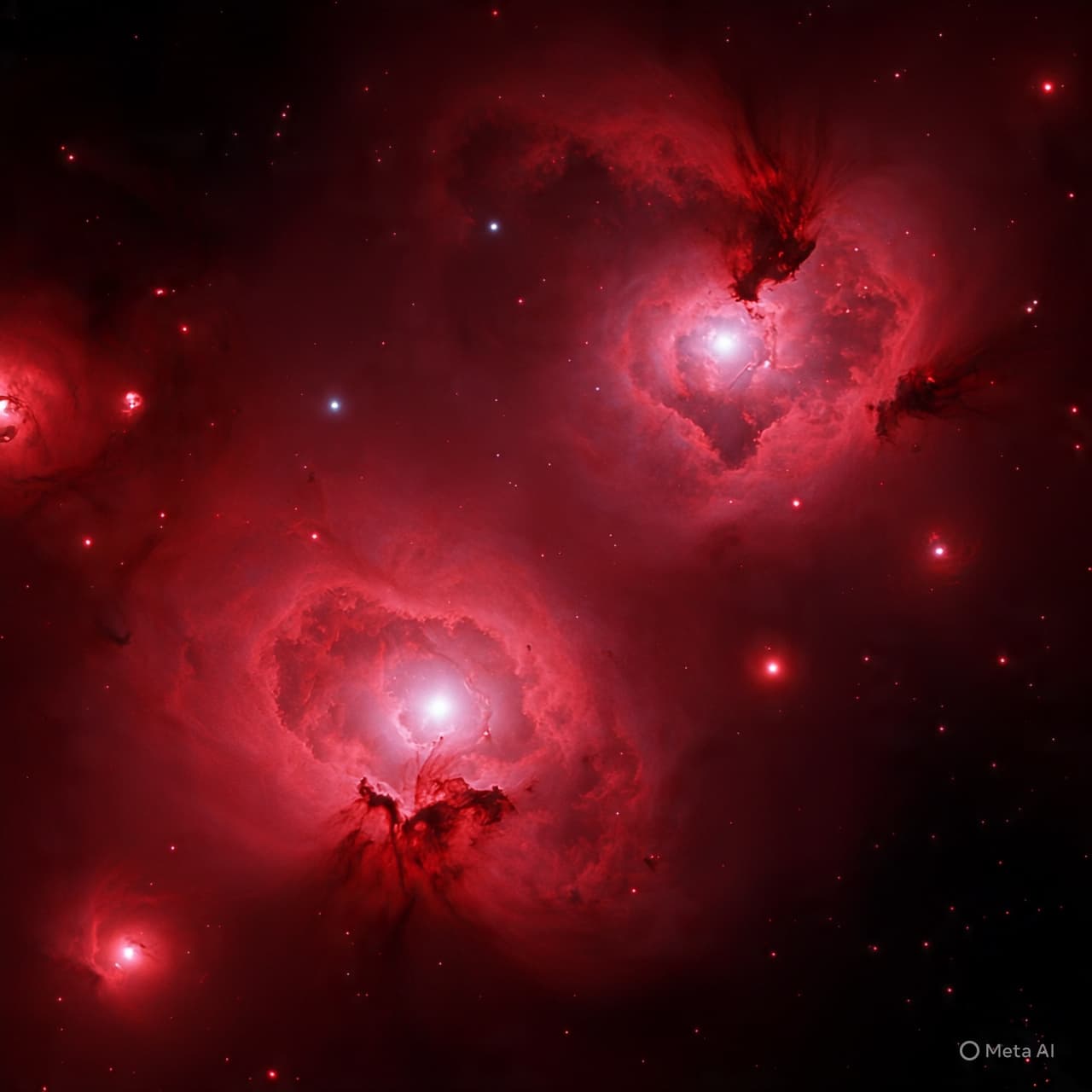
In the vastness of space, where stars quietly end their lives in spectacular fashion, the Red Spider Nebula emerges as one of the most hauntingly beautiful examples of a stellar farewell. Captured in unprecedented detail by the James Webb Space Telescope, this cosmic “arachnid” spreads its glowing limbs across the void — and within its heart lies a secret that challenges our understanding of how such nebulae form and evolve.
At its core, the Red Spider Nebula is a planetary nebula — a term that belies its true nature. Rather than planets, this structure marks the dying stage of a star somewhat akin to our Sun, which has shed its outer layers and exposed its hot core, now illuminating the surrounding material. What JWST brings to light is the hidden infrastructure behind that grand display: the hot dust, the possible companion star, the sweeping lobes, and the jets carving their way outward.
JWST’s Near-Infrared Camera (NIRCam) reveals that what appeared to be a lone faint blue star in optical images is in fact shrouded in a glowing cloud of hot dust — likely forming a disc around the central star. This dusty sheath emits in the infrared, while optical telescopes had struggle to peer through. The discovery of this dust-disc points toward a more complex evolutionary history than a single star quietly shedding its layers.
And here is where the hidden companion comes in. Although only one star is directly visible, the hourglass or “spider-leg” shape of the nebula strongly hints at the influence of a second star. The bipolar lobes — each stretching roughly three light-years — are traced by molecular hydrogen emissions in the infrared, showing that gas was expelled in giant bubble-like structures. Even more intriguing, an S-shaped plume of ionised iron ([Fe II]) is visible, marking where a fast wind from the star collides with slower material — a fingerprint of complex shaping from combined stellar winds or interactions.
The presence of a binary companion would help explain how the equatorial torus — a ring of slowly expanding material around the waist of the nebula — formed, and why the polar jets could be so strongly collimated and powerful. The academic paper accompanying the JWST data suggests this scenario: a progenitor star interacting with a close companion triggered the equatorial ejection, formed the torus, and then launched high-velocity jets along the poles.
What makes the Red Spider Nebula special is not just its shape, but the window it offers into what our own Sun might become in some five billion years. While our Sun may not produce such dramatic outflows, the processes of mass loss, dust formation, and the unveiling of the stellar core are shared. JWST’s observations therefore serve as both a spectacular image and a lesson in stellar evolution.
Yet despite all the detail, questions remain. The exact nature of the companion — its mass, orbital characteristics, and influence — is still unknown. The “hairy” texture of the filaments in the lobes (where the molecular hydrogen glows) also puzzles astronomers: why the intricate ripples, why the timing of the outflows? These are subtle clues yet to be fully interpreted.
In the heart of this glowing spider, we see far more than dust and gas: we see the signature of interplay, of cosmic choreography between stars, of transformation from life to death and beyond. The Red Spider Nebula reminds us that endings in the universe are rarely simple, and often contain beautiful complexity.
AI Image Disclaimer: Visuals are created with AI tools and are not real photographs. Sources: ScienceAlert, Space.com, Cardiff University News, ESA Multimedia, IFLScience.
Published by Banx Network. This article is part of the Banx decentralized media programme, powered by the BXE token on the XRP Ledger.