There are moments when we lift our eyes to the night sky and feel the vastness of cosmic wanderers brush past us like drifting petals on an endless river. One such wandering traveler, known simply as 3I/ATLAS, has recently whispered a secret from the deep — a glimpse into its hidden heart, revealed through the tireless gaze of the Hubble Space Telescope.
For centuries, comets have been both celestial messengers and poetic muses. They trace silent arcs across the heavens, their glowing tails reminiscent of fleeting dreams. But 3I/ATLAS carries an added layer of wonder: it is not native to our Solar System. It is the third interstellar object ever observed to visit this cosmic neighborhood, an ambassador from another star’s realm. Recent observations from space observatories have given astronomers their most detailed picture yet of its innermost core, the nucleus that lies buried beneath its swirling coma.
The Hubble Space Telescope, with its extraordinary clarity, has been able to tease out this subtle glow amid clouds of dust and gas, allowing scientists to estimate the size of the nucleus. According to these careful measurements, the icy core of 3I/ATLAS is likely on the order of a kilometer or so in diameter, though exact figures carry margins of uncertainty due to the bright envelope that shrouds it. This reflects a size not unlike the familiar comets in our own neighborhood, yet imbued with the mystery of its far–flung origins.
Such measurements are not simple. The nucleus is cloaked in a luminous coma — a tenuous atmosphere of dust and vapor — generated as the object warms while sweeping closer to the Sun. To disentangle the faint light of the solid core from this radiant halo, astronomers must rely on sophisticated image processing and photometric analysis. The result is not just a number but a story: one of a small, icy body, perhaps a relic from a distant stellar nursery, now on a solitary journey through interstellar space.
Interestingly, 3I/ATLAS’s dimensions prompt a quiet conversation within the astronomy community. Its effective nucleus size appears larger than some other visitors like 1I/ʻOumuamua yet aligns more closely with objects like 2I/Borisov, hinting at a diverse population of interstellar wayfarers with varied origins and histories.
Beyond size, spectral observations from instruments like the Very Large Telescope have revealed elements such as nickel and cyanogen gas in the coma, underscoring the richness of material this voyager carries with it — elements that might tell tales of chemistry far beyond our own solar environs.
In the quiet expanse of space, each interstellar visitor becomes a fleeting chapter in the grand story of the cosmos — a reminder that our Sun’s domain is but a small harbor in an ocean of stars.
And so, as 3I/ATLAS continues its cosmic odyssey outward, scientists and curious minds alike listen to what it can tell us. Not with words, but through light and shadow, measured patiently by instruments that have become our distant sight.
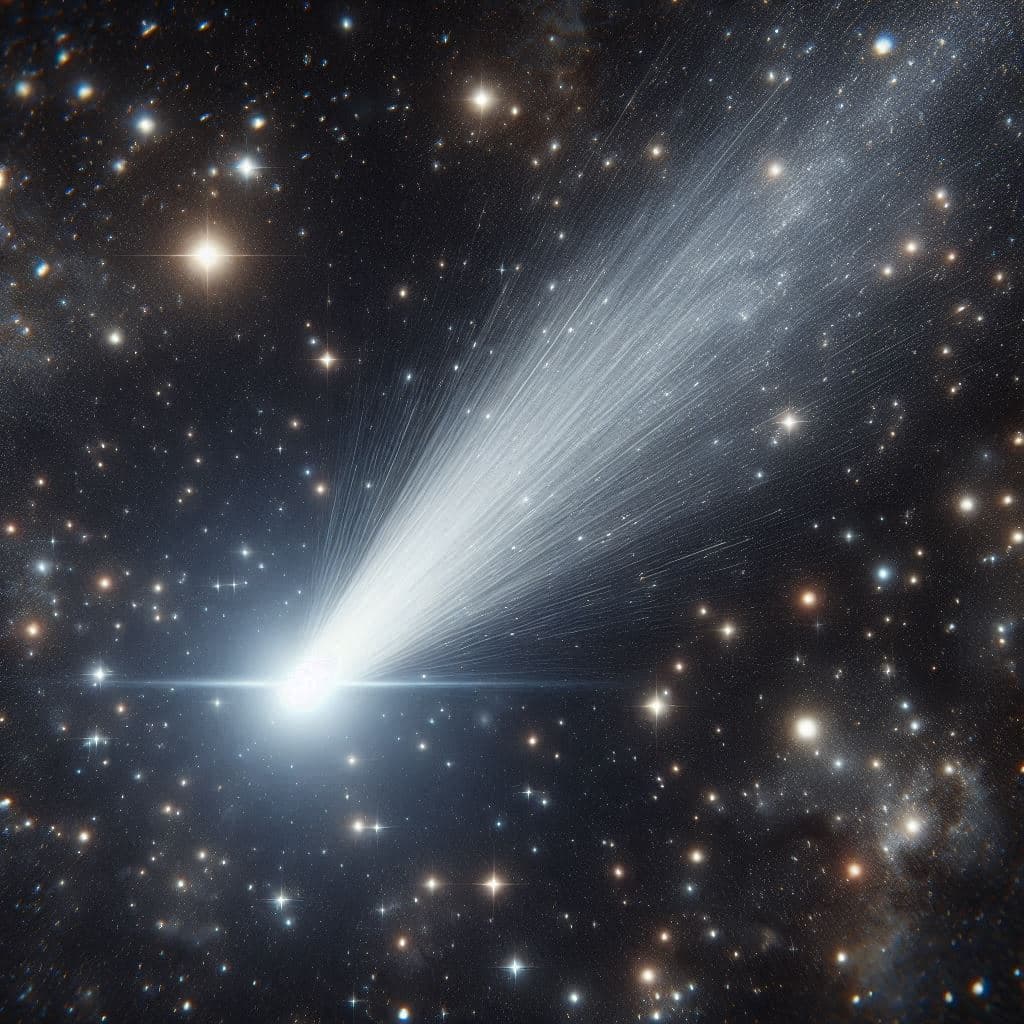
AI Image Disclaimer Illustrations were produced with AI and serve as conceptual depictions, not real photographs.
Sources (media or institutional outlets):
• NASA / ESA Hubble Mission Team (news release)
• ESA/Hubble official news release
• ScienceDaily (report on Hubble images)
• Wikipedia — 3I/ATLAS overview (size context)
• VLT spectroscopic insights (ESO data reported by scinews)
Published by Banx Network. This article is part of the Banx decentralized media programme, powered by the BXE token on the XRP Ledger.