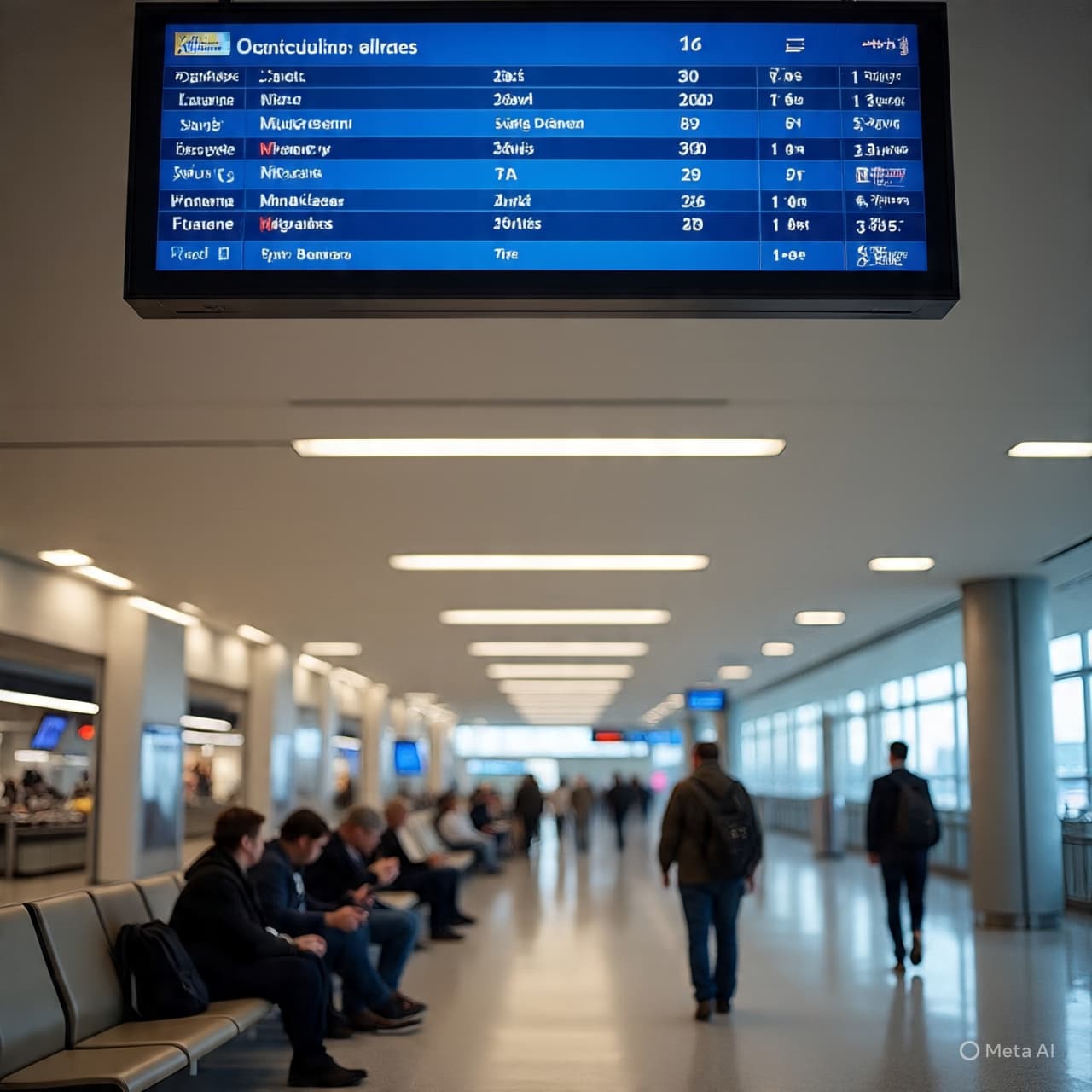
Air travel has its own quiet rituals: departure boards flickering in soft airport light, the low hum of luggage wheels crossing polished floors, aircraft lifting into the wide blue with practiced certainty. In the air, borders feel abstract—lines drawn far below by politics and history. Yet when conflict sharpens, even the sky becomes a space of caution.
In the wake of U.S. and Israeli strikes on targets in Iran, airlines across the Middle East and beyond began canceling or rerouting flights, adjusting their paths to avoid airspace newly shadowed by risk. What had been a corridor of steady movement turned into a zone of uncertainty almost overnight.
Carriers in the region announced suspensions to and from several cities, while others diverted aircraft mid-route, choosing longer arcs over safer skies. International aviation authorities issued notices advising heightened vigilance. Airports from the Gulf to Europe updated schedules as passengers watched departures vanish from screens or shift to unfamiliar gates.
The strikes, confirmed by U.S. and Israeli officials as targeted military actions against Iranian facilities, marked a sharp escalation in regional tensions. Iran, in response, signaled it would consider its options. The reverberations traveled not only through diplomatic channels but through commercial aviation networks that depend on predictability and coordination.
Airspace over parts of the Middle East is among the busiest transit routes linking Asia, Europe, and Africa. Even limited closures can ripple outward, extending flight times, increasing fuel costs, and straining crews and schedules. Airlines often plan months in advance, yet conflict compresses decision-making into hours. Safety assessments, insurance considerations, and government advisories converge in quick succession.
Passengers in transit hubs such as Dubai, Doha, and Istanbul found themselves in a suspended state—waiting for updates, scanning phones for rebooking options, listening to the steady cadence of public announcements. For many, the disruption was inconvenient. For airlines and regulators, it was procedural: a recalibration of routes to prioritize safety above timetable.
In recent years, commercial aviation has grown accustomed to navigating geopolitical shifts—conflicts in Eastern Europe, missile exchanges in regional theaters, sudden airspace closures that redraw global maps overnight. Each event reinforces the delicate balance between mobility and security. The sky, though vast, is governed by layers of agreements and risk calculations.
Military analysts suggest that further escalation could lead to prolonged restrictions in certain flight corridors. Aviation tracking data has already shown aircraft skirting Iranian airspace or flying south over the Arabian Peninsula before turning west. The adjustments add hours to long-haul journeys, a quiet reminder that even distant conflicts can lengthen the arc of an ordinary trip.
Governments have urged calm while monitoring developments. Diplomatic channels remain active, even as military postures shift. Airlines, for their part, have emphasized that decisions are guided by real-time intelligence and international safety standards.
As evening settles over airport terminals, the boards begin to stabilize, though some lines remain blank. Crews prepare revised flight plans; passengers adjust expectations. Above the clouds, aircraft continue to trace new paths—curved, cautious, deliberate.
In moments like this, the sky reveals its dual nature: open and shared, yet shaped by forces on the ground. Flights will resume where possible. Routes will be restored when assessments allow. But for now, the choreography of global travel moves with measured restraint, reflecting a world in which even the air must pause when tensions rise.
AI Image Disclaimer Visuals are AI-generated and serve as conceptual representations.
Sources Reuters Associated Press BBC News Al Jazeera The Wall Street Journal
Published by Banx Network. This article is part of the Banx decentralized media programme, powered by the BXE token on the XRP Ledger.