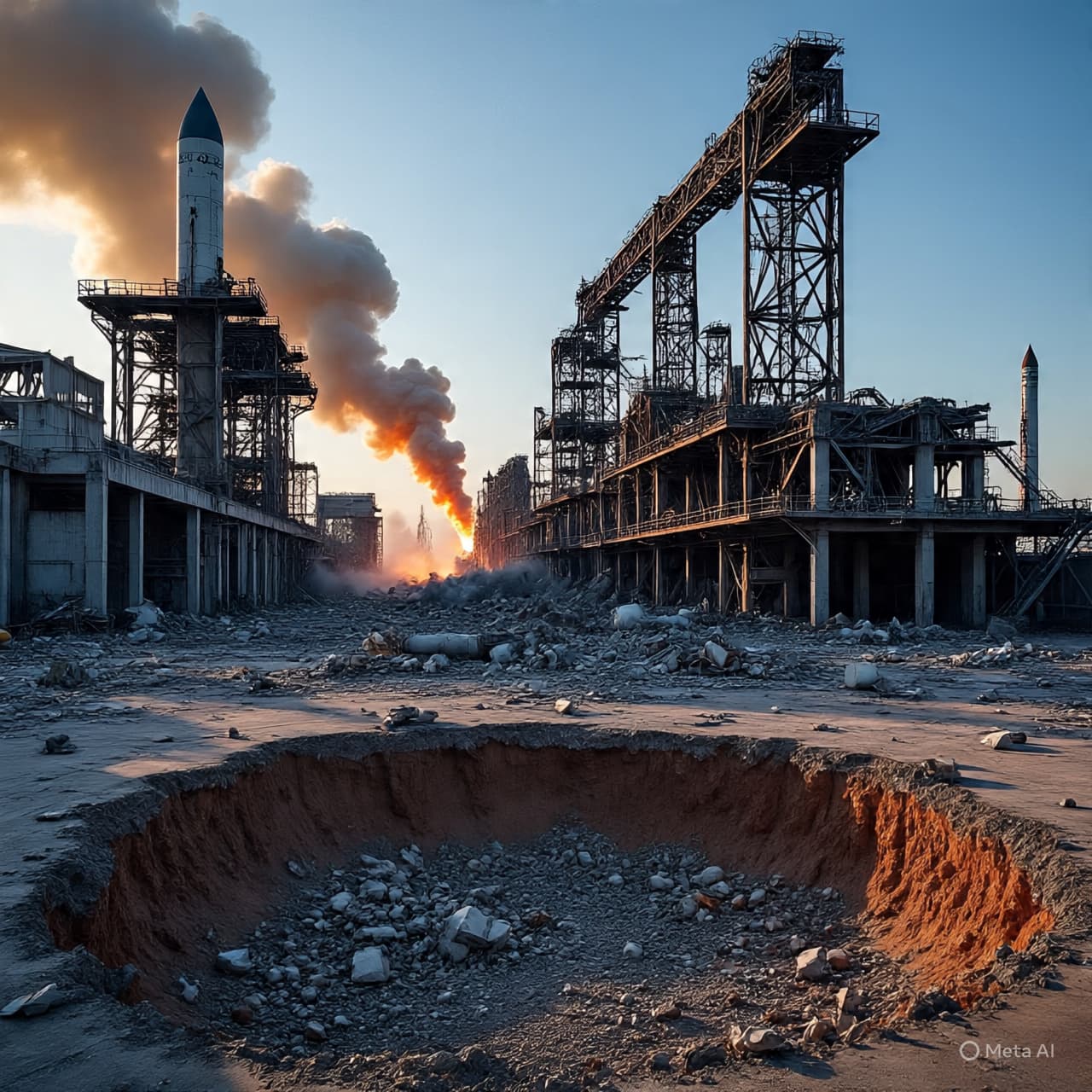
In the high, unseen corridors above the earth, where satellites trace their quiet arcs and signals move faster than thought, disruption rarely announces itself with sound. It arrives instead as absence—an interrupted transmission, a system gone dark, a silence where motion once lived. From the ground, such changes are invisible, yet their consequences ripple outward, touching both the immediate and the distant.
Recent airstrikes tied to the ongoing conflict involving Iran have reportedly dealt significant damage to elements of the country’s rocket and satellite programs. Facilities associated with missile development and space-launch capabilities have been struck, according to officials and analysts, affecting infrastructure that had long been part of Iran’s dual-use technological landscape—serving both civilian ambitions and military considerations.
The distinction between those roles has always been fluid. Iran’s satellite initiatives, often presented as steps toward scientific progress and national capability, have existed alongside a missile program closely observed by the international community. The technologies that carry payloads into orbit are not so different from those that extend reach across borders. In this overlap, intention becomes difficult to separate from potential, and progress can be read in more than one direction.
The airstrikes, described as precise and targeted, appear to have focused on critical nodes within this network—launch facilities, storage sites, and components tied to production. While the full extent of the damage remains uncertain, early assessments suggest a setback that could delay development timelines and disrupt operational continuity. In fields where momentum is built over years of incremental advancement, even a brief interruption can alter trajectories in lasting ways.
Beyond the technical impact lies a quieter, strategic recalibration. The degradation of rocket and satellite capabilities does not occur in isolation; it intersects with broader dynamics involving deterrence, signaling, and perception. For those observing from outside, such strikes may be seen as an attempt to limit future reach, to narrow the horizon of what is possible before it fully materializes.
Yet the response to such disruptions is rarely linear. Programs of this kind are often resilient, designed with redundancy and adaptation in mind. What is slowed may later resume, what is damaged may be rebuilt, though perhaps along a different path. In this sense, the airstrikes become part of a longer narrative—one in which progress and interruption exist in a continuous exchange.
The regional context adds further layers to this moment. Tensions involving Israel and Iran have continued to shape the contours of action and response, with each development interpreted through a lens of ongoing rivalry and strategic caution. Meanwhile, the presence of external actors, including the United States, lingers in the background, influencing the environment in ways both direct and indirect.
For those engaged in the technical work behind these programs—engineers, scientists, operators—the consequences are immediate and tangible. Facilities that once housed active systems now bear the marks of interruption, and the routines of development give way to assessment and repair. For the broader world, the effects are more abstract, unfolding through shifts in capability and the recalibration of expectations.
In the end, the strikes mark a moment of pause within a longer continuum. Iran’s rocket and satellite programs, though damaged, remain part of an evolving story shaped by ambition, constraint, and the unpredictable rhythms of conflict. The silence left in the wake of disrupted systems does not signify an ending, but rather a space in which the next phase will quietly begin to take form.
AI Image Disclaimer These visuals are AI-generated and intended as illustrative representations only.
Sources Reuters BBC News Al Jazeera The New York Times Associated Press
Published by Banx Network. This article is part of the Banx decentralized media programme, powered by the BXE token on the XRP Ledger.