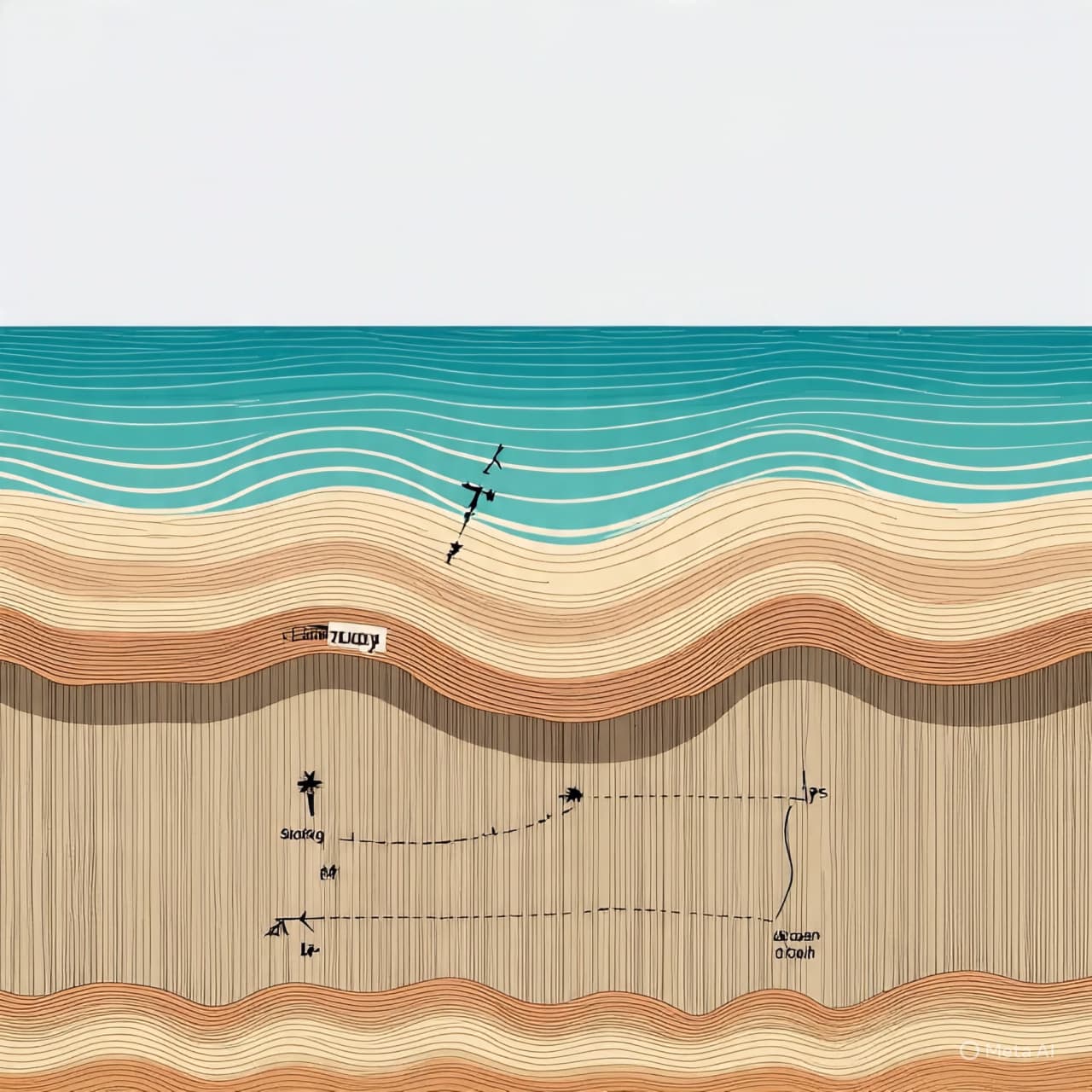
At the mouth of great rivers, where fresh water gradually yields to the sea, the ground beneath the waterline tells a quieter story. Layers of soft sediment settle year after year, shaped by tides, currents, and the long movement of rivers toward the coast. Beneath Lingdingyang Bay—part of the broad estuarine system of the Pearl River—these sediments form a landscape unseen yet vital to the stability of everything built above them.
For engineers and geoscientists, the behavior of these marine soils carries particular importance. Bridges, offshore platforms, tunnels, and coastal infrastructure depend not only on visible foundations but also on how the underlying soil responds to motion—especially the subtle, repeated forces produced by waves, tides, and earthquakes.
A recent experimental investigation has taken a closer look at two key properties of these sediments: dynamic shear stiffness and the damping ratio. Together, these parameters describe how soil resists deformation and how it dissipates energy when subjected to cyclic loading.
The relationship between shear stress and shear strain, central to understanding soil stiffness, is often expressed through the shear modulus:
G = \frac{\tau}{\gamma}
Here, represents the shear modulus, the applied shear stress, and the resulting shear strain. In dynamic environments—such as those beneath coastal waters—this modulus changes depending on the amplitude and frequency of the applied motion.
Researchers collected marine soil samples from Lingdingyang Bay and subjected them to controlled laboratory testing, often using dynamic triaxial apparatus designed to simulate cyclic loading conditions. These experiments recreate the types of stresses soils experience under wave action or seismic vibration.
As the soil samples were gradually strained, scientists observed a familiar pattern. The dynamic shear stiffness decreased as shear strain increased, indicating that the soil becomes progressively softer when subjected to larger deformations. This nonlinear behavior is common in soft marine sediments, where fine particles and high water content allow the soil structure to rearrange under stress.
Alongside this softening effect, the damping ratio—a measure of how effectively the soil absorbs and dissipates energy—tended to increase with greater strain. In physical terms, this means the soil becomes more capable of absorbing vibrational energy as deformation grows, reducing the transmission of motion through the ground.
In engineering dynamics, the damping ratio is commonly defined as the proportion of actual damping relative to critical damping:
\zeta = \frac{c}{2\sqrt{km}}
In this expression, represents the damping ratio, the damping coefficient, the system stiffness, and the mass. While soils are far more complex than simple mechanical systems, the concept provides a useful framework for describing how energy dissipates within sediment layers.
The experiments also revealed that factors such as confining pressure, soil density, and moisture content influence both stiffness and damping behavior. Higher confining pressures generally increased the initial stiffness of the soil, while looser structures and higher water content tended to reduce it.
Such findings are not merely theoretical. Lingdingyang Bay sits within one of the world’s most active coastal development zones, near major ports, bridges, and transportation corridors of the Pearl River Delta. Understanding how the underlying sediments respond to cyclic loads helps engineers design foundations that remain stable under long-term environmental forces.
In this way, the work belongs as much to the quiet geography beneath the sea as it does to engineering laboratories. The soils of Lingdingyang Bay continue their slow evolution, shaped by river sediment and tidal flow. Yet through careful measurement, researchers can begin to read the mechanical language written into those layers.
The study concludes that marine soils in Lingdingyang Bay exhibit strain-dependent reductions in dynamic shear stiffness and increases in damping ratio, findings that provide important parameters for seismic response analysis and offshore infrastructure design.
AI Image Disclaimer
Illustrations were created using AI tools and represent conceptual visualizations rather than real photographs.
Source Check
Credible coverage and/or primary reporting exist from: Ocean Engineering Engineering Geology ScienceDirect Springer Nature China Ocean Engineering
Published by Banx Network. This article is part of the Banx decentralized media programme, powered by the BXE token on the XRP Ledger.