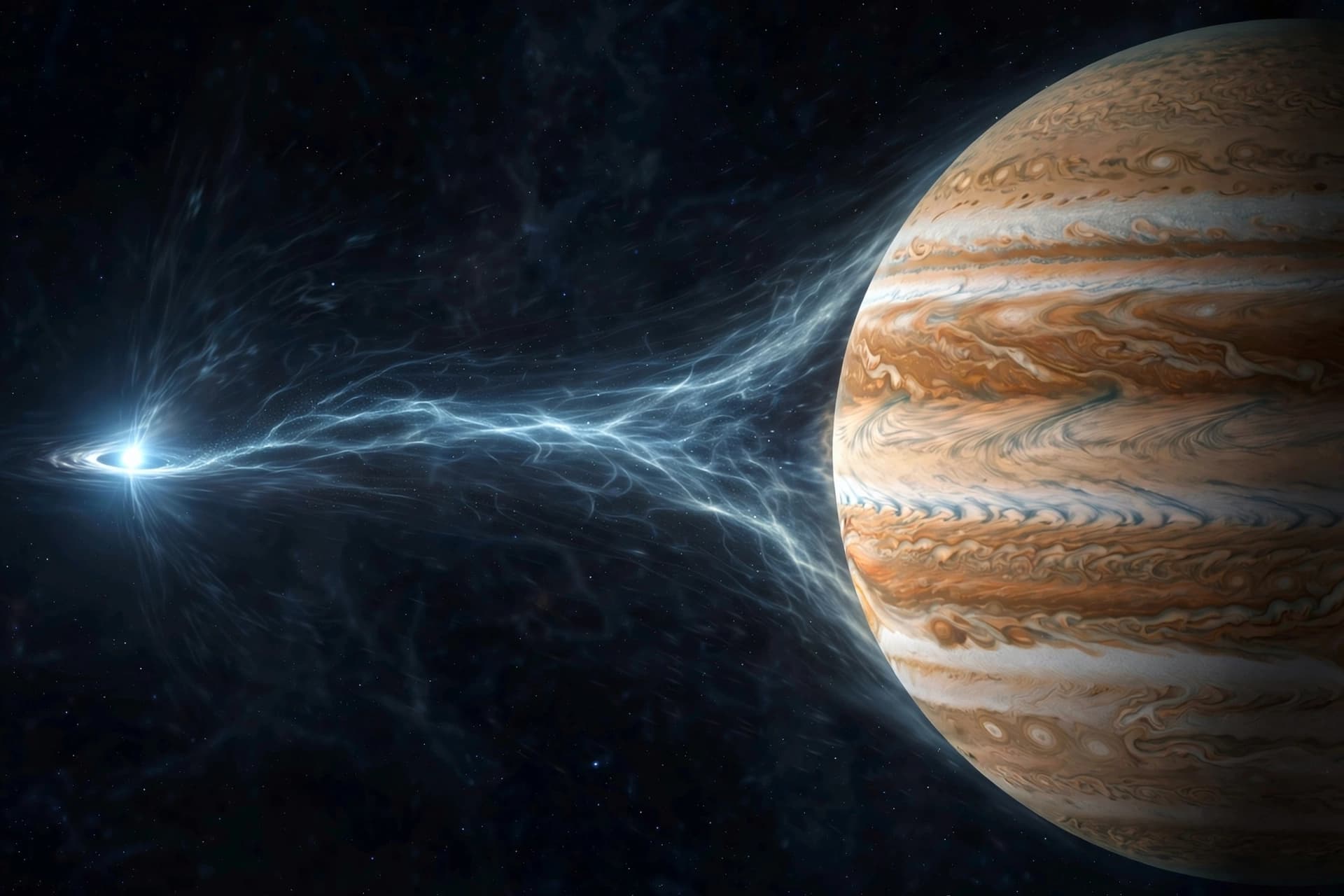
There are forces in the universe so subtle that they pass through everything without asking permission—quiet ripples that stretch and compress the fabric of space itself. We do not see them in the ordinary sense, nor hear them in any familiar way, yet their presence reshapes distances, ever so slightly, as they travel across the cosmos. These are gravitational waves, gentle messengers from distant and often violent events, arriving not with noise, but with a kind of silent persistence.
Until now, our ability to observe these waves has relied on vast instruments, delicate yet monumental in scale, designed to detect the faintest distortions in space. Facilities like have transformed these ripples into measurable signals, allowing scientists to trace them back to colliding black holes or merging neutron stars. It is a remarkable achievement—listening to the universe through its most subtle movements.
A new theoretical study, however, suggests a different and more intimate possibility: that gravitational waves may leave detectable imprints on light itself, specifically the light emitted by atoms. It is a quiet idea, almost poetic in its simplicity—that as space stretches and contracts, the energy levels within atoms might shift ever so slightly, altering the light they release.
At the heart of this concept lies the interaction between spacetime and matter at its most fundamental level. Atoms emit light at very precise frequencies, governed by the arrangement of their electrons and the laws of quantum mechanics. These frequencies are typically stable, forming the basis for everything from spectroscopy to atomic clocks. But if spacetime itself is gently oscillating due to a passing gravitational wave, then the energy transitions within atoms may experience minute variations.
These changes would be extraordinarily small—far beyond the reach of everyday measurement—but not necessarily beyond the reach of future technology. The study proposes that with sufficiently sensitive instruments, scientists might detect these shifts as subtle modulations in emitted light, effectively turning atoms into microscopic detectors of gravitational waves.
There is a certain elegance in this idea. Instead of relying solely on large-scale observatories, it opens the possibility of distributed sensing at a much smaller scale. Light, already one of the primary tools of observation in physics, becomes not just a messenger of distant stars, but a recorder of spacetime’s gentle undulations.
The implications extend beyond detection alone. If confirmed, this effect could deepen our understanding of how gravity interacts with quantum systems—a question that sits at the boundary of modern physics. The relationship between general relativity, which describes gravity, and quantum mechanics, which governs atomic behavior, remains one of the most profound challenges in science. Observing gravitational wave effects on atomic emissions could offer a rare bridge between these two frameworks.
There is also a broader sense of continuity in this development. Science often progresses by expanding the ways in which we observe the same phenomenon. Gravitational waves were once purely theoretical, then detectable through large instruments, and now, perhaps, observable through the behavior of light at the smallest scales. Each step does not replace the last, but adds another layer of perspective.
Yet it is important to recognize that this work remains theoretical. The predictions, while grounded in established physics, have yet to be confirmed through experiment. The path from idea to observation may be long, requiring advances in precision measurement and instrumentation that are still in development.
Still, there is something quietly compelling in the notion that the universe’s most delicate ripples might be recorded in the glow of atoms. It suggests a kind of interconnectedness, where even the smallest systems are not isolated, but gently influenced by events unfolding across unimaginable distances.
In measured terms, researchers continue to explore this possibility, refining their models and considering how such effects might be observed in practice. Whether or not these imprints are soon detected, the study adds a thoughtful dimension to our understanding of gravitational waves and their reach.
AI Image Disclaimer Graphics are AI-generated and intended for representation, not reality.
Source Check (Credible Media Identified): Physical Review Letters Nature Physics Science Magazine Scientific American Physics Today
Published by Banx Network. This article is part of the Banx decentralized media programme, powered by the BXE token on the XRP Ledger.