In the silent corridors of orbit, where Earth hangs like a blue lantern against endless night, life continues to surprise us. Beyond the hum of machinery and the careful choreography of astronauts, something smaller — almost invisible — has been quietly at work. Not with drills or lasers, but with filaments as fine as whispers. Fungi, those patient architects of decay on Earth, have revealed an unexpected talent aboard the International Space Station.
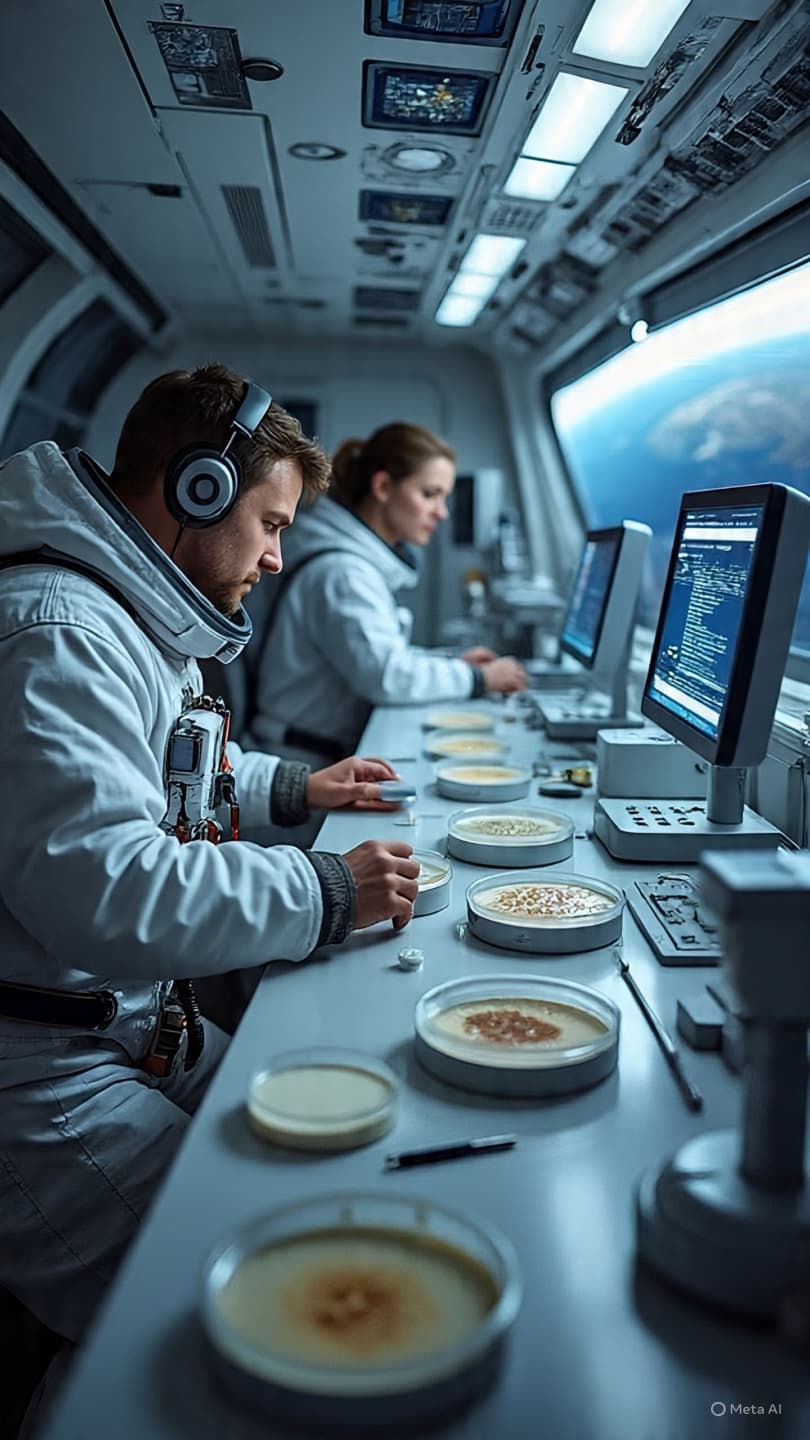
On the International Space Station, experiments designed to observe microbial behavior in microgravity have uncovered a remarkable trait: certain fungal species can extract metals from surrounding materials with surprising efficiency. What on Earth might seem like a simple biological process has taken on new significance in orbit, where every gram of material and every system failure carries amplified consequence.
Scientists studying these fungi found that they produce organic acids capable of dissolving and mobilizing metals from rock-like substrates and manufactured surfaces. On Earth, such processes are part of natural weathering cycles, contributing to soil formation and mineral recycling. In space, however, this ability opens an entirely different conversation. The same mechanisms that allow fungi to leach nutrients from stone may also influence the integrity of spacecraft materials — or perhaps even support future resource extraction beyond our planet.
The implications stretch in two gentle but distinct directions. First, there is caution. Spacecraft are finely engineered ecosystems, and microbial activity must be carefully monitored. Metal corrosion in orbit could pose long-term maintenance challenges. Understanding how fungi interact with aluminum alloys, steel components, or other station materials is essential to safeguarding infrastructure in space.
Second, there is possibility. As humanity contemplates longer missions to the Moon and Mars, the question of in-situ resource utilization grows more pressing. Transporting all necessary materials from Earth is costly and limiting. If fungi can assist in bio-mining — extracting useful metals from lunar or Martian regolith — they may become unlikely partners in humanity’s expansion beyond Earth. Instead of heavy industrial equipment, future settlers might employ biological systems that work quietly, steadily, and sustainably.
Research conducted in collaboration with agencies such as NASA and the European Space Agency continues to explore how microgravity alters fungal metabolism and mineral interactions. Microgravity appears to influence growth patterns and biofilm formation, factors that may enhance or modify metal extraction processes. Each discovery adds a thread to a larger tapestry — one that blends biology, engineering, and exploration.
There is a certain poetry in this development. On Earth, fungi decompose forests and recycle nutrients, sustaining ecosystems in quiet cycles of renewal. In orbit, they hint at sustaining human ambition. The smallest organisms, often overlooked, remind us that exploration is not only about rockets and robotics, but also about understanding the subtle intelligence of life itself.
As research advances, protocols for microbial management aboard spacecraft will evolve. Engineers and biologists will work side by side, balancing protection with innovation. The story unfolding on the space station is not one of alarm, nor of unchecked optimism. It is a story of observation — of paying close attention to life’s quiet capabilities in unfamiliar environments.
In the stillness of space, where metals gleam under artificial light and Earth spins far below, fungi have added a modest yet meaningful chapter to the narrative of exploration. Their work is unassuming, but its implications may travel far — perhaps even to the surface of another world.
AI Image Disclaimer Visuals are created with AI tools and are not real photographs.
Source Check: Credible coverage and scientific reporting found from:
1. NASA 2. European Space Agency (ESA) 3. Nature Communications 4. Scientific American 5. Space.com
Published by Banx Network. This article is part of the Banx decentralized media programme, powered by the BXE token on the XRP Ledger.