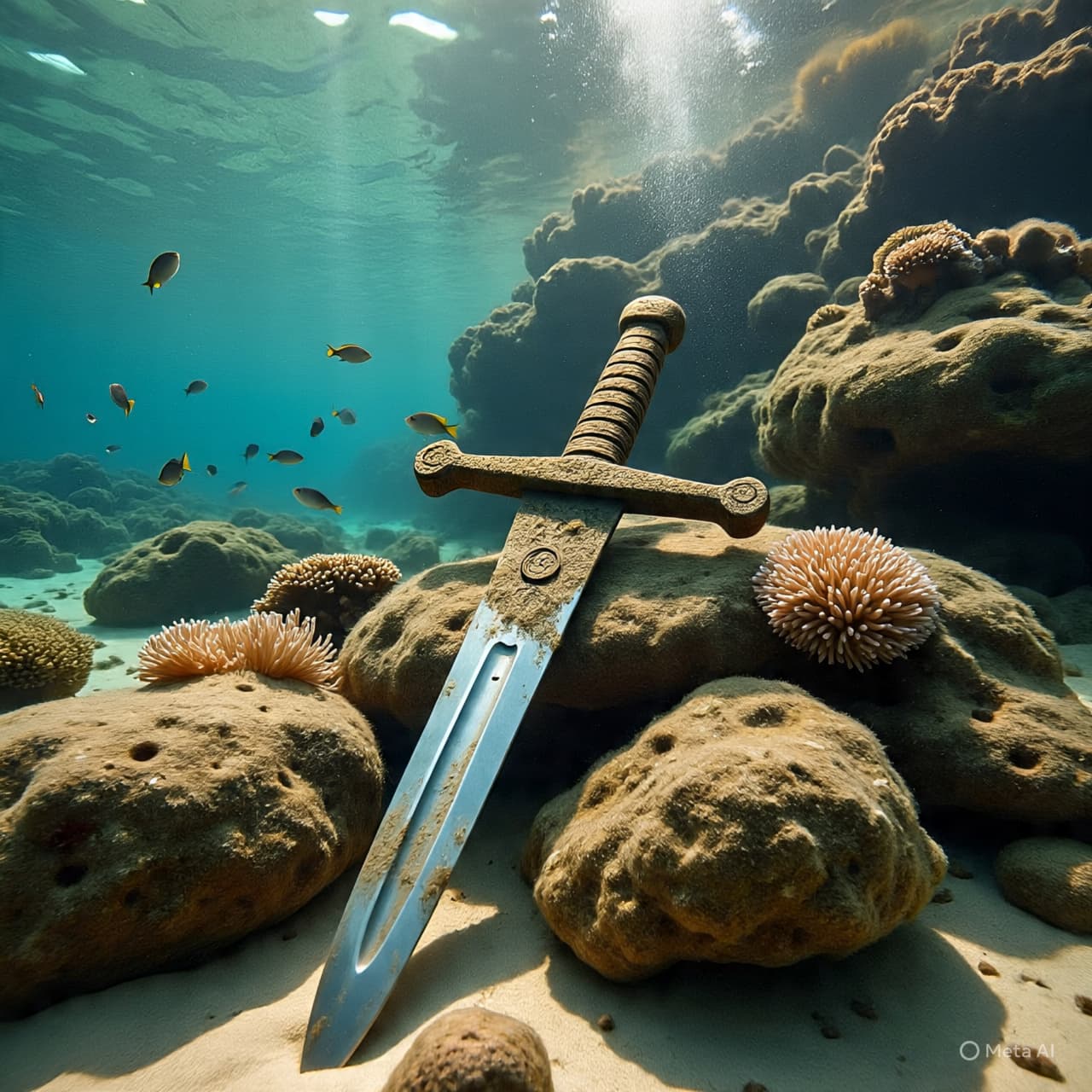
The sea along Israel’s Carmel coast rarely gives up its secrets all at once. It rolls in and out with a patient rhythm, brushing against stone and sand as it has for centuries, smoothing sharp edges into quiet curves. On a recent afternoon, as sunlight flickered beneath the surface, a student swimming near the ancient harbor ruins off Atlit noticed something angular resting among the rocks—a shape that did not belong to coral or tide.
What emerged from the water was an 800-year-old sword, its blade long and encrusted, its hilt still discernible despite centuries beneath the Mediterranean. Marine archaeologists later identified it as a Crusader-era weapon, likely dating back to the 12th or 13th century, when European knights and regional powers contested the Levant’s coastline in a series of campaigns known as the Crusades.
The find was reported to the Israel Antiquities Authority, whose experts carefully retrieved and stabilized the artifact. Encrusted with marine growth and sand, the sword had been preserved in a kind of underwater stillness. Preliminary examinations suggested a blade nearly a meter long, consistent with weapons carried by Crusader knights who established fortified outposts along the coast.
Not far from where the sword was discovered lie the ruins of Atlit Castle, a 13th-century stronghold built by the Knights Templar. The fortress once stood as a maritime sentinel, guarding trade routes and serving as a departure point for pilgrims and soldiers. The surrounding seabed has yielded anchors, ceramics, and other relics over the years, testimony to a shoreline that was once crowded with ships and ambition.
Historians describe the Crusader period as an era layered with conflict and exchange—battles waged alongside moments of commerce and cultural contact. The sword, though silent now, would have been part of that wider tapestry. Whether lost in combat, dropped during a hurried embarkation, or surrendered to the sea in a storm, its journey from a medieval forge to a modern laboratory spans continents and centuries.
Underwater archaeology along Israel’s coast often depends on shifting sands and winter storms that expose artifacts long concealed. The Mediterranean’s currents both protect and threaten what they carry. Salt preserves metal differently than dry earth; time accumulates in coral and rust. Each discovery becomes a dialogue between nature and history.
For the student who first spotted the blade, the moment was less about conquest than about curiosity—a glint beneath the waterline that hinted at another age. For archaeologists, the sword offers material evidence of a period often narrated through chronicles and legend. Its weight, balance, and craftsmanship can be studied anew, grounding distant events in tangible form.
As conservation work begins, the sword will likely find a place in a museum, where controlled light replaces the shifting shimmer of the sea. Visitors will stand before it, separated by glass rather than water, contemplating a past that feels both remote and startlingly present. The Mediterranean will continue its slow conversation with the shore, and somewhere beneath its surface, other objects wait—reminders that history does not disappear. It settles, patiently, until someone looks closely enough to see it.
AI Image Disclaimer Visuals are AI-generated and serve as conceptual representations.
Sources Israel Antiquities Authority Reuters BBC News The Jerusalem Post Haaretz
Published by Banx Network. This article is part of the Banx decentralized media programme, powered by the BXE token on the XRP Ledger.