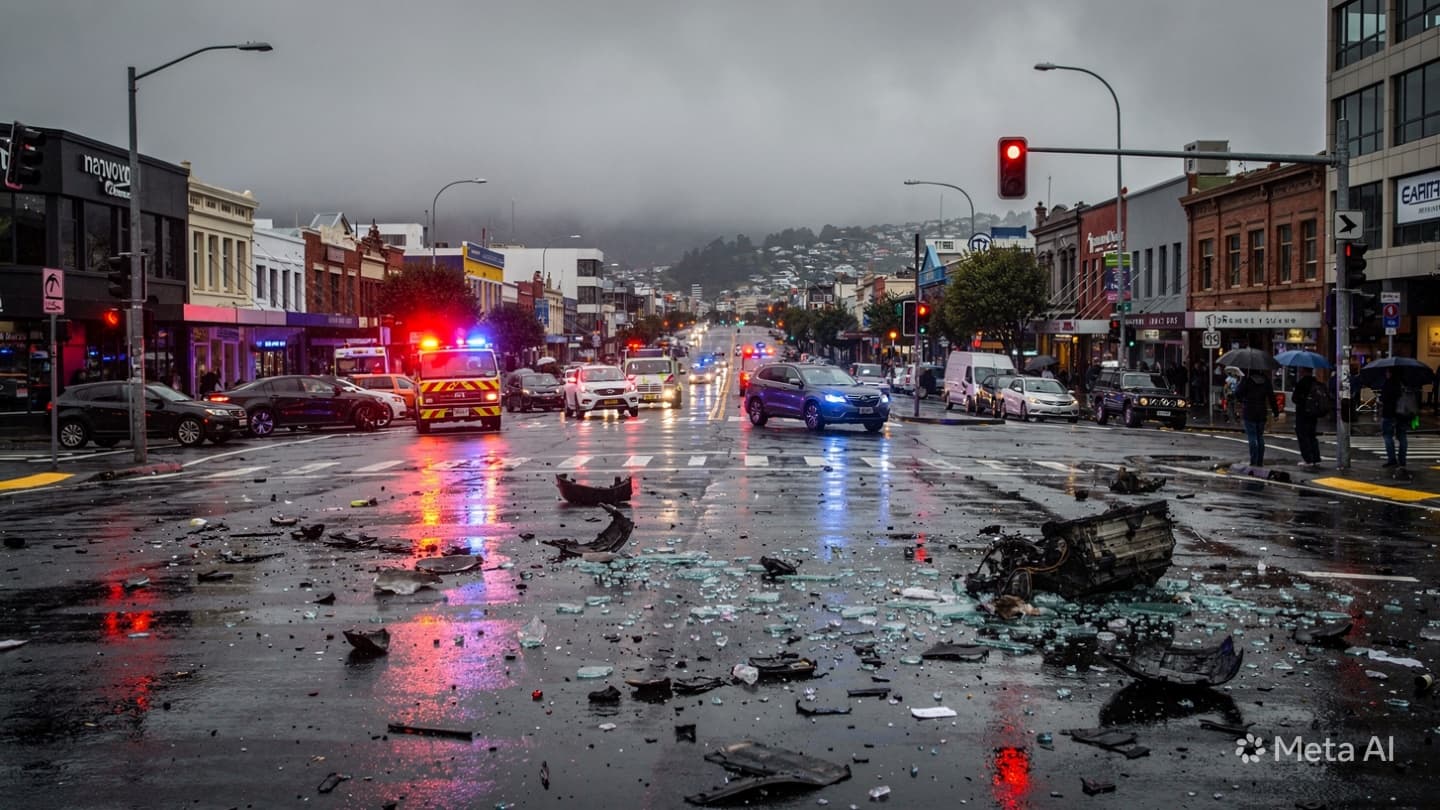
The morning commute along the sweeping coastal roads and narrow urban corridors of Wellington usually possesses a rhythmic, predictable fluidity. Drivers navigate the hillsides and harbor views with a quiet familiarity, insulated within the warmth of their vehicles against the sharp southerly wind. It is an environment built upon a shared social contract of safety and mutual predictability. Yet, that fragile order was shattered when a high-speed pursuit tore through the traffic, transforming an ordinary road into a corridor of immediate peril.
The pursuit unfolded with a sudden, disruptive velocity that left bystanders with little time to react. The distance between safety and catastrophe shrank instantly as the fleeing vehicle navigated the tight asphalt lanes with a desperate disregard for the surrounding public. The sound of high-RPM engines and the distant, wailing rise of police sirens altered the atmosphere of the city streets, introducing an element of volatile danger into a peaceful Tuesday morning.
For the drivers who found themselves unwittingly caught in the path of the chase, the experience was a jarring reminder of how quickly the public sphere can be compromised. The physics of speed and heavy metal culminated in a multi-vehicle collision that brought the pursuit to an abrupt, violent halt. The sound of twisting metal and shattering safety glass echoed across the concrete barriers, followed by an immediate, heavy silence as the momentum of the chase died away.
Emergency personnel rushed to the scene, their flashing red and blue lights reflecting off the crumpled bodywork of multiple cars scattered across the intersection. The immediate priority shifted to assessing the well-being of those who had been innocently swept up in the chaos. Passersby watched from the footpaths, their faces reflecting a mixture of shock and quiet relief that the damage had not been more severe.
Officers moved quickly to secure the perimeter and detain the individual responsible for the disruption, bringing a clinical, systematic end to an erratic event. The suspect was removed from the wreckage under tight security, while paramedics attended to the shaken occupants of the involved vehicles. The intersection, normally a conduit for daily commerce, became a static tableau of investigation and recovery.
The surrounding traffic ground to a halt, stretching back along the motorway in a long, glittering ribbon of brake lights. Commuters sat in their stationary cars, looking out at the distant scene with a quiet frustration, yet fully aware that the delay was a small price to pay compared to the ordeal of those at the front of the queue. The city’s complex anatomy had been temporarily constricted by a single act of lawlessness.
In the hours that followed, tow trucks arrived to clear the twisted remains of the vehicles, and road crews swept the broken glass and leaked fluids from the asphalt. The physical debris was cleared away with relative speed, but the psychological residue of the event lingered for those who had witnessed the high-speed approach. It stands as a stark reminder of the underlying vulnerability inherent in our shared public infrastructure.
Wellington authorities arrested a suspect following a high-speed police chase that concluded in a major multi-vehicle collision on a main city thoroughfare. The pursuit began after officers attempted to stop a vehicle driving erratically, which then accelerated away from patrol units. The incident resulted in significant damage to several civilian cars and caused widespread traffic gridlock across the capital, though no life-threatening injuries were reported.
Published by Banx Network. This article is part of the Banx decentralized media programme, powered by the BXE token on the XRP Ledger.