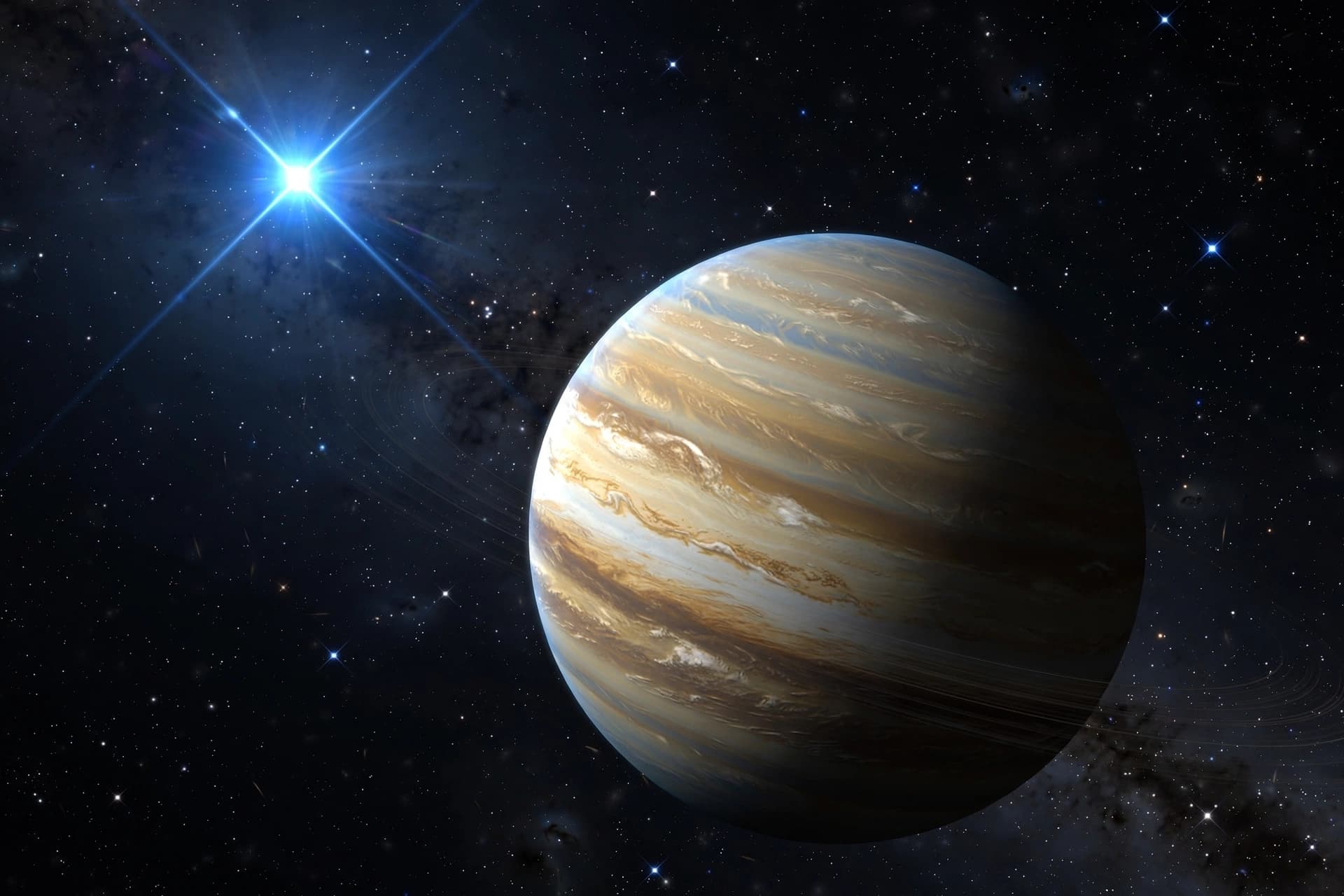
The habitable zone is one of astronomy‘s most evocative concepts—a ring of orbital distance around a star where conditions might allow liquid water to exist on a planet’s surface. For decades, the search for such zones has focused on stars like our Sun, quiet and yellow, with temperatures that seem compatible with life as we know it. But what if the star itself is nothing like the Sun? What if it is hotter, brighter, and bluer, and yet still has a planet orbiting in that temperate ring? A new discovery, if confirmed, would mark the first time a planet has been found in the habitable zone of such an extreme star.
The star is called HD 156295, located about 140 light-years from Earth. It is an A-type star, bluish-white and brilliant, with a surface temperature around 7,500 degrees Celsius—significantly hotter than the Sun. It is roughly twice as massive and nine times more luminous, visible to the naked eye despite its distance. The candidate planet, designated HD 156295 b, is estimated to be a gas giant about six times the mass of Jupiter, orbiting its star at a distance of about 3.9 astronomical units, with a year lasting roughly 2,200 days.
The detection was made using a technique called pulsation timing. HD 156295 is a Delta Scuti variable, a type of star whose brightness pulses in a regular rhythm, like a cosmic metronome. Researchers analyzed data from NASA‘s TESS satellite for nearly 16,500 such stars, looking for tiny periodic variations in the timing of the pulses—irregularities that could be caused by the gravitational tug of an orbiting companion. For HD 156295, the signal was there: a periodic shift that suggests something massive is circling the star.
The researchers are cautious. The probability that the signal is truly planetary is estimated at just over 50 percent—barely better than a coin toss. Additional observations will be needed to confirm or refute the detection. If confirmed, HD 156295 would become the hottest star known to host a planet in its habitable zone.
But “habitable zone” does not mean “habitable.” HD 156295 b is a gas giant, a world of hydrogen and helium with no solid surface. It could not support life as we understand it. If it has large moons—and gas giants often do—those moons might theoretically harbor liquid water and conditions suitable for life. But that remains speculation, and the planet itself is a far cry from Earth.
What makes this candidate interesting is not its potential for life, but what it reveals about where planets can form and survive. A-type stars are short-lived and emit intense radiation. Finding a planet in the habitable zone of such a star challenges assumptions about which stellar environments are compatible with planetary systems. It also demonstrates the value of non-traditional detection methods. Pulsation timing, originally developed for other purposes, has opened a window into a type of star where conventional techniques struggle.
The work is preliminary. The signal is weak, the probability modest, and the parameters uncertain. But it points toward a future in which the search for habitable worlds extends beyond Sun-like stars into the hotter, brighter corners of the galaxy. Whether or not HD 156295 b is confirmed, the method has proven its potential. The habitable zone, it seems, may be broader than we thought—and the stars that host it, more varied.
AI Image Disclaimer: All images accompanying this report are AI-generated and do not depict actual astronomical observations.
Sources: The Astrophysical Journal, New York Post, NDTV, 3DNews, Sputnik Türkiye
Published by Banx Network. This article is part of the Banx decentralized media programme, powered by the BXE token on the XRP Ledger.