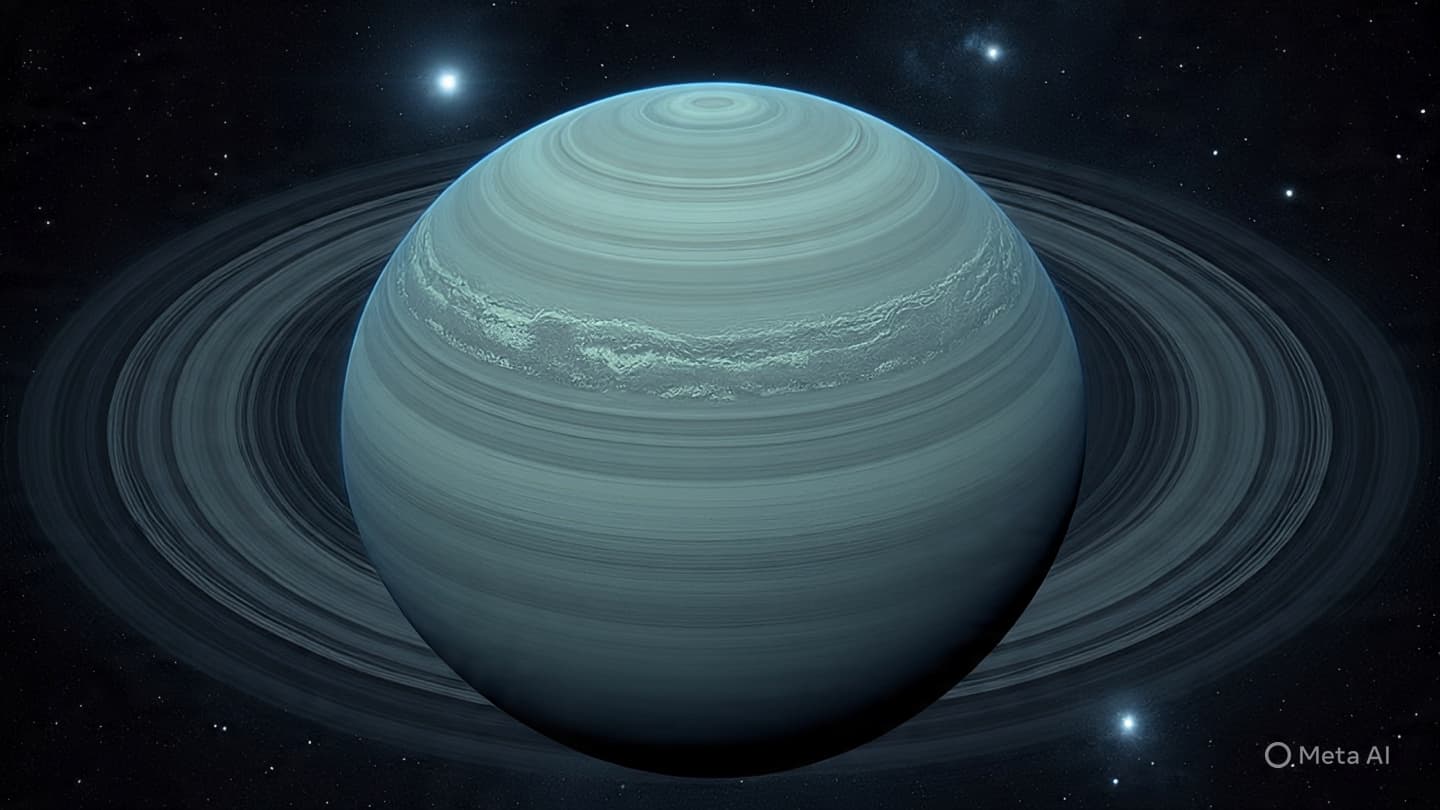
Far from the warmth of the Sun, the planet Uranus turns in a distant, quiet orbit, encircled by faint rings that have long held more questions than answers. Recent observations now suggest those rings may be hinting at unseen companions.
Astronomers studying irregularities within the ring համակարգ have identified patterns that could be explained by the gravitational influence of small, hidden moons. These subtle distortions appear as gaps or waves, shaped by objects too small or dim to be directly observed.
The rings of Uranus are less prominent than those of Saturn, yet they are complex in their own right. Composed largely of dark, icy particles, they offer a sensitive record of gravitational interactions occurring nearby.
By analyzing shifts in ring structure, scientists can infer the presence of orbiting bodies. This indirect method has been used before in planetary science, revealing moons that initially eluded direct detection.
The potential discovery of additional moons would expand understanding of Uranus’s system, which already includes more than two dozen known satellites. Each new finding adds depth to the history of how these systems form and evolve.
Researchers note that confirming the existence of these hidden moons will require further observation, likely involving more advanced telescopes and refined imaging techniques.
The study also highlights how even distant planetary systems remain dynamic. What appears still and unchanging from afar is, in reality, shaped by ongoing interactions and subtle forces.
As observational tools improve, the outer solar system continues to offer discoveries that reshape its quiet image. The rings, once thought to be simple structures, now emerge as active participants in revealing unseen motion.
In this distant region, knowledge grows not through direct sight alone, but through careful interpretation of patterns—where absence becomes a clue as meaningful as presence.
AI Image Disclaimer: Some visuals are AI-generated to depict planetary ring systems and may not represent actual telescope imagery.
Sources: NASA European Space Agency (ESA) Nature Astronomy Sky & Telescope
Published by Banx Network. This article is part of the Banx decentralized media programme, powered by the BXE token on the XRP Ledger.