There are nights when the sky changes almost imperceptibly, and yet the shift touches the entire planet.
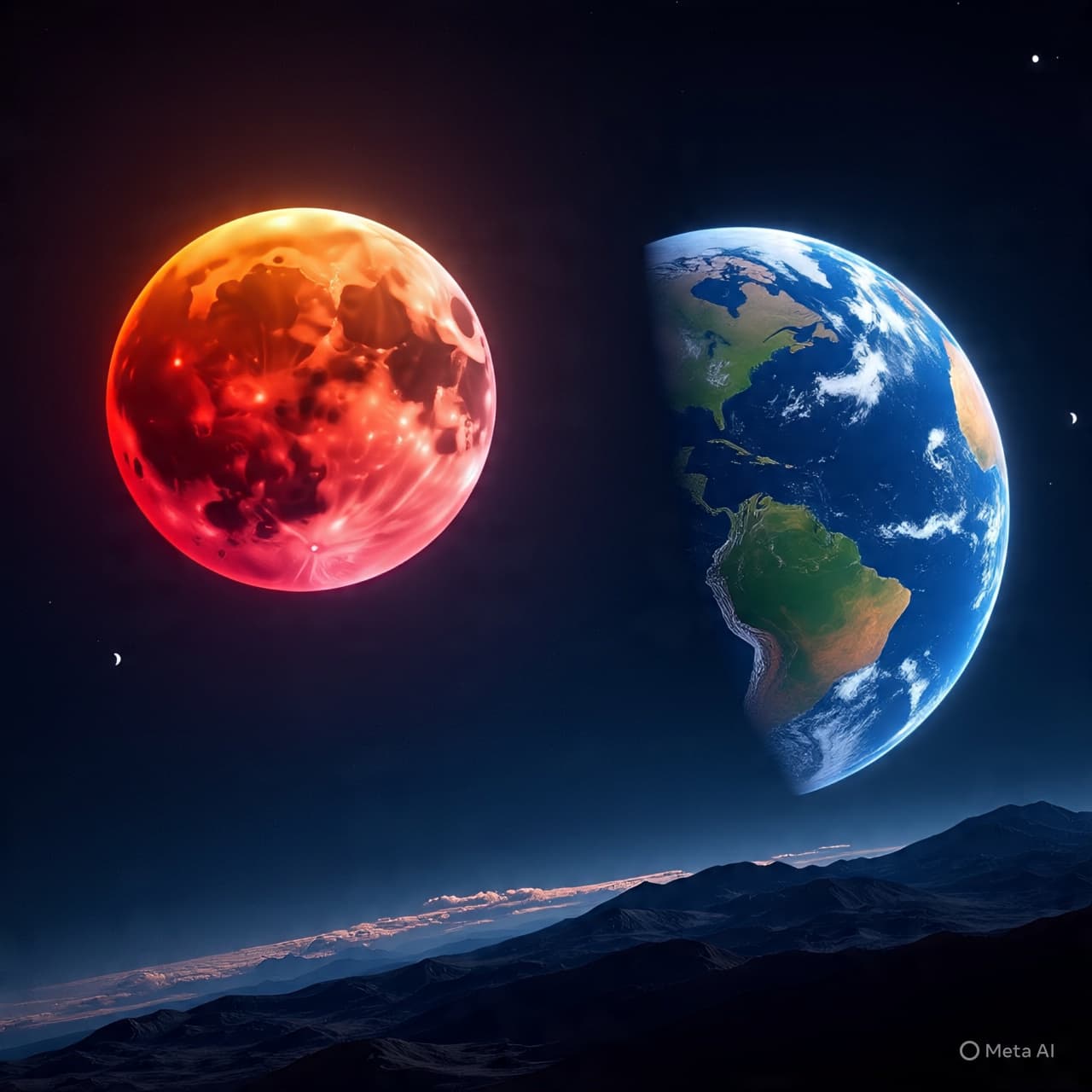
The Moon, so often a steady companion in the darkness, begins to lose its familiar brightness. Its silver surface softens, then deepens in tone, until the light takes on a muted red glow. To observers standing beneath the night sky, it appears as though the Moon itself has changed. In truth, it is the Earth that has moved—placing its shadow carefully across the lunar face.
During the March Blood Moon lunar eclipse, that quiet alignment unfolded once again. As Earth, the Moon, and the Sun fell into near-perfect geometry, Earth’s shadow stretched outward through space, enveloping the Moon in darkness tinged with red light.
From the ground, the eclipse appeared as a slowly changing Moon suspended above the horizon. From orbit, however, satellites recorded another perspective—one that revealed how the event touched the planet itself.
New satellite imagery captured the passage of the eclipse as it dimmed sections of Earth’s surface. As the Moon moved through Earth’s shadow, the reflected light that normally brightens the night side of the planet briefly faded. The result was a subtle darkening visible in orbital images, tracing the movement of the eclipse across oceans and continents.
These observations illustrate the delicate balance of light within the Earth–Moon system. The brightness we see at night does not come solely from direct moonlight. It also includes reflected sunlight bouncing from the lunar surface back toward Earth. During a total lunar eclipse, that reflected light temporarily diminishes, altering the faint illumination that satellites can detect from above.
The reddish color of a blood moon arises from another quiet process. As sunlight passes through Earth’s atmosphere, shorter blue wavelengths scatter while longer red wavelengths bend into the planet’s shadow. Those red tones then reach the Moon, bathing it in a copper glow that has fascinated skywatchers for centuries.
In this sense, every lunar eclipse carries a trace of Earth itself. The color of the Moon during totality reflects the composition of our atmosphere—the dust, clouds, and particles that filter sunlight before it reaches the lunar surface.
Seen from space, the event becomes a planetary phenomenon rather than a local spectacle. Satellites orbiting Earth record the subtle shifts in light and shadow that accompany the eclipse, offering scientists a broader view of how celestial alignments influence the illumination of our world.
The March eclipse provided another example of this cosmic geometry in motion. As Earth’s shadow crossed the Moon, orbital instruments documented the corresponding changes in brightness across the planet’s night side.
The satellite images show the temporary dimming of Earth’s surface during the eclipse, illustrating how the alignment of the Sun, Earth, and Moon can influence nighttime illumination on a planetary scale.
AI Image Disclaimer
Visuals are AI-generated and serve as conceptual representations of astronomical phenomena rather than real satellite photographs.
Source Check
Credible coverage and/or primary reporting exist from: Space.com NASA Live Science Phys.org The Guardian
Published by Banx Network. This article is part of the Banx decentralized media programme, powered by the BXE token on the XRP Ledger.