There is a quiet movement within materials that power our devices—a motion too small to see, yet constant in its presence. Charge flows, ions drift, and within these confined pathways, structure is asked to hold steady against change. For a time, it does. Then, almost imperceptibly, new forms begin to appear.
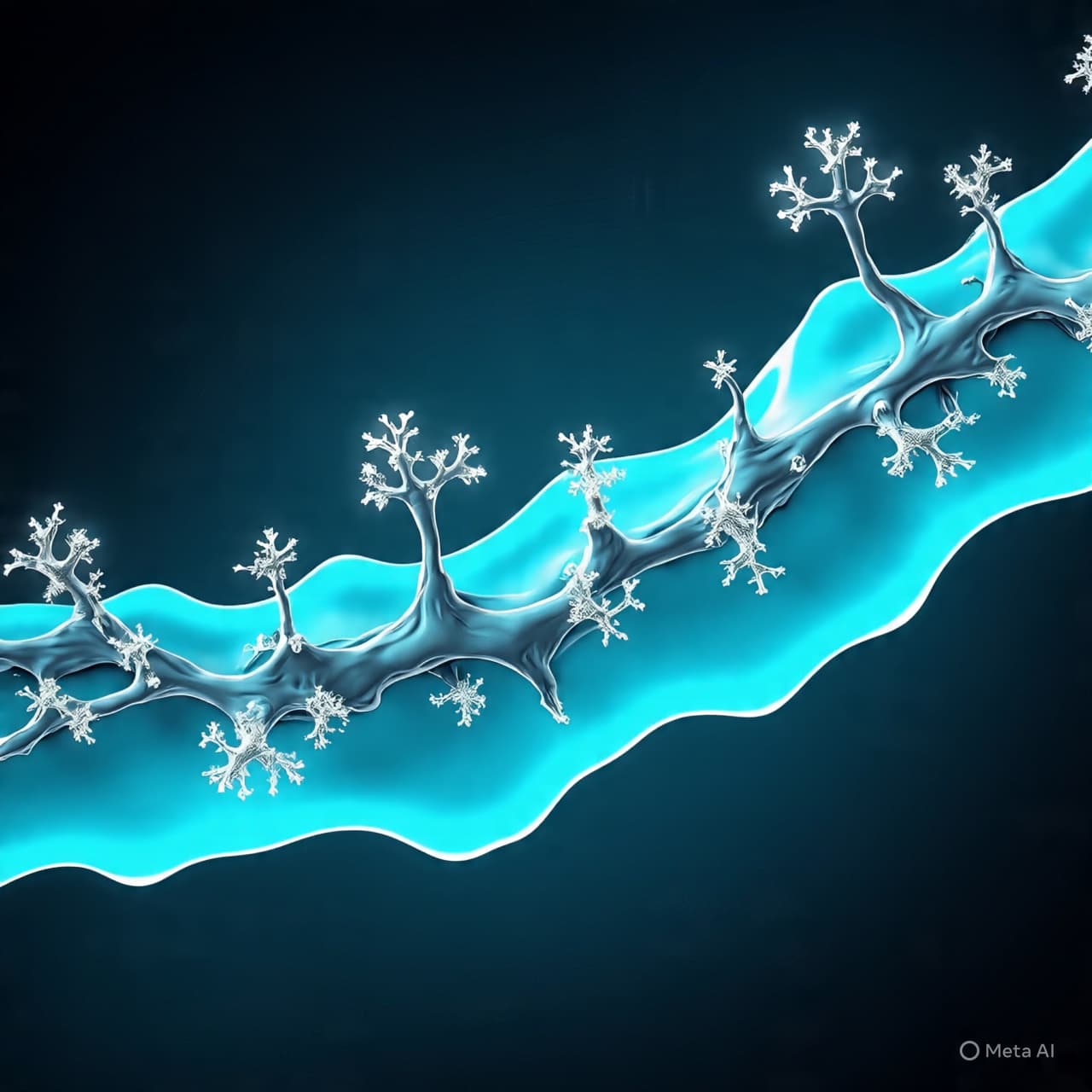
In solid-state systems, particularly within solid electrolytes, one such form emerges as dendrites—branching structures that grow as ions accumulate and deposit along preferred paths. Their shape recalls something organic, like frost spreading across a surface, delicate yet persistent. But unlike frost, their presence carries consequence. As they extend, they can bridge boundaries meant to remain separate, altering the behavior of the system in ways that are not always immediately visible.
Recent research suggests that this growth does not occur in isolation. Alongside the formation of dendrites, a second process unfolds—electrochemical corrosion at the interfaces where materials meet. This pairing, growth and degradation, reflects a deeper interaction between structure and energy, one that is central to the study of electrochemistry and materials science.
As ions move through a solid electrolyte, they do so under the influence of electric potential, guided toward regions where they can be incorporated into a growing structure. In ideal conditions, this movement is uniform, the material accommodating the flow without disruption. Yet in practice, variations in composition, defects, or local stress can create uneven pathways. Dendrites begin in these regions, extending gradually as more material is deposited.
At the same time, the interfaces—those narrow boundaries between electrode and electrolyte—experience their own transformations. Electrochemical reactions can alter the composition of these regions, breaking down stable phases and forming new ones. This is corrosion in its electrochemical form, not the visible rust of exposed metal, but a subtle reconfiguration at the atomic scale. It changes the properties of the interface, sometimes weakening it, sometimes making it more susceptible to further growth or fracture.
The relationship between dendrite formation and corrosion appears to be intertwined. As dendrites grow, they can concentrate stress and electric fields, accelerating reactions at nearby interfaces. Conversely, corrosion can create conditions that favor dendrite initiation, altering pathways and reducing the uniformity of ion transport. What emerges is not a single process, but a feedback loop—growth influencing degradation, and degradation shaping growth.
Understanding this interplay has become a focus within the development of next-generation energy storage technologies. Solid-state batteries, often seen as a pathway toward safer and more efficient systems, depend on the stability of their internal structures. The presence of dendrites and the accompanying corrosion challenges that stability, introducing points of failure that must be addressed through design, material selection, and engineering control.
Researchers approach this challenge through a combination of experimental observation and modeling, seeking to map how these processes begin and evolve. By identifying the conditions under which dendrites form and corrosion accelerates, they aim to guide the development of materials that resist both—structures that can sustain the movement of ions without yielding to unintended transformation.
There is a certain balance at the heart of this work. Energy must move, yet structure must endure. The system must remain dynamic without becoming unstable. In this balance, the quiet interplay between growth and corrosion becomes not only a problem to solve, but a window into how materials behave under the persistent influence of electric force.
Scientists report that electrochemical corrosion accompanies dendrite growth in solid electrolytes, with both processes influencing each other at material interfaces. The findings highlight challenges for solid-state battery development and underscore the need for improved materials and designs to ensure long-term stability.
AI Image Disclaimer
Artwork is generated by AI to conceptually depict scientific phenomena and is not derived from direct imaging.
Sources
Nature Materials Science Joule Advanced Energy Materials MIT Technology Review
Published by Banx Network. This article is part of the Banx decentralized media programme, powered by the BXE token on the XRP Ledger.