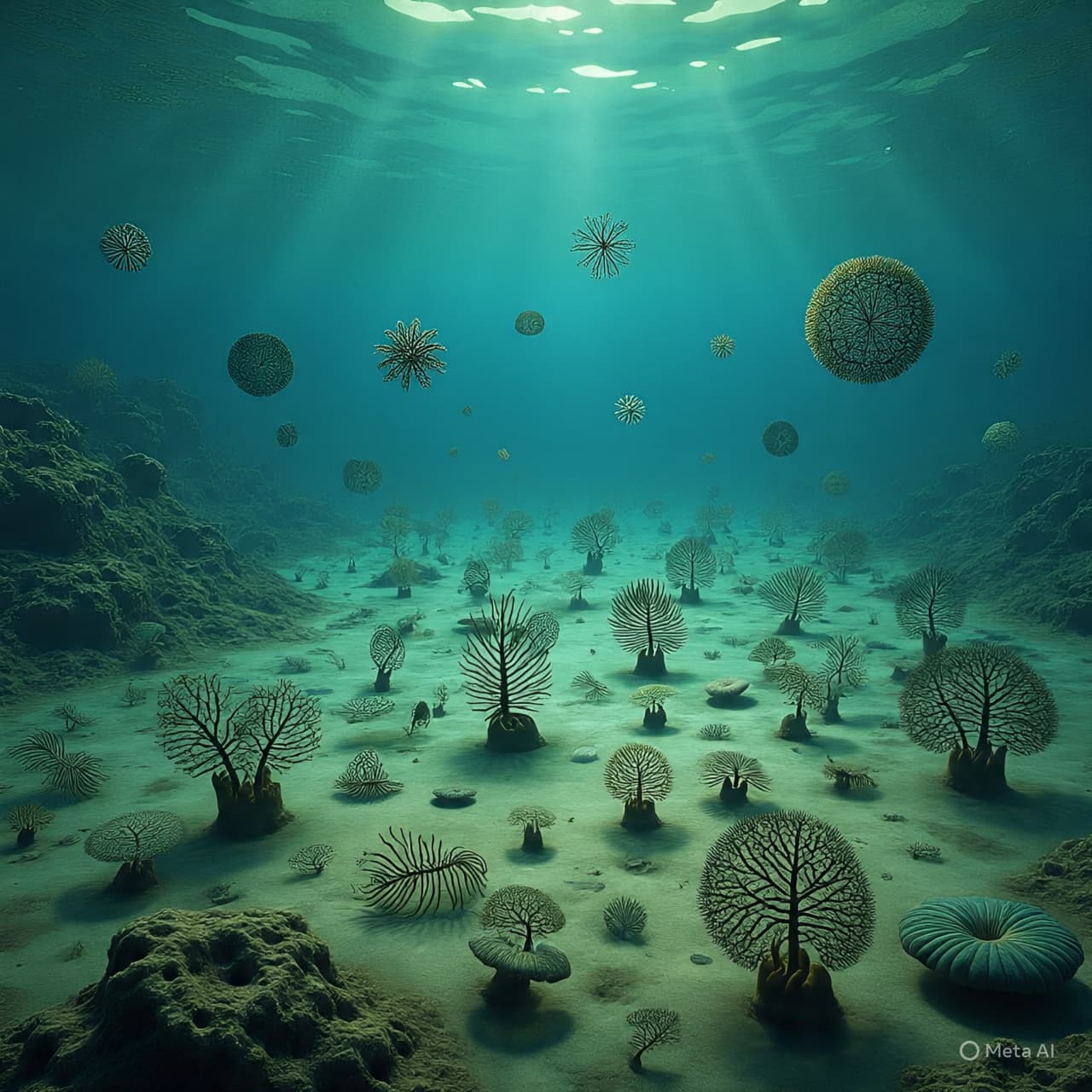
Long before forests covered the continents or animals walked across the land, Earth’s oceans held a quieter world.
In those distant waters of the late Ediacaran Period, life moved slowly across the seafloor. Soft-bodied organisms—strange in shape and unfamiliar to modern eyes—rested in the sediment or drifted gently with currents. Their forms left delicate impressions in ancient rock, faint signatures of a biological experiment unfolding more than half a billion years ago.
For many years, scientists believed that these early organisms lacked the complex structures seen in later animals. The idea of a brain, in particular, seemed to belong to a later chapter in evolutionary history, emerging only after the explosive diversification known as the Cambrian Explosion.
Yet a newly studied fossil may tell a quieter, more complicated story.
Researchers examining a 550-million-year-old organism have identified anatomical features suggesting that it may have possessed a centralized nervous structure—something resembling a primitive brain. The creature, preserved in remarkable detail in ancient sedimentary rock, shows patterns that appear consistent with nerve tissues extending from a central region.
The fossil belongs to a group of enigmatic early animals whose soft bodies rarely survive intact in the geological record. When they do appear, they often resemble leaflike or segmented forms pressed gently into stone. For decades, interpreting these impressions has been a careful process of observation, imaging, and comparison.
In this case, scientists used advanced imaging techniques to examine the fossil’s internal patterns. Within the preserved structure, they detected symmetrical arrangements that resemble nerve cords and a concentrated anterior region where signals may once have been processed.
If confirmed, the finding would push the origins of centralized nervous systems deeper into evolutionary time than previously thought.
Brains, after all, represent a turning point in biological complexity. They allow organisms to integrate sensory information, coordinate movement, and respond to their surroundings in more sophisticated ways. In modern animals, this capacity is often linked to active behaviors—swimming, hunting, navigating complex environments.
But in the ancient oceans of the Ediacaran world, even a modest nervous system may have been transformative.
The creature itself likely lived along the seafloor, interacting with microbial mats that covered large portions of the ancient marine landscape. Its body structure suggests a form of bilateral organization—an arrangement with left and right sides—which is common among animals that possess centralized nervous systems.
For paleontologists, the discovery offers a glimpse into a moment when the foundations of animal life were still forming. Evolution rarely moves in sudden leaps; instead, it advances through gradual experiments in form and function, some of which survive while others vanish into extinction.
The fossil record preserves only fragments of this process. Each new specimen adds a small but meaningful piece to the larger narrative of how complex life emerged.
In this case, the suggestion of an early brain hints that neural organization may have begun developing before the dramatic diversification of animals in the Cambrian period.
The research reports that a 550-million-year-old fossil organism from the Ediacaran era shows anatomical features consistent with a centralized nervous structure, potentially representing one of the earliest examples of a brain-like system in the animal lineage.
AI Image Disclaimer
These images are AI-generated visual interpretations intended to illustrate scientific concepts rather than depict actual fossil photographs.
Source Check
Credible coverage and/or primary reporting exist from: Nature Science ScienceDaily Phys.org Smithsonian Magazine
Published by Banx Network. This article is part of the Banx decentralized media programme, powered by the BXE token on the XRP Ledger.