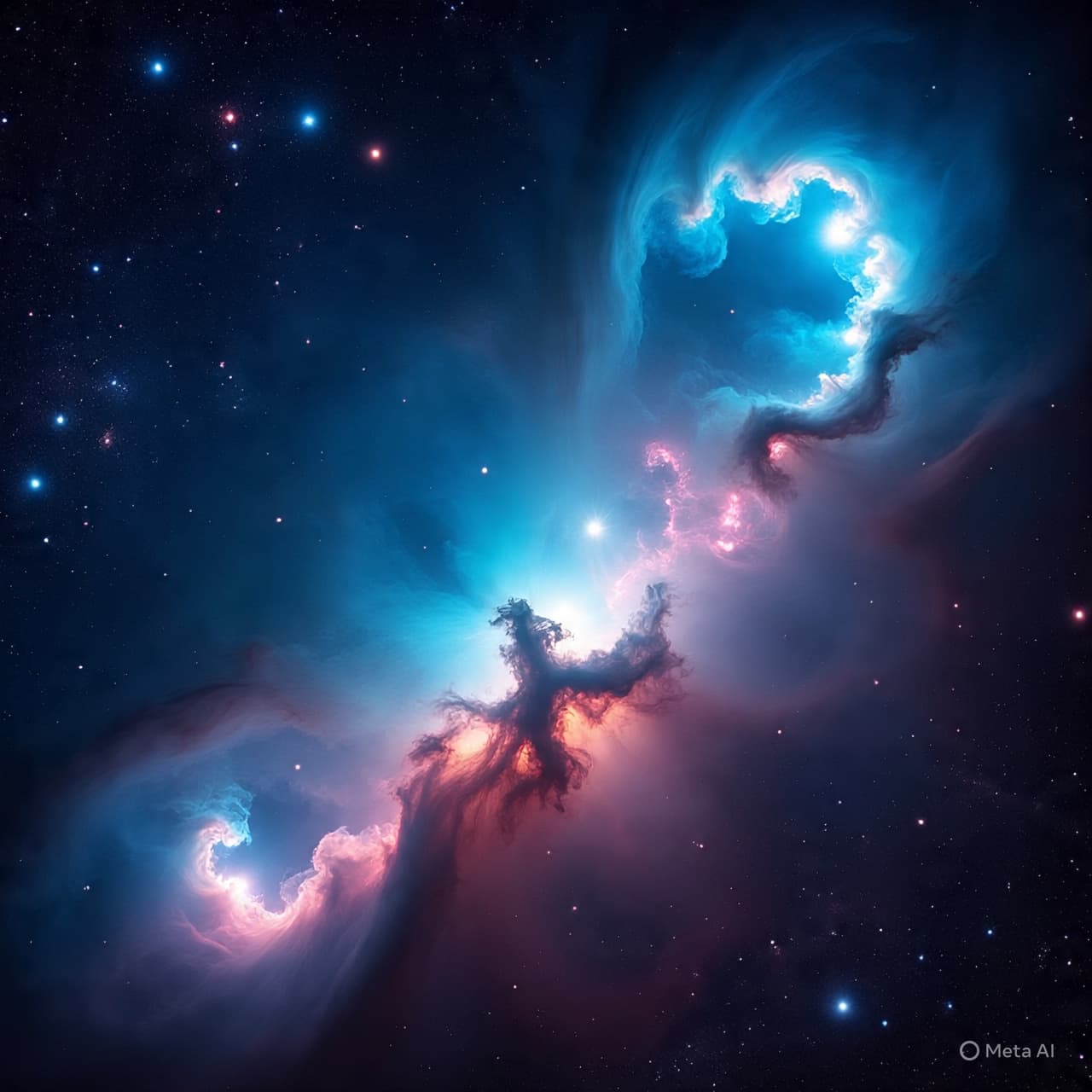
There are places in the universe where light is still learning how to be born. In the quiet folds of cosmic dust, where silence hangs like an unfinished sentence, something ancient and tender is unfolding. Within the heart of the Cocoon Nebula, a region long wrapped in veils of gas and shadow, a hidden gathering of young stars has begun to reveal itself—thanks to the patient gaze of NASA’s Chandra X-ray Observatory. The Cocoon Nebula, formally known as IC 5146, lies thousands of light-years from Earth. To optical telescopes, it appears as a misty bloom of interstellar gas and dust—a cradle of star formation softly glowing in the dark. But visible light can only whisper part of the story. Much of the nebula’s heart remains obscured, shielded by thick curtains of cosmic material. This is where X-rays speak more clearly than light. Using its powerful X-ray vision, Chandra has detected a cluster of young stars previously hidden from traditional observation. These stars, still in their early stages of life, emit high-energy radiation that pierces through dense clouds of dust. In doing so, they reveal themselves not as faint sparks, but as vibrant newborn suns in the making. Young stars are often restless. They flare, they pulse, they radiate intensely as gravity continues to sculpt them into stability. Such activity produces strong X-ray emissions, which become invaluable clues for astronomers seeking to understand how stellar nurseries evolve. In the Cocoon Nebula’s case, what once appeared as a quiet pocket of space is now understood as a dynamic environment—rich with stellar infancy. NASA researchers explain that identifying hidden clusters like this helps scientists trace the broader architecture of star formation within our galaxy. Are stars born alone, or in close-knit families? How does surrounding gas influence their growth? Each new detection adds another thread to the tapestry. The Cocoon Nebula itself has long been admired in visible and infrared imagery. Yet the Chandra findings deepen that portrait. What appears serene from afar is, in truth, a region alive with movement and transformation. Gas collapses. Temperatures rise. Nuclear fusion stirs. And within these processes, new stars quietly claim their place in the cosmos. Such discoveries are less about spectacle and more about patience. They remind us that much of the universe remains hidden—not because it is absent, but because it requires the right lens to be seen. Technology, in this sense, becomes a form of listening. As astronomers continue to study the cluster, further observations may reveal how many stars reside there, how massive they are, and whether planetary systems may one day form around them. For now, the finding stands as a testament to the evolving dialogue between human curiosity and cosmic mystery. In the end, the Cocoon Nebula lives up to its name. It shelters, it conceals, and in time, it releases. And through instruments like Chandra, we are invited not only to witness these beginnings—but to understand them with greater clarity. NASA has not framed this as a dramatic breakthrough, but rather as a meaningful addition to our map of stellar birthplaces. Still, within the quiet cadence of scientific discovery, there is something profound: another hidden chapter of the galaxy has gently come into view.
AI Image Disclaimer
Illustrations were produced with AI and serve as conceptual depictions.
---
Sources
NASA Space.com The Associated Press Sky & Telescope Scientific American
Published by Banx Network. This article is part of the Banx decentralized media programme, powered by the BXE token on the XRP Ledger.