Far above the restless weather of Earth, where continents drift slowly beneath a moving horizon, the Tiangong space station circles the planet in patient silence. Inside its modules, machines hum and instruments glow softly. Experiments unfold in careful routines measured by orbit and time.
Yet among the wires, panels, and laboratory equipment, something quieter has taken root.
Leaves stretch toward artificial light. Stems sway gently in the subtle currents of air inside the station. And in this small corner of orbit, a cluster of tomatoes has ripened—bright red against the pale interior walls of the spacecraft.
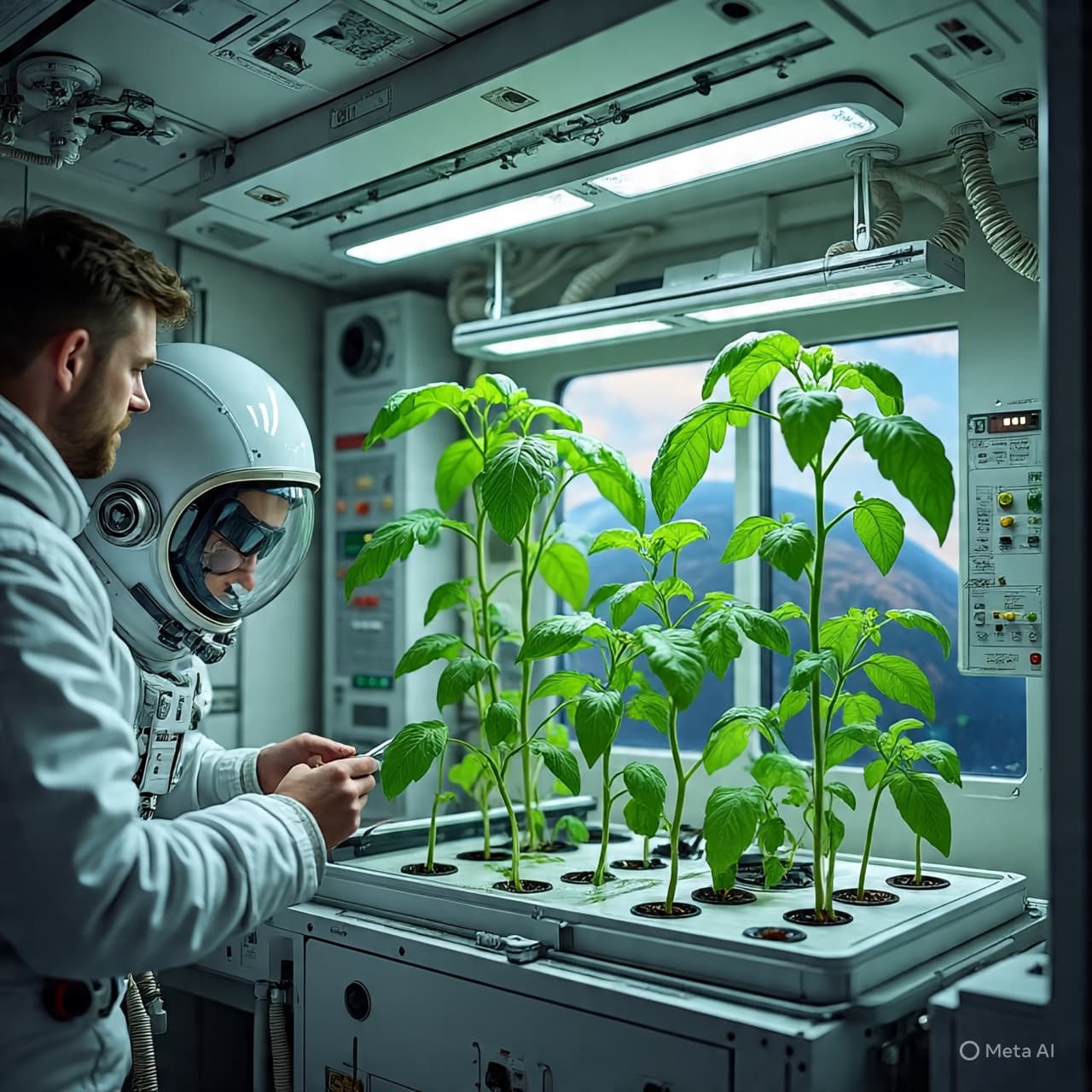
The crew of China’s Shenzhou-21 mission recently reported harvesting these tomatoes from an experimental cultivation system aboard the Tiangong space station. The plants were grown using an aeroponic system, a technique that nourishes roots with a fine mist of water and nutrients rather than soil.
The technology was delivered to the station aboard the Tianzhou-9 cargo spacecraft in 2025 as part of ongoing experiments designed to understand how plants grow in microgravity. In the absence of gravity, water behaves differently, roots orient themselves in unfamiliar ways, and even the direction of plant growth can shift in response to light rather than the pull of the Earth below.
For the astronauts tending the plants, the garden has become something more than a laboratory experiment. In a video shared through Chinese media, astronaut Zhang Hongzhang described the growing area as a small “healing corner” inside the station. The tomatoes, he explained, release a faint fresh scent that drifts through the module when the crew passes by.
His fellow astronaut Wu Fei noted that the crew monitors the plants daily, recording their growth and maintaining the cultivation system. The data collected from these experiments will help scientists understand how crops might be produced during long-duration missions in space.
Growing food in orbit carries implications far beyond the novelty of fresh vegetables in space. Future journeys to the Moon, Mars, or deeper into the solar system will require systems capable of supporting astronauts for months or even years. Plants could play a vital role in such missions—providing food, producing oxygen, recycling carbon dioxide, and helping regulate water within closed life-support systems.
The aeroponic system aboard Tiangong also uses specially designed LED light spectra to maximize plant growth while conserving energy, an important consideration in the tightly controlled environment of a space station.
China’s space agriculture experiments are expected to expand in the coming years. Researchers plan to test the cultivation of additional crops, including wheat, carrots, and medicinal plants, gradually building a broader understanding of how sustainable farming might work beyond Earth.
In orbit, however, the tomatoes themselves remain a quiet symbol of something simple: life continuing in a place far removed from the soil where it first began.
The Shenzhou-21 crew launched in October 2025 and has been conducting a series of scientific experiments aboard the Tiangong station during their mission. The successful harvest of tomatoes forms part of ongoing research into space agriculture and life-support systems for future long-duration space exploration.
AI Image Disclaimer These images are AI-generated visualizations intended to illustrate the concept described in the article.
Sources
Xinhua China Daily CGTN China Media Group TVB News
Published by Banx Network. This article is part of the Banx decentralized media programme, powered by the BXE token on the XRP Ledger.