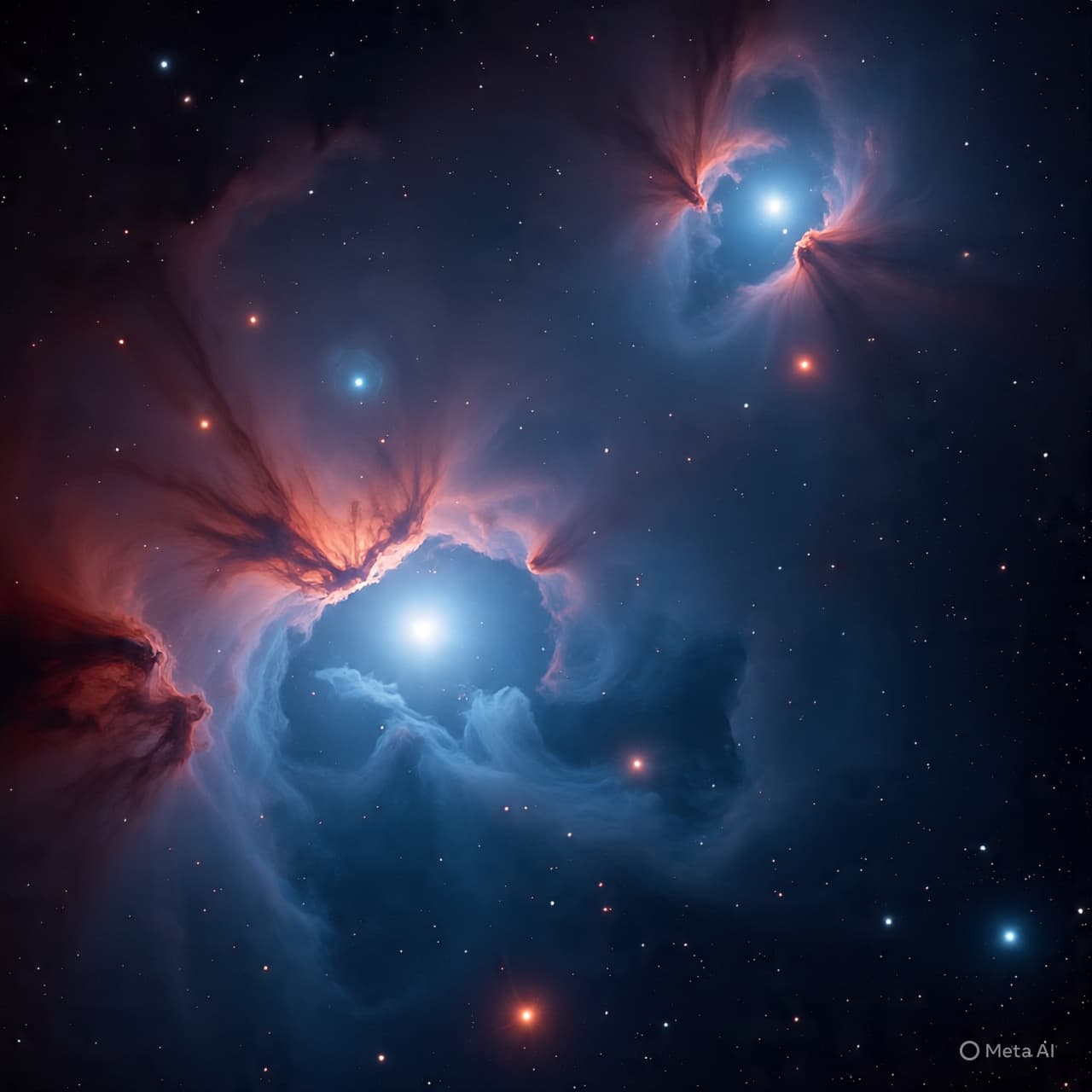
The universe often hides its beginnings the way a garden hides its seeds—quietly, patiently, beneath layers of dust and shadow. In the vast darkness between stars, light does not always travel freely. Sometimes it must struggle, filtering through cosmic veils before revealing what has long been growing in silence. It is within this hush of space that NASA’s Chandra X-ray Observatory has turned its gaze toward what astronomers call the Cocoon Nebula, uncovering a story not of endings, but of beginnings. Using the powerful X-ray vision of Chandra X-ray Observatory, scientists have peered into the dense heart of the Cocoon Nebula, a stellar nursery located thousands of light-years away in the constellation Cygnus. What they found was not a single luminous beacon, but a gathering—hundreds of young stars clustered together, still wrapped in the remnants of the gas and dust from which they were born. Unlike visible light, which can be scattered or blocked by cosmic material, X-rays cut through obscuring clouds. This ability allowed Chandra to detect young stellar objects that might otherwise remain concealed. Many of these stars are in their earliest stages of development, emitting energetic flares as magnetic activity surges across their surfaces. In many ways, their restless X-ray signatures are like the first cries of newborns—brief, bright declarations of arrival. The Cocoon Nebula has long been recognized as a region of star formation, but Chandra’s recent observations have sharpened the picture. By mapping X-ray emissions, researchers were able to distinguish youthful stars from older background stars and distant galaxies. The result is a clearer census of this emerging cluster, offering new insight into how stars gather and evolve within dense molecular clouds. This discovery also contributes to a broader understanding of stellar formation. Stars rarely form in isolation. They are social by nature, born in clusters that shape their early environments. Radiation, stellar winds, and gravitational interactions within such groups influence planetary formation and the architecture of future solar systems. Observations like these help astronomers refine models of how our own Sun—once part of a similar cluster—may have come into being. NASA’s findings demonstrate once again how observing the universe in multiple wavelengths reveals hidden layers of reality. Optical telescopes show us beauty; infrared reveals warmth; and X-ray observatories like Chandra expose energy in its rawest form. Each perspective adds a brushstroke to a far larger cosmic portrait. In revealing the youthful heart of the Cocoon Nebula, Chandra does not simply catalogue stars. It reminds us that even in the densest darkness, creation is quietly underway. The cosmos, vast and ancient, continues to weave new lights into its tapestry. NASA officials note that continued multiwavelength observations will further refine our understanding of this star-forming region. As data analysis progresses, astronomers expect deeper insights into how such stellar nurseries evolve over time.
AI Image Disclaimer
Visuals are created with AI tools and are not real photographs.
Source Check:
Credible mainstream and scientific sources covering this topic include: NASA Chandra X-ray Observatory Space.com ScienceAlert Sky & Telescope
Published by Banx Network. This article is part of the Banx decentralized media programme, powered by the BXE token on the XRP Ledger.