There is a kind of quiet that only space can hold.
It is not the quiet of absence alone, but of distance—of signals traveling outward, thinning as they go, waiting for something to answer. From Earth, the exchange with a spacecraft feels continuous, almost effortless, as though the connection itself were part of the orbit. Messages rise, responses return, and the unseen line between ground and sky remains intact.
Until, one day, it loosens.
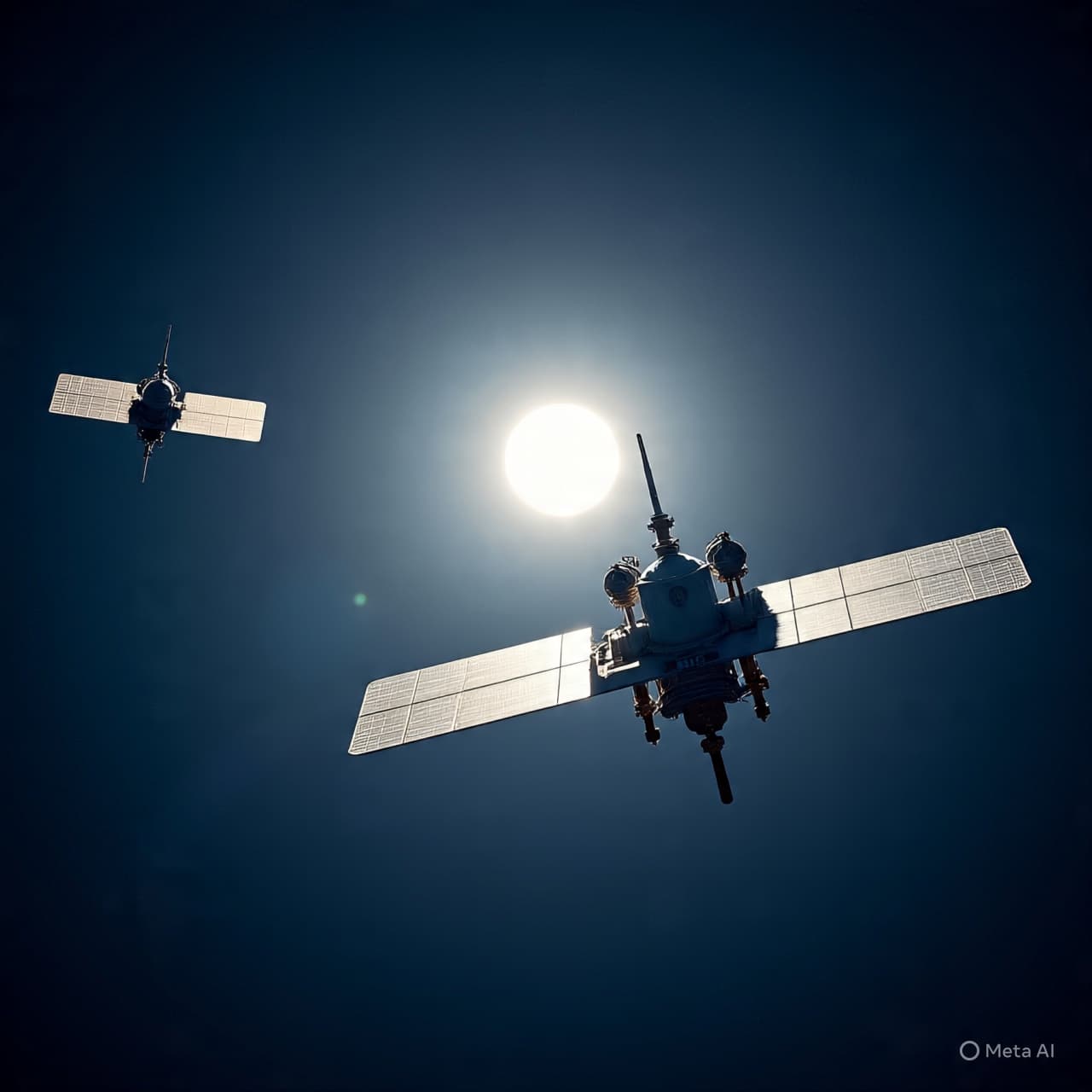
A spacecraft designed to create an artificial eclipse—part of a delicate mission led by the European Space Agency—slipped into that quiet. Its purpose had been precise: to move in careful formation with a companion satellite, aligning itself so exactly that it could block the Sun and cast a controlled shadow. Within that shadow, instruments would observe the solar corona, a region usually hidden except during rare natural eclipses.
It was a mission built on alignment, on timing, on the steady exchange of signals.
Then the exchange stopped.
Contact was lost without clear warning, leaving only a silence that could not immediately be explained. The spacecraft remained in orbit, continuing its motion as all such machines do, yet no longer responding. For engineers on the ground, the absence of data became its own kind of presence—something to interpret, to work around, to endure.
Time stretched quietly.
Days became weeks, and still the effort continued. Signals were sent again and again, adjusted in frequency and timing, each one an attempt to reach across a distance that offered no immediate reply. There is a patience built into space operations, an understanding that systems may withdraw before they fail, that silence does not always mean loss.
Still, uncertainty remains a constant companion in such moments.
The spacecraft may have entered a protective state, reducing its activity in response to an anomaly. It may have shifted its orientation, altering how its antennas faced Earth. Or it may have encountered a fault that simply required time to resolve. Each possibility carries its own weight, its own quiet tension.
And then, without announcement, the silence eased.
A signal returned.
ESA confirmed that communication had been re-established, allowing engineers to begin the careful process of assessment. The spacecraft, once unreachable, was again part of the conversation. What had been a closed interval opened, not with certainty, but with possibility.
The cause of the outage is still being examined. Early indications suggest the spacecraft may have entered a safe mode, a built-in response designed to preserve systems when conditions fall outside expected limits. Such responses can interrupt communication, but they also allow the spacecraft to endure, to wait for recovery.
Now, the work shifts.
Diagnostics are underway, systems are being checked, and the conditions for resuming the mission are being evaluated. The artificial eclipse experiment depends on precision—on the ability of two spacecraft to maintain alignment across vast distances with remarkable accuracy. Whether that precision can be fully restored remains part of the ongoing analysis.
For the moment, the essential fact is simple.
Contact has been regained. The spacecraft is responding. Engineers are assessing its condition and determining the next steps for the mission’s continuation.
AI Image Disclaimer
This imagery is AI-generated and intended for visual interpretation only.
Source Check: Reuters, BBC, Space.com, European Space Agency (ESA), The Guardian
Published by Banx Network. This article is part of the Banx decentralized media programme, powered by the BXE token on the XRP Ledger.