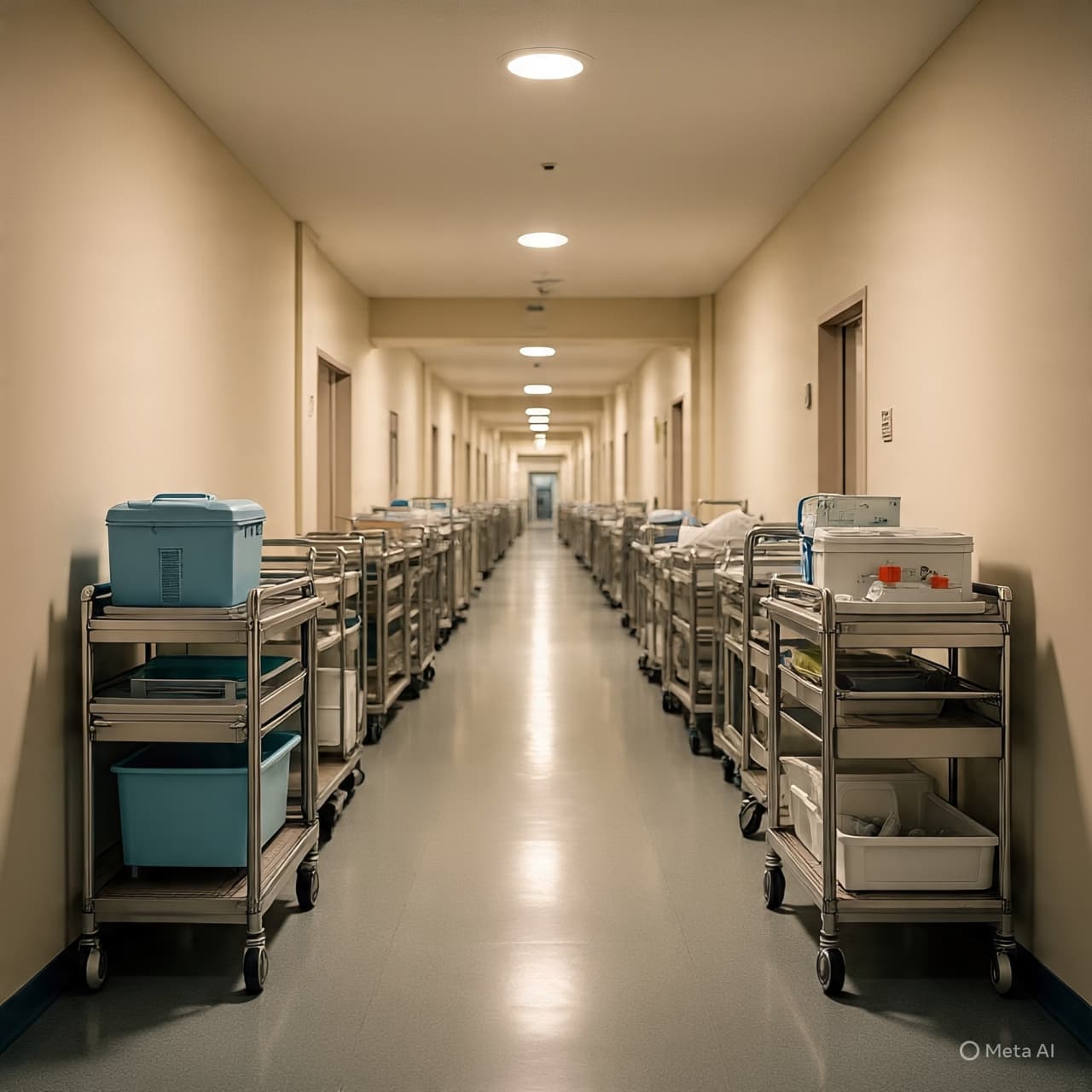
Hospitals are imagined as places of arrival — where pain is met with purpose, and uncertainty with care. Yet for some patients, the journey does not end at a ward door or bedside. It lingers instead in the spaces between, where footsteps echo and curtains sway, and where waiting becomes its own kind of endurance.
That was the experience described by a patient who spoke publicly about spending days receiving treatment in an NHS hospital corridor. His words were not sharpened by anger, but weighted with fatigue. “It makes you feel inhuman,” he said — not as an accusation, but as a quiet confession of what it feels like when care is delivered without a room to contain it.
Over several days, the patient moved between an ambulance, a waiting area, and a corridor lined with trolleys and passing staff. There was no fixed bed, no sense of arrival. Personal moments unfolded in public view, amid conversations, alarms, and the constant motion of a hospital stretched beyond its seams. Privacy, once assumed, became a fragile courtesy rather than a given.
The corridor itself was never meant to hold people still. Designed for movement, it became instead a holding place — a narrow margin where clinical necessity met human vulnerability. In such spaces, time behaves differently. Minutes blur into hours, and hours into days, while the body waits for both treatment and acknowledgment.
Healthcare staff continued their work around him, attentive yet constrained. Nurses and doctors, he noted, did what they could within the limits of space and staffing. The strain was visible not only in the overcrowding, but in the quiet apologies offered in passing — gestures that spoke of care delivered under pressure rather than indifference.
Professional bodies have warned that corridor care is becoming an increasingly common feature of an overstretched system. They describe environments that challenge patient dignity and staff morale alike, where the intention to care collides with the reality of limited beds and rising demand. These warnings are not abstract. They are lived, moment by moment, by patients whose illnesses unfold without walls.
For the patient at the center of this account, the experience coincided with a personal milestone, underscoring the dissonance between ordinary life and institutional strain. What should have been a marker of time became instead a reminder of suspension — of being present, yet not properly placed.
Hospital leaders acknowledge that care in corridors is not the standard they aspire to provide. They point to winter pressures, delayed discharges, and systemic backlogs that funnel patients into spaces never designed for treatment. These explanations describe a system under stress, but they do not soften the human experience of waiting without shelter.
The story resonates because it is not singular. It reflects a pattern repeated across hospitals, where corridors quietly absorb the overflow of demand. In these in-between spaces, patients are still monitored, still treated, still counted — yet often feel unseen in the ways that matter most.
As debates continue about funding, capacity, and reform, the corridor remains a telling symbol. It is where care persists despite constraint, and where dignity becomes something that must be actively protected rather than assumed.
For those who have waited there, the memory lingers not as a policy failure, but as a feeling — of being present in a place meant for healing, and still feeling unfinished, unplaced, and profoundly human.
AI Image Disclaimer “Graphics are AI-generated and intended for representation, not reality.”
Sources ITV News BBC News PA Media The Guardian Sky News
Published by Banx Network. This article is part of the Banx decentralized media programme, powered by the BXE token on the XRP Ledger.