In the rainforest, sound often arrives before sight.
As evening settles beneath the canopy, the forest begins to speak in layered voices—chirps, clicks, and rhythmic calls rising from leaves and branches. Some notes resemble the croak of frogs. Others are sharper, thinner, almost metallic. In such places it is not always clear who is calling, or from where.
For researchers working in the dense forests of Uganda, one such voice led to an unexpected discovery.
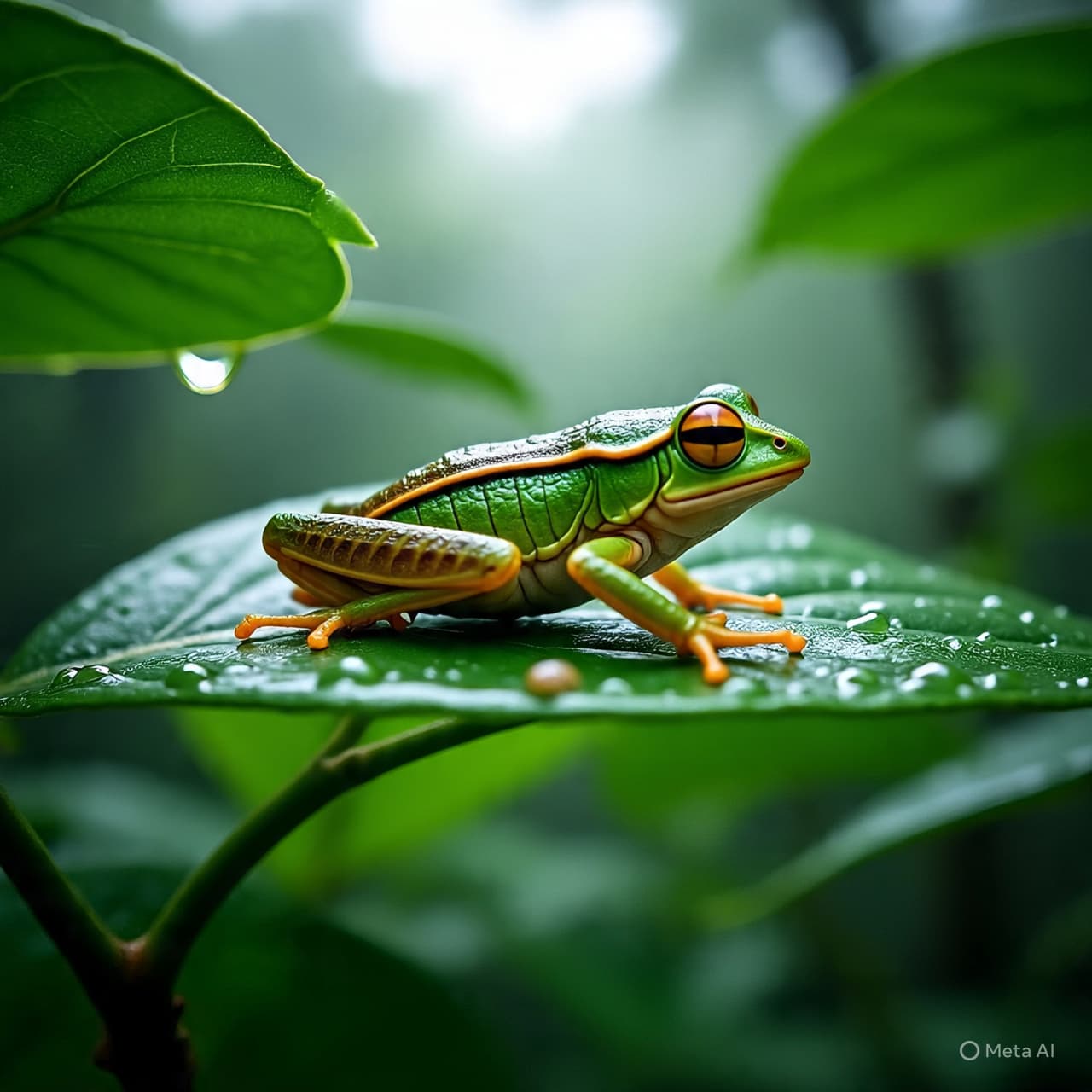
While studying insect life in the country’s rainforest ecosystems, scientists encountered a group of tiny creatures whose appearance and behavior seemed almost playful in their strangeness. They moved like insects but carried an outline that reminded observers of frogs—compact bodies, rounded shapes, and powerful hind legs built for jumping.
Closer examination revealed something more remarkable: these animals were not frogs at all but a previously unknown group of planthoppers, small sap-feeding insects belonging to a broader family of plant-dwelling species.
Researchers ultimately identified seven new species hidden among the forest vegetation.
The insects belong to a group known scientifically as Issidae, a lineage already known for unusual shapes and elaborate structures. Yet the newly described species stand out for their distinctive bodies and their surprising resemblance to tiny amphibians.
Seen from the side, their bodies curve upward in a way that recalls the arched back of a crouching frog. Their hind legs are strong relative to their size, allowing them to leap quickly from leaf to leaf when disturbed.
This resemblance may serve a purpose in the forest’s complex web of survival. Many insects evolve shapes that imitate other animals or natural objects, confusing predators that rely on quick visual recognition. Looking slightly like a frog—or even simply like an unfamiliar creature—might provide a moment of hesitation that helps these insects escape.
The discovery highlights how much of the rainforest’s biodiversity remains unseen.
Tropical forests are among the most biologically rich environments on Earth, yet their dense vegetation and immense diversity make them difficult to fully explore. Small insects, in particular, often remain overlooked because they blend easily into the foliage and are active at times when few observers are present.
Scientists studying Uganda’s forests say that many similar species likely remain undiscovered, quietly inhabiting leaves and stems throughout the region.
Each newly described species adds another thread to the tapestry of rainforest life. Though tiny, such insects play important roles in ecosystems, feeding on plants, serving as prey for birds and reptiles, and contributing to the intricate balance that allows forests to flourish.
For the researchers who encountered them, the frog-like insects offered a reminder of the forest’s capacity for surprise.
A small leap from a leaf, a strange silhouette in the shadows, and suddenly the familiar world of insects expands once again—revealing creatures that had lived unseen among the rain and leaves for centuries.
Scientists say the seven newly identified planthopper species from Uganda’s rainforest add to the growing catalog of tropical biodiversity, underscoring how many small organisms remain undocumented in Earth’s ecosystems.
AI Image Disclaimer
Illustrations were created using AI tools and are not real photographs.
Source Check
Credible coverage and/or reporting exist from: Live Science Mongabay Phys.org New Scientist National Geographic
Published by Banx Network. This article is part of the Banx decentralized media programme, powered by the BXE token on the XRP Ledger.