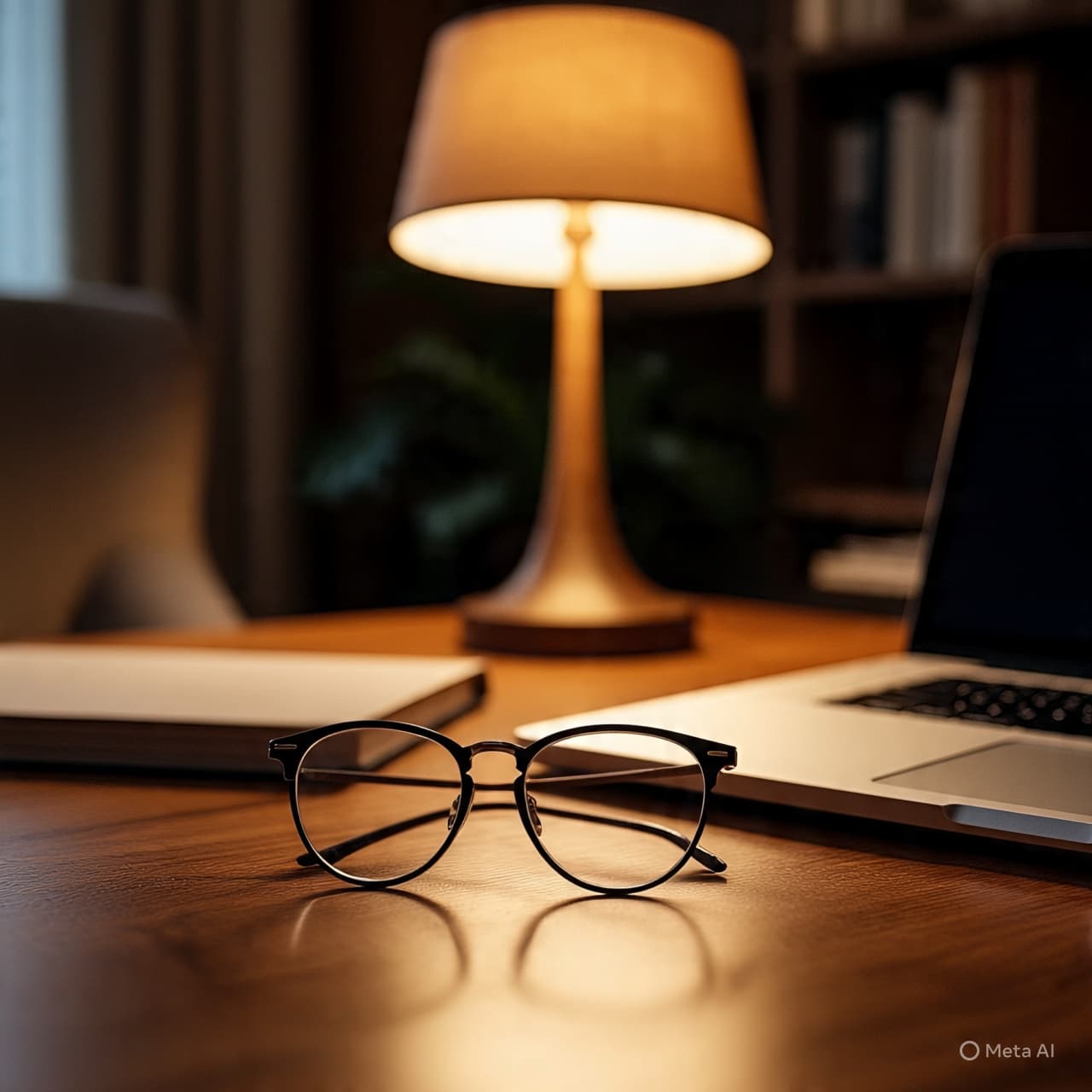
In the soft blue glow of evening, cities no longer fall into darkness — they hum. Screens flicker in bedrooms, on trains, in quiet corners of cafés. Light no longer comes only from the sun; it pulses from glass. And somewhere in that subtle shift, vision itself is changing.
At the turn of the millennium, about 23 percent of the global population was nearsighted. It was already a common condition, easily corrected, often overlooked. But projections now suggest that by 2050, nearly half of humanity may be living with myopia. The curve is not dramatic in a single year; it is gradual, almost polite — and yet unmistakably steep.
Researchers describe the trend as one of the fastest-growing health phenomena of the modern age. The reasons are layered. Genetics remains part of the picture, quietly passed from one generation to the next. But inheritance alone does not explain the acceleration. The world itself has altered the way eyes are used.
Children spend more hours indoors than their parents once did. Classrooms glow with digital boards; homework unfolds on tablets. Adults move between laptops and phones in an unbroken stream of text and image. Close-up work — reading, scrolling, typing — has become the default posture of modern life. The eye, designed to scan horizons and track distant motion, is increasingly asked to focus at arm’s length or less.
Lighting, too, has shifted. Bright outdoor exposure, long understood to play a protective role in eye development, competes with softer indoor illumination. The warm ambiance of dim lamps and backlit screens creates comfort but may not provide the intensity that developing eyes once relied upon. Researchers continue to examine how reduced time in natural daylight affects eye growth, especially in children.
The consequences extend beyond inconvenience. While mild myopia can often be corrected with glasses or contact lenses, higher degrees increase the risk of retinal detachment, glaucoma, and other complications later in life. Health systems in parts of East Asia, where rates of myopia among young people have already reached striking levels, offer a preview of what a more nearsighted world may look like.
And yet, this is not a story of alarm so much as adaptation. Public health experts emphasize prevention strategies that are simple in principle: more time outdoors for children, balanced screen habits, periodic visual breaks during prolonged near work. Some regions have introduced school-based eye health programs and awareness campaigns aimed at slowing progression in early years.
If current projections hold, by mid-century the human relationship with distance may feel different. Horizons will still exist — across oceans, above skylines — but many will view them through corrective lenses. The transformation is subtle, embedded in daily routines and the architecture of light. Vision, it seems, is not only biological. It reflects the era in which it is shaped.
As researchers continue to study the interplay between genetics, environment, and technology, the numbers remain clear: the world is becoming more nearsighted. And in that shift lies a quiet reminder that even our senses evolve alongside the lives we build.
Published by Banx Network. This article is part of the Banx decentralized media programme, powered by the BXE token on the XRP Ledger.

.jpg&w=3840&q=75 "Qantas Grounds Plane After Passengers Report Bedbug Bites")