At the narrow mouth of the Persian Gulf, where water compresses into a passage both vital and vulnerable, the horizon often appears deceptively calm. Tankers move slowly through the Strait of Hormuz, their paths traced against a landscape shaped as much by currents as by politics. Here, movement is constant, but meaning shifts with each passing day.
In recent days, that meaning has taken on a different tone. Following the launch of a U.S.-led blockade initiative associated with Donald Trump, Iranian officials and affiliated accounts have turned to social media with a response that blends commentary with provocation. Posts emerging from within Iran have sought to frame the blockade not only as a geopolitical maneuver, but as a moment to engage in a different kind of contest—one of narrative, symbolism, and public perception.
The exchanges, often brief and pointed, reflect a broader pattern in which digital platforms become extensions of statecraft. Messages circulate rapidly, crossing borders in seconds, where tone can carry as much weight as substance. In this space, humor, irony, and critique intertwine, creating a language that resonates differently than formal diplomatic statements.
The blockade itself, positioned as part of a wider effort to control maritime flows and exert pressure, has drawn attention for its potential implications on global trade and energy markets. The Strait of Hormuz, through which a significant portion of the world’s oil supply passes, remains one of the most sensitive transit points in the global economy. Any disruption, whether physical or perceived, carries consequences that ripple outward—into pricing, supply chains, and the calculations of governments far removed from the region.
Iran’s response, situated within this context, appears to serve multiple purposes. It signals resistance, shapes domestic and international narratives, and underscores the interplay between traditional geopolitical strategies and modern communication tools. While the tone may vary—from restrained to sharply rhetorical—the underlying message reflects a continued contest over influence and interpretation.
Observers note that such exchanges, though seemingly informal, contribute to the broader atmosphere surrounding the situation. They do not alter the immediate mechanics of the blockade, but they shape how it is understood and perceived. In an era where information moves as quickly as goods, perception itself becomes a form of currency.
Meanwhile, the waters of the Strait continue their steady flow. Ships pass through under heightened awareness, and monitoring efforts remain in place. The physical reality of the passage—its narrowness, its importance—remains unchanged, even as the narratives surrounding it evolve.
As the situation develops, both the blockade and the responses it has generated will likely continue to unfold across multiple arenas—maritime, political, and digital. Each contributes to a larger picture that resists simplicity, defined instead by layers of action and reaction.
For now, the facts stand in quiet contrast to the noise that surrounds them: a U.S.-linked blockade initiative has been launched, and Iran has responded not only through official channels but also through a stream of social media commentary. Between these gestures lies a space where meaning is negotiated, shaped by words as much as by movement.
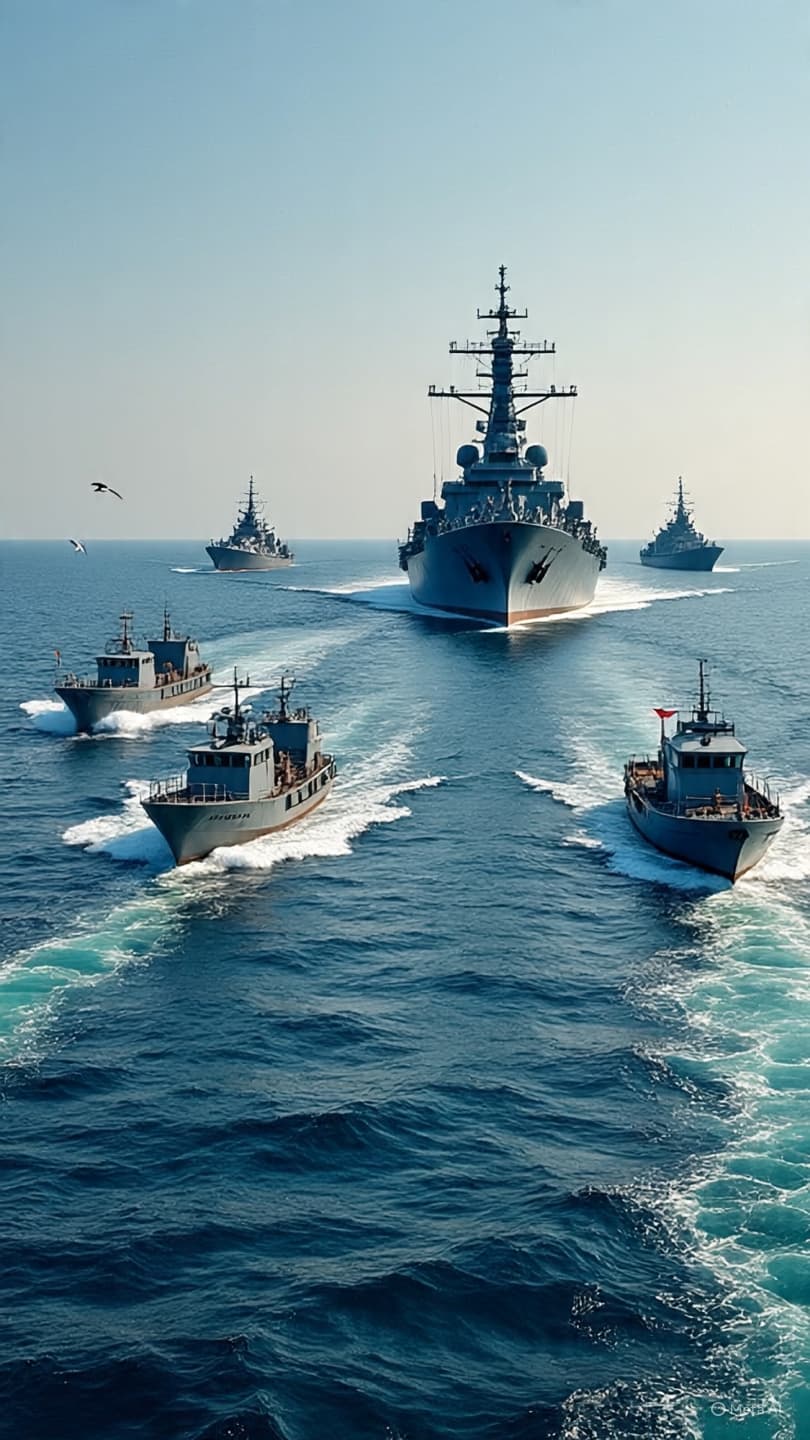
AI Image Disclaimer Visuals are AI-generated and serve as conceptual representations.
Sources Reuters Bloomberg BBC News Al Jazeera The Guardian
Published by Banx Network. This article is part of the Banx decentralized media programme, powered by the BXE token on the XRP Ledger.