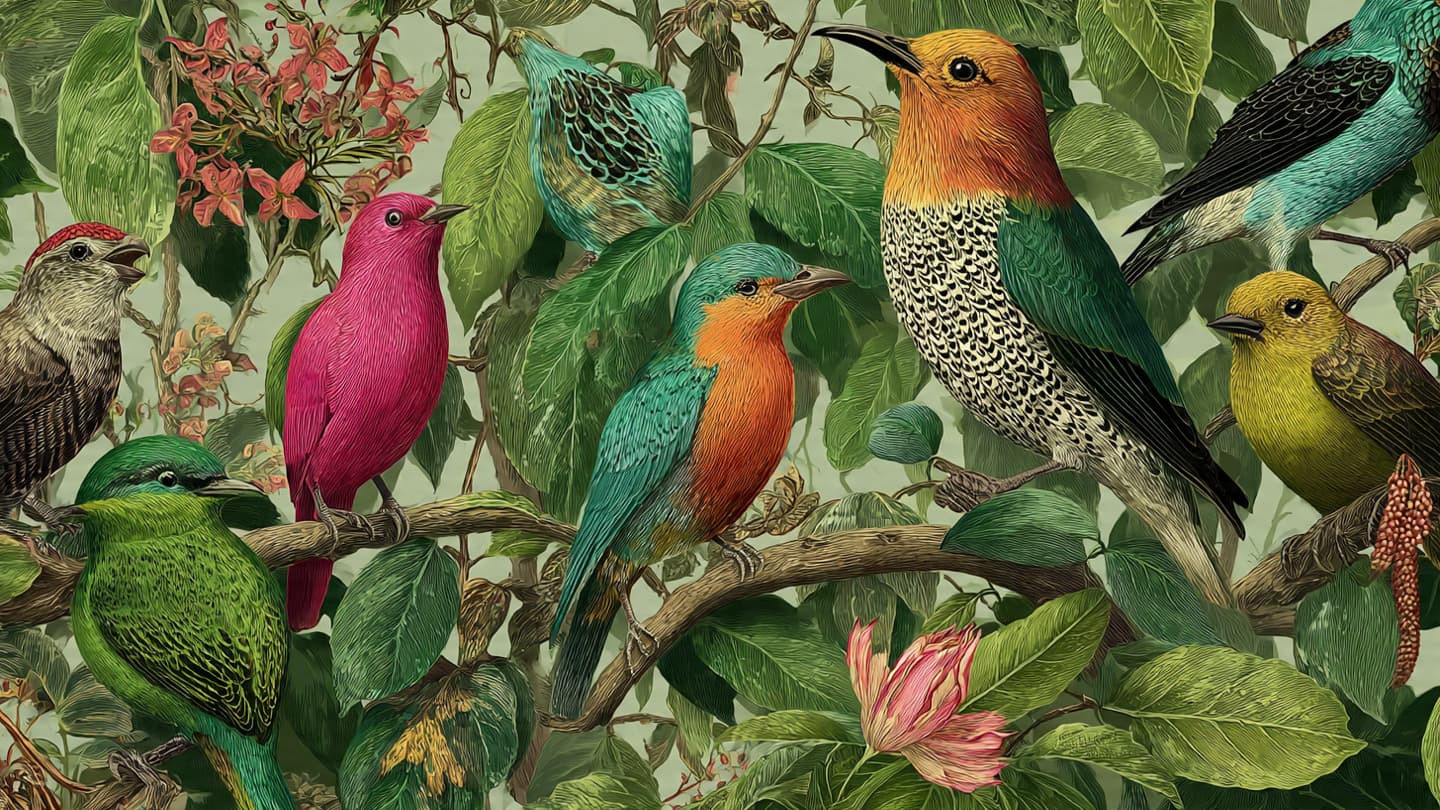
In the dense green quiet of Colombia’s forests, where light filters through leaves in shifting patterns and the air carries the layered calls of unseen wings, time often feels suspended. Here, sound becomes a map—each birdsong a small declaration of presence, each flutter a reminder that life continues in delicate, persistent ways. It is in this setting that an unlikely story has taken root, shaped not by conflict alone, but by what follows after it fades.
Years ago, a man moved through these same forests under very different circumstances, held captive by the guerrilla group known as FARC. His days were defined by uncertainty, his surroundings marked by watchfulness rather than wonder. Yet even then, the forest spoke in its own language—through birds that crossed overhead, through rhythms that existed beyond human struggle.
In the years since his release, that memory has taken on a different form. Rather than turning away from the place that once confined him, he returned to it with a quieter purpose. Drawing on a growing passion for birdwatching—often called birding—he began to share this practice with those who had once been his captors. The act, simple on its surface, carries a deeper resonance: a shift from survival to observation, from division to a shared attention directed outward.
Colombia’s long conflict, involving groups like the FARC, has left behind not only political agreements but human landscapes shaped by reintegration. Following the 2016 peace accord, former fighters have entered civilian life, navigating paths that are often uncertain and complex. Programs aimed at reintegration have explored various forms of livelihood and education, from agriculture to ecotourism. Within this broader effort, birding has emerged as an unexpected bridge.
The country itself is uniquely suited to such a transformation. Colombia is among the most biodiverse nations in the world, home to more bird species than any other country. Its forests, wetlands, and mountains create a vast mosaic of habitats, each sustaining its own chorus of life. For those learning to observe these environments, birding becomes more than a pastime—it becomes a way of seeing, a practice of patience and attention.
In this context, the former hostage’s initiative unfolds not as a grand gesture, but as a series of quiet encounters. Small groups move through forest trails, pausing to listen, to identify a call, to trace the arc of a bird’s flight through the canopy. The act requires stillness, a willingness to notice what might otherwise go unseen. It also invites a shared focus, one that gently redirects attention away from past roles and toward a common experience.
There is no suggestion that such efforts resolve the deeper complexities of conflict or memory. The past remains present, carried in ways that are not easily transformed. Yet within these moments, something shifts—subtle, provisional, but real. The forest, once a place of captivity, becomes a space of learning. The relationship between individuals, once defined by opposition, finds a different rhythm.
As Colombia continues to navigate the long process of reconciliation, stories like this move quietly at the edges of larger narratives. They do not replace policy or erase history, but they offer glimpses of how change can take shape in unexpected ways.
In clear terms, a former hostage of Colombia’s FARC rebels has chosen to teach birdwatching to ex-combatants, reflecting broader efforts to support reintegration after the country’s peace agreement. The initiative highlights how shared activities, grounded in the natural environment, can create new forms of connection in the aftermath of conflict.
AI Image Disclaimer These visuals are AI-generated and meant for illustrative purposes only.
Sources Reuters Associated Press BBC News The Guardian National Geographic
Published by Banx Network. This article is part of the Banx decentralized media programme, powered by the BXE token on the XRP Ledger.