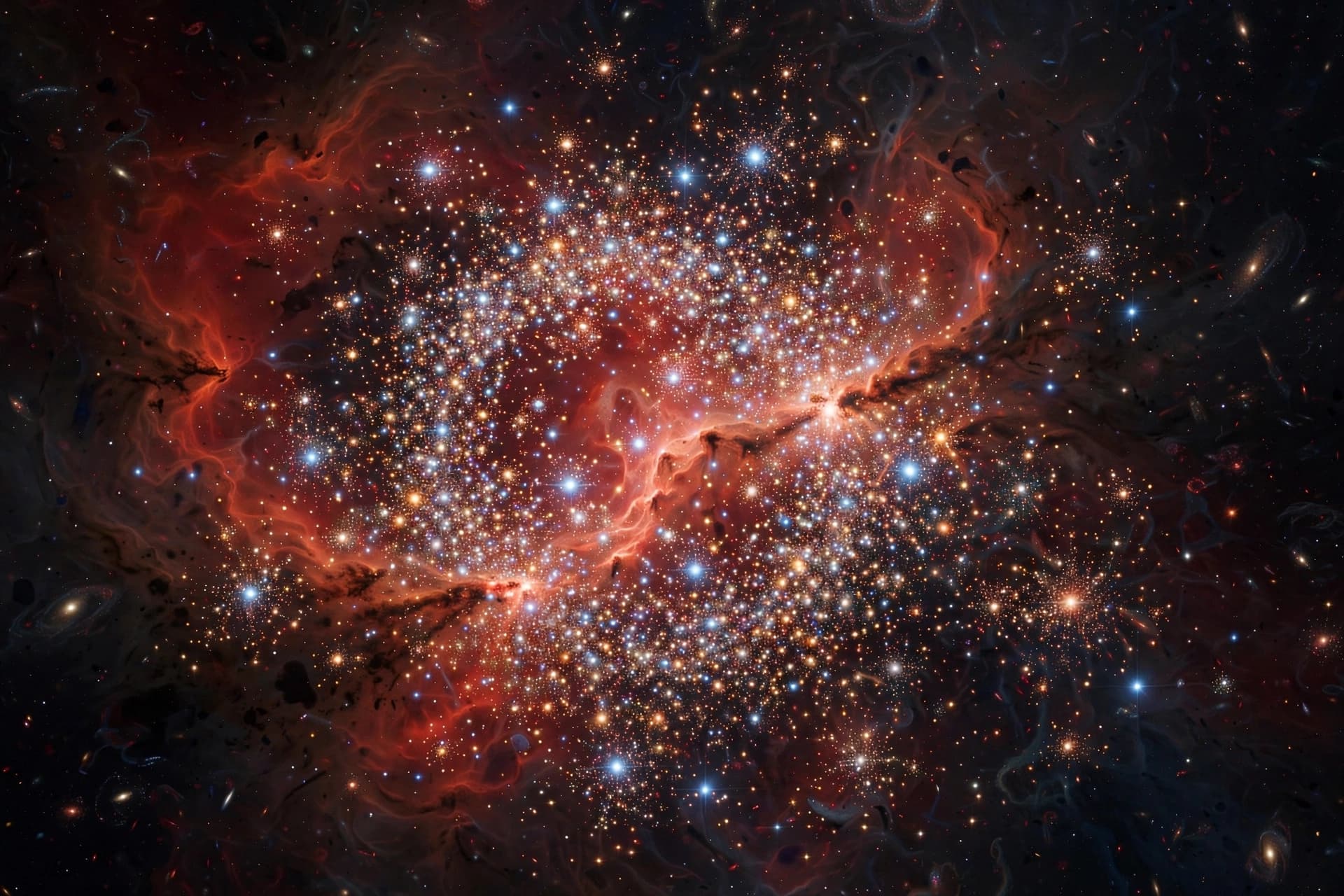
The James Webb Space Telescope has a habit of finding things it was not designed to find. Among its most puzzling discoveries are the Little Red Dots—compact, reddish objects scattered through the early universe, their light carrying signatures that do not fit neatly into any existing category. Astronomers have debated their nature with the fervor of people describing an elephant in a dark room, each touching a different part and arriving at a different conclusion .
A new study led by UCLA astrophysicists suggests the answer may lie in collisions—not the catastrophic kind that destroys stars, but the gentler sort that merges them. In the dense stellar clusters of the early universe, the researchers propose, stars could have collided repeatedly, growing into single objects of extraordinary mass, some of them eventually collapsing into black holes .
The simulations model conditions hundreds of millions to a billion years after the Big Bang, when the universe was far denser than it is today. In these environments, stellar systems were extremely compact, and collisions were frequent. Some impacts occurred at high speeds and destroyed the stars. Others happened more slowly, allowing the stars to merge and grow .
What emerges from the models is a scenario in which a single star can accumulate mass equal to an entire cluster—tens of thousands of times the mass of our Sun, or more. "When a star this huge reaches the end of its life, models suggest that it may have no option but to collapse into itself and form a massive black hole," said Claire Williams, the study's lead author .
This is where the Little Red Dots come in. These objects are believed to contain rapidly growing black holes at their centers, but their light has been difficult to explain. The UCLA team proposes that LRDs may be dense star clusters in the process of forming a very massive star, which will eventually become a black hole. The same environment that forms the black hole also provides the stars and gas that influence its growth .
The research does not claim to solve the LRD mystery definitively. The simulations have limitations, from the treatment of gas to the modeling of collisions themselves. But they offer a framework that connects several observations at once—the compactness of the objects, their reddish hue, the apparent presence of massive black holes, and the timing of their existence in the early universe .
Smadar Naoz, a co-author, offered a metaphor that captures the state of the field. Studies of LRDs, she said, resemble "the tale of blind people who are trying to describe an elephant by touching it, and each person describes it differently based on what part they're touching" . The new work, she suggested, may help researchers see more of the animal.
The findings were published in the Astrophysical Journal. They will not be the last word on Little Red Dots. But they offer a path—one that begins with the simple, violent, generative act of stars finding each other in the dark.
The images in this article are AI-generated illustrations and are not actual astronomical photographs.
Sources: UCLA Newsroom, IFLScience, The Astrophysical Journal, Repositorio Académico Universidad de Chile
Published by Banx Network. This article is part of the Banx decentralized media programme, powered by the BXE token on the XRP Ledger.