In the quiet stillness of the desert, sand and stone have long kept their secrets — until now. In a narrow tomb at the ancient necropolis of Tanis in Egypt’s Nile Delta, archaeologists recently unearthed a trove of funerary figurines that have shattered centuries of uncertainty. What lay silent for millennia at last spoke — and through its voice, the tomb revealed its long-lost occupant.
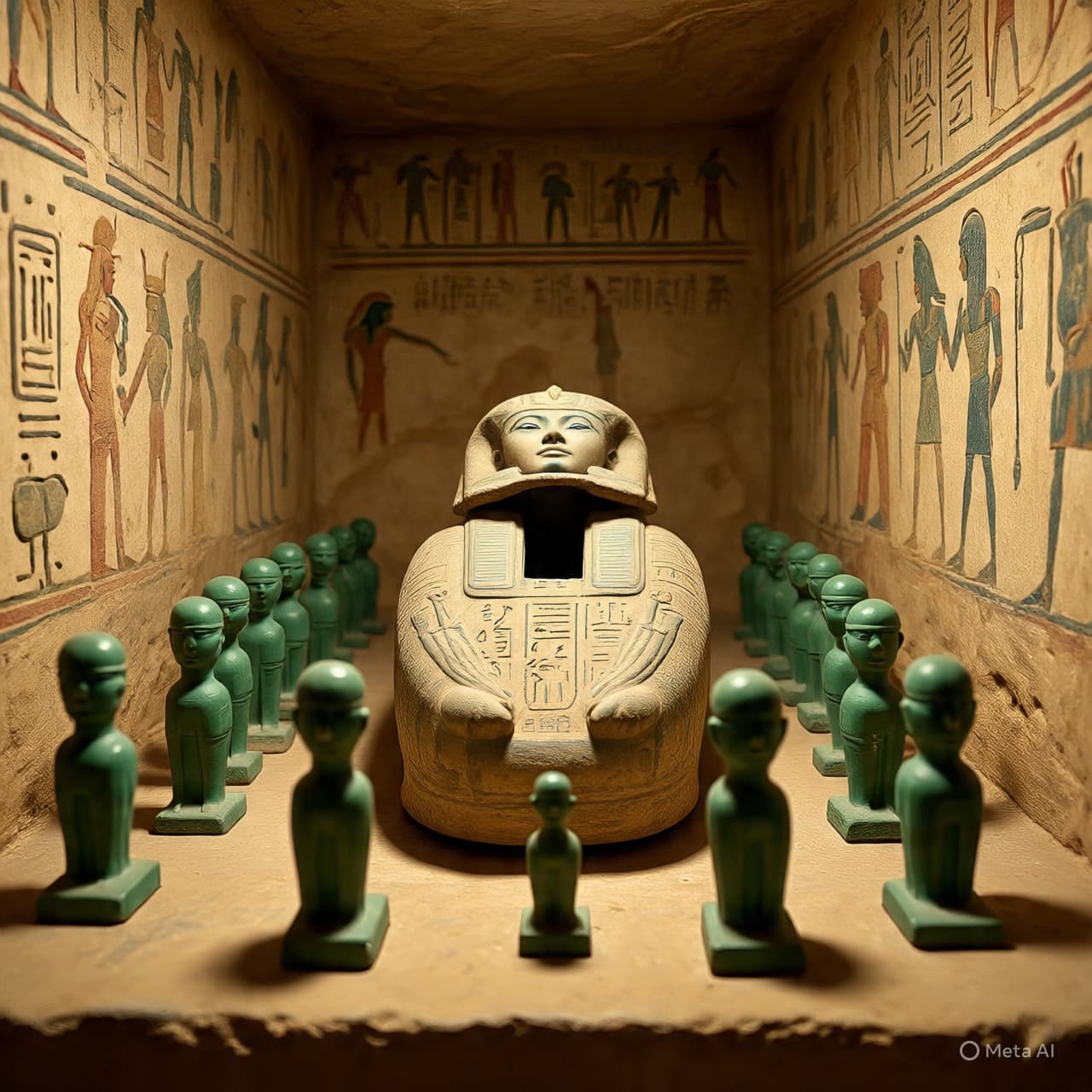
Early on a morning in October, the excavation team working under the leadership of French archaeologist Frédéric Payraudeau discovered three or four small statuettes clustered together. That simple sight — unassuming, almost humble — triggered a sense of astonishment. As more figurines emerged, arranged in star-like patterns around a trapezoidal pit and layered at the bottom, it dawned on the team that they were witnessing something extraordinary. Over ten days, a total of 225 funerary figurines — called “ushabti” — were carefully extracted.
These little statuettes, meant to accompany the dead into the afterlife, are rarely found undisturbed: looting and time have robbed nearly every ancient tomb of its treasures. According to Payraudeau, “finding figurines in place inside a royal tomb has not happened in the Tanis necropolis since 1946.” Their preservation — more than two centuries after the last similar find — instantly raised hopes that the tomb’s identity could be clarified.
The breakthrough came when scholars inspected the royal insignia on the ushabti: the cartouche belonged not to the original tomb’s ostensible owner, but to Shoshenq III, a pharaoh who reigned between 830 and 791 BC. That discovery resolved a decades-long mystery: the unmarked sarcophagus in the tomb — long assumed to belong to one ruler — now has a name.
Yet the finding is more than a single revelation. It challenges assumptions about royal burials in the 22nd Dynasty: why had Shoshenq III not been laid to rest in a tomb bearing his name? Why instead was he entombed in a seemingly unrelated mausoleum, its walls silent until now? As Payraudeau reflected: a pharaoh’s tomb was never a guarantee — even the greatest plans could be overturned by the shifting sands of history.
In the end, the 225 ushabti statues — small, anonymous in the dust, but monumental in meaning — became the voice for the voiceless tomb. Through them, the identity of the dead was restored; through them, a puzzle solved; and through them, a once-forgotten king returned to the annals of memory.
Now, as the figurines are studied and preserved for display in an Egyptian museum, the tomb at Tanis stands as a testament to resilience — of clay and stone, of memory across millennia, and of human perseverance to uncover truth beneath silence.
AI Image Disclaimer: Visuals are created with AI tools and intended for conceptual illustration only, not real photographs.
Sources: CBS News, France24, eNCA, major international media
Published by Banx Network. This article is part of the Banx decentralized media programme, powered by the BXE token on the XRP Ledger.