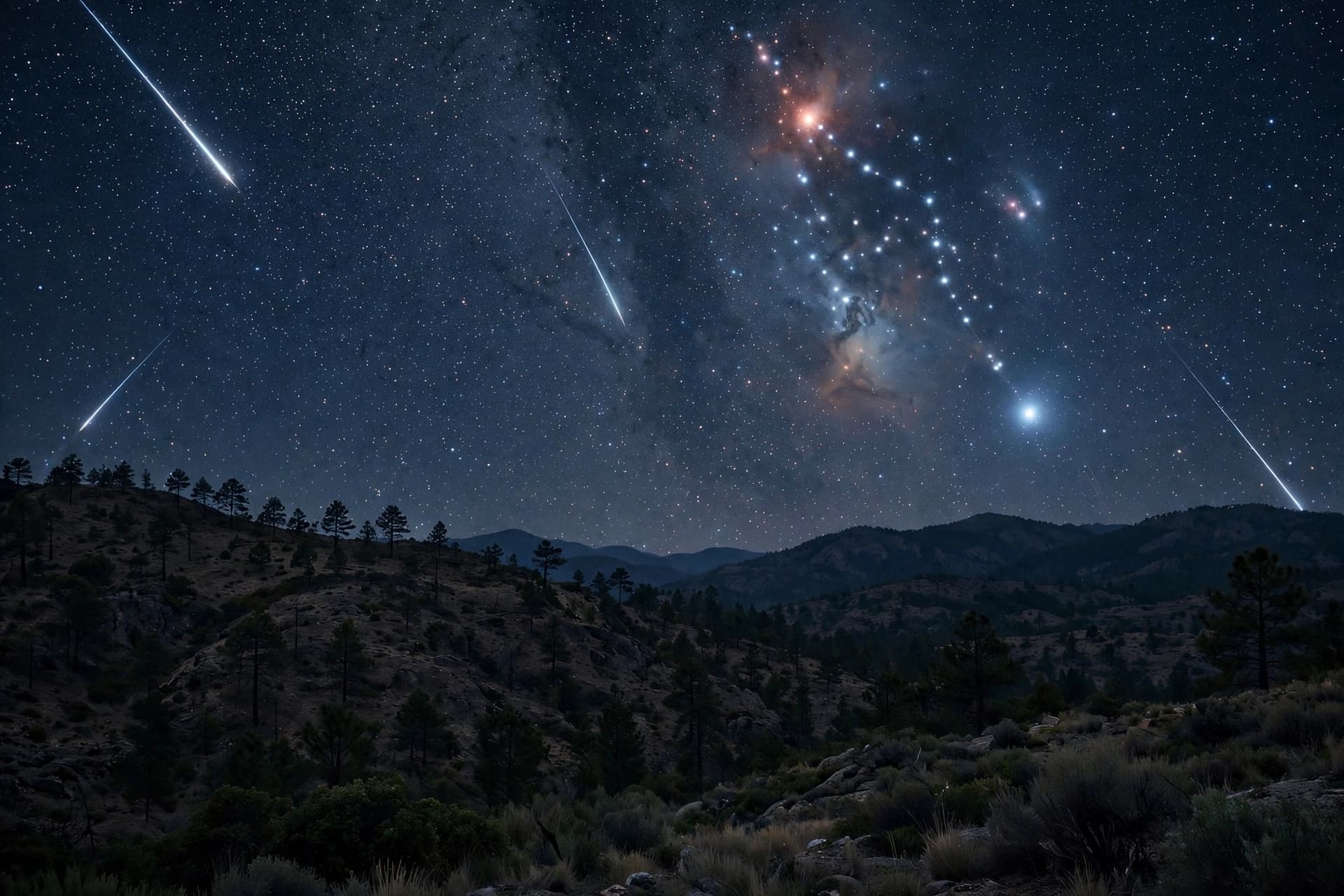
On a clear night far from city lights, the sky can still feel immense — a vaulted dark scattered with distant suns, untroubled and unclaimed. For most of human history, that canopy suggested infinity. Nothing we built could touch it. Nothing we launched could linger there for long.
But in recent years, faint lines have begun to cross the constellations. They move steadily, not like meteors that flare and vanish, but like deliberate travelers following invisible tracks. Low Earth orbit, once the quiet province of a few government missions, has grown busy.
At the center of this expansion stands SpaceX, whose Starlink constellation has placed thousands of small satellites into orbit to deliver global broadband coverage. The scale is unprecedented. Where once dozens or a few hundred satellites circled the planet, there are now many thousands — and plans for tens of thousands more from multiple operators.
The transformation is not singular. Companies and governments around the world are pursuing their own constellations, seeking communications networks, Earth observation capabilities, and strategic advantages. Low Earth orbit — typically defined as altitudes below 2,000 kilometers — has become a shared frontier of commerce, research, and connectivity.
Yet with growth comes density. Astronomers have raised concerns about the increasing number of satellites streaking across telescope images, leaving bright trails that complicate observations of distant galaxies and faint cosmic signals. Even with mitigation efforts — such as darkened satellite coatings and adjusted orientations — the cumulative presence alters the visual and scientific character of the night sky.
There is also the quieter matter of debris. Every object in orbit travels at extraordinary speed, roughly 28,000 kilometers per hour in low Earth orbit. Even a small fragment can cause catastrophic damage in a collision. The risk of cascading debris — sometimes referred to as the Kessler syndrome — has long been discussed in aerospace circles. As satellite numbers climb, so too does the complexity of tracking and avoiding potential collisions.
Space agencies and private firms now conduct routine maneuvers to prevent close approaches. Automated systems calculate conjunction probabilities and adjust trajectories accordingly. International guidelines call for satellites to deorbit within a set number of years after mission completion, allowing them to burn up in Earth’s atmosphere rather than linger as hazards.
Still, the pace of launches has accelerated. Reusable rockets, many developed and operated by SpaceX, have lowered costs and increased frequency. What was once rare has become routine. A single rocket can deploy dozens of satellites at once, dispersing them into orbital shells that gradually fill.
The conversation unfolding is not one of simple opposition but of balance. Satellite networks provide internet access to remote regions, support disaster response, enable navigation, and facilitate scientific monitoring of climate and land use. At the same time, the shared environment of near-Earth space demands coordination and restraint.
Regulators in the United States and abroad review launch approvals and spectrum allocations. Astronomical organizations collaborate with satellite operators to reduce brightness impacts. Engineers explore improved tracking systems and debris mitigation strategies. The question is not whether space will be used, but how densely — and under what safeguards.
Recent reports from major news outlets and aerospace analysts note the rapid increase in active satellites and the corresponding rise in collision-avoidance maneuvers. According to publicly available tracking data, the majority of operational satellites in low Earth orbit now belong to Starlink, underscoring the scale of one company’s presence in a domain once dominated by national space agencies.
The sky remains vast. Yet the region just above our atmosphere is no longer empty in the way it once was. It has become a working layer — a lattice of signals and machinery encircling the planet.
For observers on the ground, the stars still shine. But between them, faint points move with steady intention, reminders that even the space above Earth has entered an era of accumulation. As launches continue and constellations expand, policymakers, engineers, and scientists face a shared task: ensuring that this new traffic does not outpace the rules designed to keep it safe.
Visual representations are AI-generated and intended for illustrative purposes only.
Sources (Media Names Only)
Reuters BBC The New York Times SpaceNews Nature
Published by Banx Network. This article is part of the Banx decentralized media programme, powered by the BXE token on the XRP Ledger.