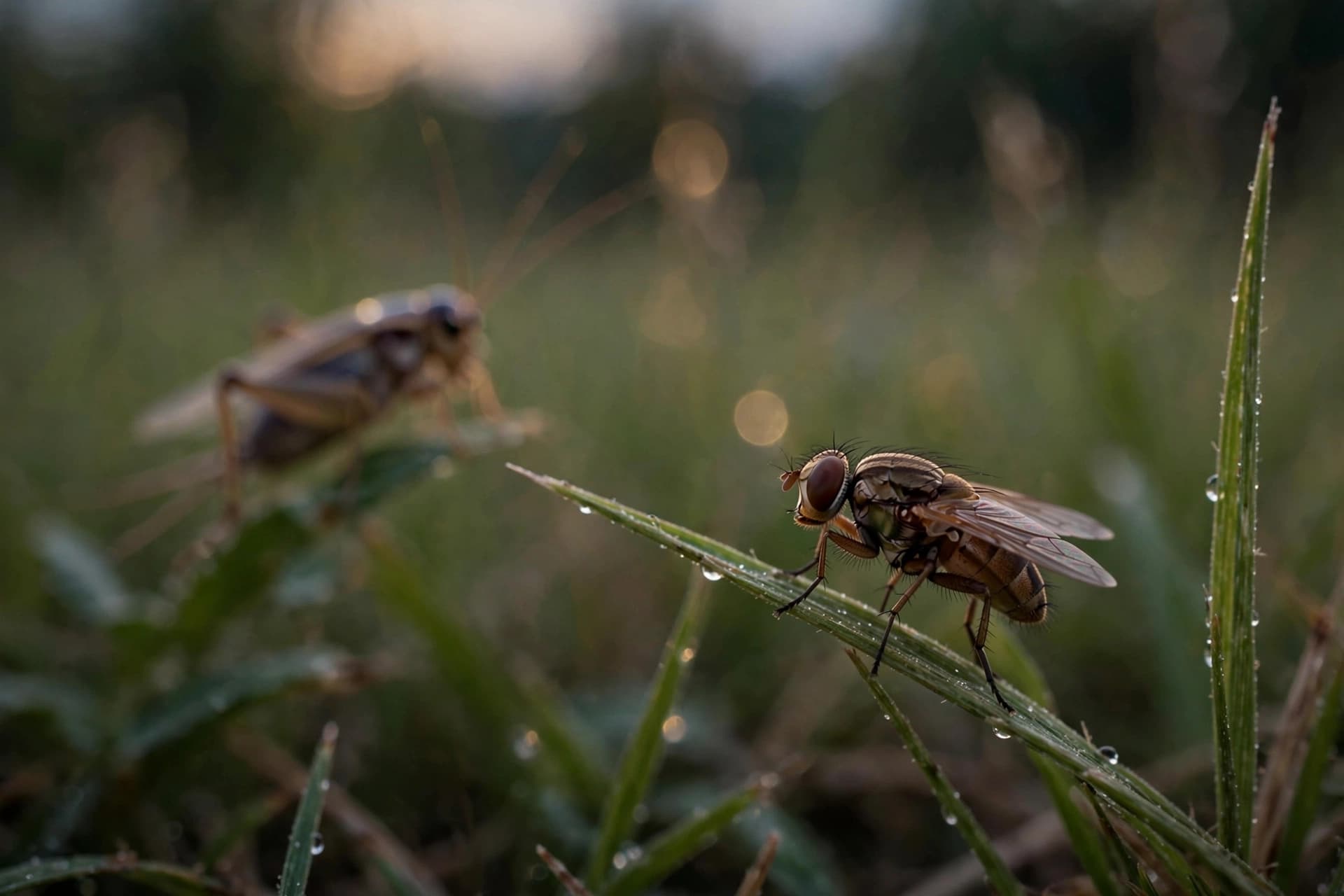
There is a particular kind of listening that happens in the dark—not the passive reception of sound, but the active, focused attention of a creature that must find its host or die trying. For the parasitic fly Ormia ochracea, that listening is the difference between reproduction and failure, and the song it seeks is not merely a rhythm but a signature.
The female Ormia ochracea fly must locate a singing male cricket to deposit her parasitic larvae. She does this by eavesdropping on the cricket's calling song, a behavior that has evolved into a remarkable feat of acoustic detection . But new research suggests the fly is not simply responding to the beat of the song—it is listening to a more complex set of cues, including the frequency and quality of the sound.
The fly's hearing organ is a marvel of convergent evolution. It resembles a cricket's ear more than a typical fly's ear, allowing it to exploit the same acoustic niche as its host . In darkness, the fly can locate a sound source with surprising accuracy, landing within about 8 centimeters of a loudspeaker after a flight of roughly 4 meters . This is not a simple reflex. It is navigation.
But the relationship between fly and cricket is not static. In Hawaii, where Ormia was introduced in the 1990s, the interaction has become an evolutionary arms race playing out in real time. The Pacific field cricket, Teleogryllus oceanicus, has responded to the fly's predation pressure by evolving a mutation that eliminates the calling song entirely in some populations—males on Kauai have fallen silent, their reproductive sounds gone from the evening soundscape . In other populations, crickets have modified their songs, shifting the frequency upward to escape the fly's detection range.
The flies, in turn, are shifting with them. Research has shown that Hawaiian Ormia populations have altered their auditory tuning, broadening their hearing to higher frequencies to match the modified songs of their hosts. The fly's hearing is changing "in step" with the cricket's capacity to alter its call . This is coevolution in action—not a slow process measured in geological time, but a rapid, observable struggle unfolding over mere decades.
Not all populations of the fly are equally specialized. A study examining flies that parasitize multiple cricket species found that their song preferences are less rigid than those of flies that target a single host. The strength of their preference varies with the number of host species available, suggesting that behavioral specialization is flexible rather than fixed .
For the fly, the cricket's song is not just a beacon. It is a moving target—one that changes with temperature, with evolution, with the shifting pressures of survival. To find a host, the fly must listen not only to the beat but to the whole song, and to the silence that sometimes follows.
AI Image Disclaimer: All visuals in this article are AI-generated and are for illustrative purposes only.
Sources: Journal of Experimental Biology, ScienceDirect, Current Biology, Behavioral Ecology
Published by Banx Network. This article is part of the Banx decentralized media programme, powered by the BXE token on the XRP Ledger.