Far from Earth, beyond the reach of oceans and clouds, the universe sometimes pauses to display a quiet kind of beauty. It is not the brightness of a new star being born, nor the violent drama of a cosmic explosion. Instead, it is the gentle, luminous farewell of a star nearing the end of its life.
In a newly highlighted image released as a Space Photo of the Day for March 10, 2026, astronomers turn their attention to the Cat’s Eye Nebula, a remarkable celestial structure where a dying star is slowly shedding its final layers into the surrounding darkness.
Located roughly 4,400 light-years from Earth in the constellation Draco, the Cat’s Eye Nebula—also known as NGC 6543—has long fascinated astronomers with its intricate shape and glowing rings of gas. Observations from the Hubble Space Telescope combined with data from the Euclid space telescope have revealed new details about the structure and the complex story unfolding at its center.
The image shows what appears almost like a cosmic sculpture: swirling shells of blue and white gas expanding outward from a bright central star. These layers are not random. Each ring represents a moment in the star’s long, slow transformation as it approaches the end of its evolutionary journey.
Despite the name, a planetary nebula like the Cat’s Eye has nothing to do with planets. The term dates back centuries, when early telescopes showed these objects as small round shapes that resembled the disks of distant planets. Today astronomers understand them very differently. They are the glowing remnants of stars similar in mass to our Sun as they exhaust the fuel that once powered nuclear fusion in their cores.
As a star ages and begins to run out of hydrogen, the delicate balance between gravity and outward pressure slowly changes. Without enough energy from fusion reactions, the star can no longer maintain its stable form. Its outer layers begin to expand and drift away into space.
What follows is both delicate and dramatic. Gas expelled from the star becomes illuminated by intense radiation from the shrinking stellar core, causing it to glow in vivid colors. The result is a planetary nebula—a luminous cloud marking the final visible stage of a star like our Sun.
In the Cat’s Eye Nebula, this process appears unusually intricate. Observations reveal concentric shells, jets of high-speed gas, and dense knots of material, forming patterns that resemble ripples frozen in space. Scientists believe these structures record repeated episodes in which the star expelled layers of gas during its final stages.
Seen together, these layers create something like a cosmic archive. Each ring and filament reflects a chapter in the star’s fading life, revealing how stellar winds and explosive bursts of material shaped the nebula over time.
The collaboration between the Hubble and Euclid telescopes allows astronomers to view the nebula from two complementary perspectives. Hubble provides a detailed close-up of the central structure, while Euclid captures a much wider view that includes the surrounding halo of gas stretching outward into space.
Beyond the nebula itself, Euclid’s broader view also reveals countless distant galaxies scattered across the background, quietly reminding viewers how small even a spectacular nebula can appear within the vast scale of the universe.
The Cat’s Eye Nebula has been studied for decades, yet it continues to reveal new details as telescopes grow more powerful and imaging techniques become more sophisticated. Each new observation adds clarity to a phenomenon that astronomers believe may eventually represent the distant future of our own Sun.
In roughly five billion years, the Sun is expected to expand and eventually shed its outer layers in a similar process, forming its own planetary nebula before leaving behind a dense stellar core known as a white dwarf.
For now, however, the Cat’s Eye Nebula serves as both a scientific puzzle and a visual reminder of how stars live and fade across cosmic timescales.
The image released this week does not capture a sudden moment of destruction. Instead, it shows a gradual transformation unfolding over thousands of years.
In the vast rhythm of the universe, even the end of a star can become something quietly luminous—an elegant trace of energy and matter returning to the wider cosmos.
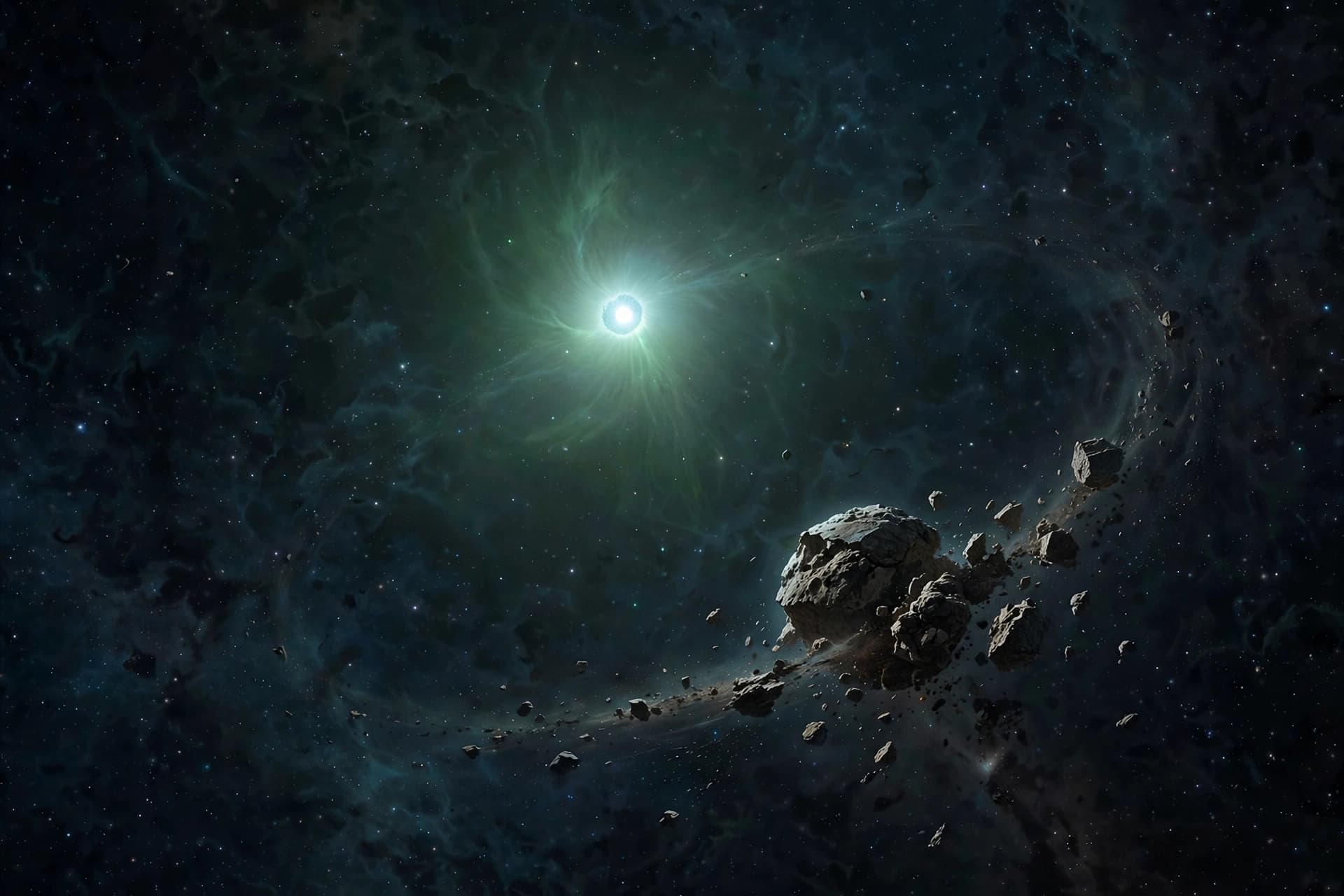
AI Image Disclaimer Illustrations were produced with AI and serve as conceptual depictions rather than real photographs.
Sources Space.com Phys.org Universe Today ESA/Hubble PetaPixel
Published by Banx Network. This article is part of the Banx decentralized media programme, powered by the BXE token on the XRP Ledger.