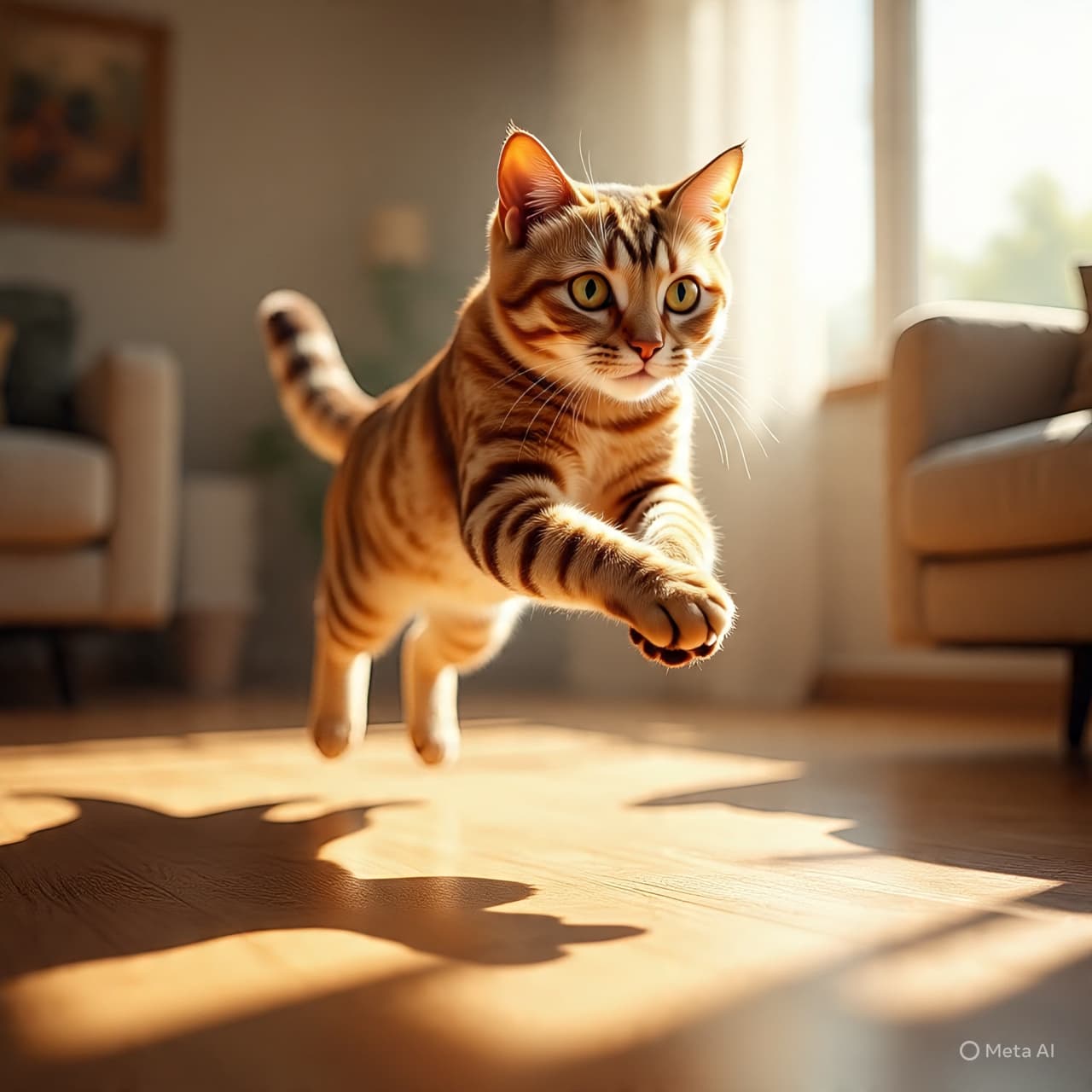
There is a quiet mystery in the way a cat pauses before it leaps. Its pupils widen, its whiskers tremble, and in that suspended second the world seems to slow. Or perhaps, for the cat, it does not slow at all. Perhaps it flows at a rhythm faster than our own — a subtle acceleration of perception that allows the feline mind to read motion where we might see only blur.
Scientists have long known that animals experience time differently. Research in visual neuroscience suggests that cats process visual information more rapidly than humans, perceiving more “frames” per second in the continuous film of reality. Where the human eye blends motion into a seamless stream, a cat’s visual system refreshes more quickly, detecting flickers and subtle movements that would escape our notice. This heightened temporal resolution once meant survival: the ability to track prey at dusk, to respond instantly to threat, to interpret the faintest twitch in tall grass.
At the heart of this phenomenon lies what researchers call critical flicker fusion frequency — the speed at which a flickering light appears steady. In humans, this threshold is lower than in many smaller animals, including cats. For them, the world contains more distinct visual moments per second. A television screen that looks fluid to us may appear faintly stuttering to a cat. A hummingbird’s darting path, invisible in its detail to human perception, may unfold more clearly within feline awareness.
This difference is not merely a curiosity of biology. It reveals something profound about intelligence itself. Perception shapes cognition. The faster an organism can process visual change, the more precisely it can respond. Reaction time, motion prediction, spatial judgment — all are influenced by the tempo of sensory input. In evolutionary terms, time quite literally equals life.
And here, gently, science turns its gaze toward technology. Engineers in artificial intelligence are increasingly inspired by biological systems, not only in structure but in rhythm. Modern computer vision systems, particularly those used in robotics and autonomous vehicles, rely on high-frame-rate sensors and event-based cameras designed to detect changes in light with exceptional speed. These so-called neuromorphic sensors attempt to mimic the efficiency of animal vision, processing information only when change occurs rather than capturing redundant frames.
The cat’s visual system offers a living example of optimized perception. Instead of flooding the brain with every possible detail, it prioritizes motion and contrast. Artificial intelligence researchers see in this an elegant lesson: intelligence may not require seeing more, but seeing more efficiently. By modeling AI systems after the temporal sensitivity of animals like cats, scientists hope to create machines that react more fluidly in dynamic environments — drones navigating crowded skies, vehicles interpreting sudden hazards, robotic assistants moving safely among people.
Yet there is humility in this comparison. The feline eye evolved over millions of years, shaped by ecology and instinct. AI, by contrast, is still learning how to see. The quest is not to replicate nature perfectly, but to understand the principles beneath it — how perception and action are woven together in time.
If a cat experiences the world in finer slices of the present, perhaps it reminds us that intelligence is not only about depth of thought but about the cadence of awareness. The future of artificial intelligence may depend not just on bigger datasets or faster processors, but on learning how to perceive as nature does: selectively, swiftly, and with purpose.
In the quiet arc of a cat’s leap, there is both biology and blueprint — a small, graceful hint at how machines might one day learn to see.
AI Image Disclaimer (Rotated Version) Visuals are created with AI tools and are not real photographs.
---
Sources: BBC News The Guardian ScienceDaily Nature New Scientist
Published by Banx Network. This article is part of the Banx decentralized media programme, powered by the BXE token on the XRP Ledger.