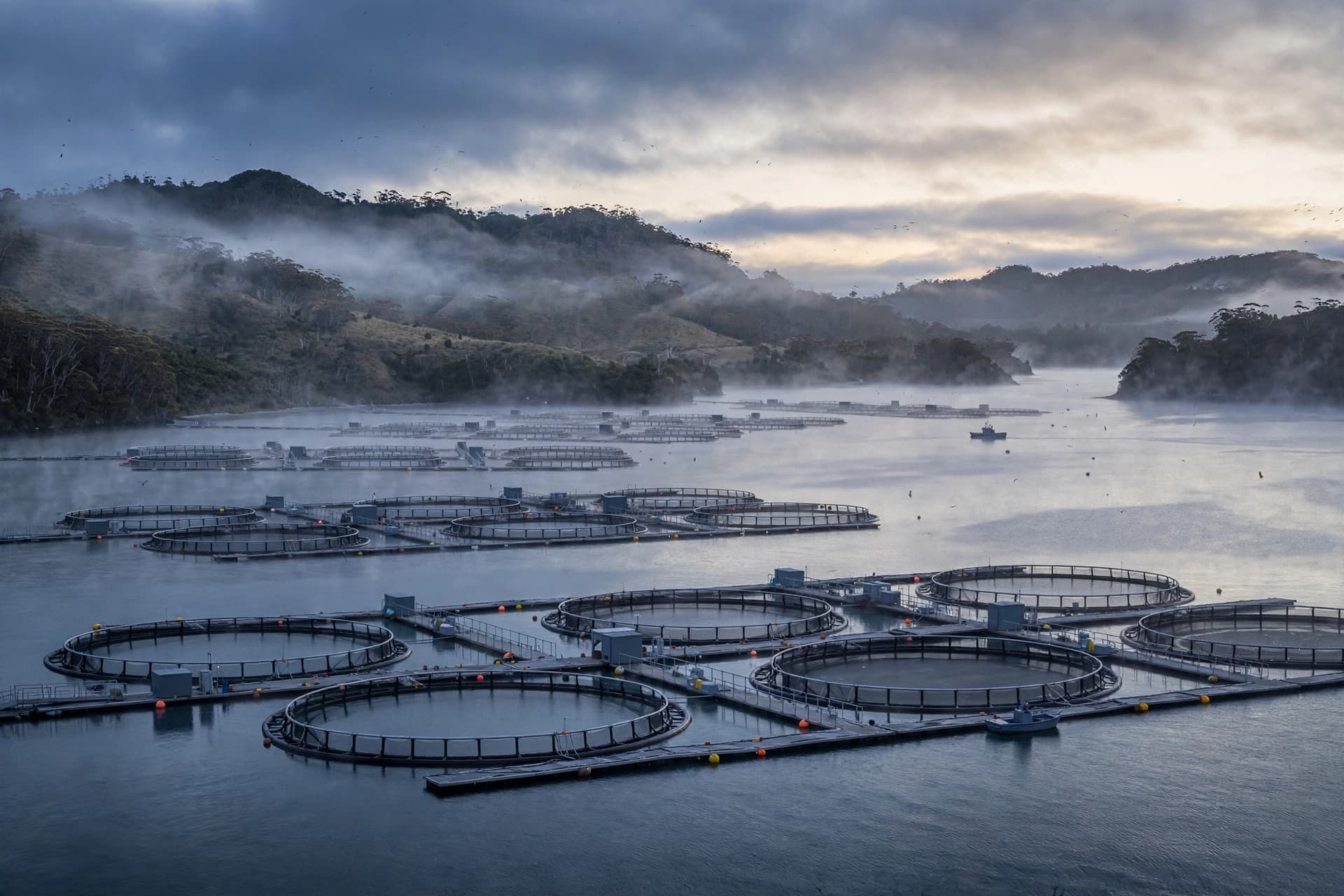
There is something deeply unsettling about the intersection of industrial food production and the natural world—the moment when the sea itself becomes a factory floor, and the creatures within it become units to be medicated, monitored, and managed. This week, in the cold waters off Tasmania's coast, that moment arrived with a syringe.
Tassal, the Canadian-owned seafood giant that dominates Tasmania's salmon farming industry, will begin individually injecting salmon in its pens with the antibiotic oxytetracycline (OTC) after detecting an early outbreak of the bacterial disease Piscirickettsia salmonis . The company says it will anaesthetise each fish, inject it, monitor its recovery, and return it to the water .
The announcement marks a significant shift. While OTC has been used by the industry before, this is the first time it will be injected directly into fish at sea—a practice Tassal describes as a "new practice for the state" . About 10 kilograms of OTC will be used in the first pen, with fish individually treated in what the company says is a more targeted approach than medicated feed .
The context for this decision is a painful recent history. Last summer, a bacterial outbreak killed more than 9,000 tonnes of farmed salmon in Tasmania . The industry responded with florfenicol, an antibiotic dispersed through fish feed, but the Australian Pesticides and Veterinary Medicines Authority (APVMA) revoked the permit in March after residues were detected in wild species, including rock lobster and abalone, up to 14 kilometres from treated pens .
Tassal is now waiting for approval to use florfenicol again. A company spokesperson said the antibiotic in feed remains "the most effective option," and that OTC is being used "where required" while they await a permit . Salmon Tasmania chief executive John Whittington said the industry is bracing for another marine heatwave this summer and is doing "everything we can" to maintain animal welfare .
But the reliance on antibiotics has drawn sharp criticism. Greens MP Vica Bayley said the approach is not sustainable: "To simply be treating diseased fish with antibiotics isn't a solution for the environment, [and] it's not really a solution for consumers" . Wild fisheries representatives have expressed concern about the impact on their industries, and the Tasmanian government has said it expects the salmon industry to work constructively with the wild catch sector on questions of compensation if antibiotic use leads to fishery closures .
The deeper question is not whether Tassal can manage this outbreak, but whether the model itself is sustainable. As waters warm and disease pressures mount, the industry finds itself caught between the welfare of its fish and the health of the shared marine environment. The syringe may offer temporary relief, but it does not address the underlying conditions that made the disease inevitable.
AI Image Disclaimer: The images accompanying this article are generated by artificial intelligence and are intended for illustrative purposes only.
Sources: Australian Broadcasting Corporation, Tasmanian Country, Salmon Tasmania
Published by Banx Network. This article is part of the Banx decentralized media programme, powered by the BXE token on the XRP Ledger.