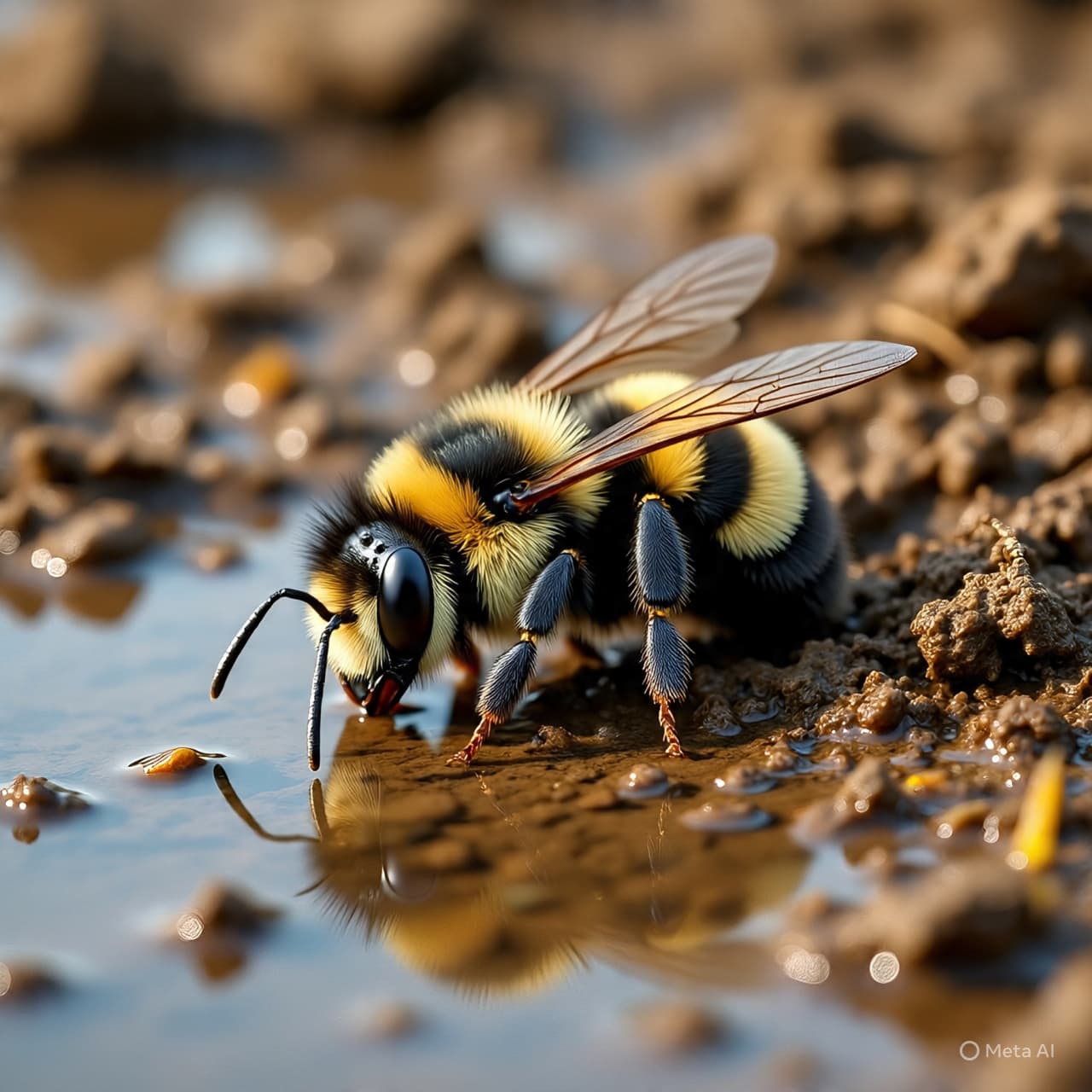
There are moments in the quiet shadows of nature where a tiny creature teaches us a lesson about stillness and survival — the sort of thing that feels like watching a candle burn slowly in a softly lit room. Imagine a world beneath your feet, where a delicate bumblebee queen waits through winter in the embrace of cold soil, her heartbeat reduced to a whisper. In that silent space, water can seep up like an uninvited guest, filling the burrow and challenging life in its deepest, most vulnerable form.
For the common eastern bumblebee queen, this is not merely a hypothetical threat, but something her ancestors may have encountered again and again — rain falling, snowmelt rising, and wetlands pressing gently against the earth. In a state called diapause — a form of deep rest that nature has tuned over millennia — a queen’s metabolism already slows dramatically, like a clock running at half speed to conserve its precious energy. But as recent research suggests, the story of survival goes even deeper than this quiet slowdown.
Scientists studying these queens have discovered that when submerged under water — fully surrounded by a liquid that would seem to promise only peril — they can survive for days and even up to a week. What makes this nearly poetic is that these terrestrial insects, so familiar as visitors to flowers and gardens, appear to access oxygen from the water around them, an ability once thought exclusive to aquatic life. When submerged, carbon dioxide levels in the water fall while oxygen is consumed — a sign that these queens continue to exchange gases and sustain life even beneath the surface.
It is a kind of underwater breathing that scientists are still trying to fully understand. Some believe a thin layer of air clings to the queens’ bodies, acting as a “physical gill” that allows dissolved oxygen to diffuse in — a delicate, almost mystical layer of breath between the insect and its aqueous surroundings.
But the story doesn’t end there. To survive such prolonged submersion, the queens also turn to anaerobic metabolism — a way of producing energy without oxygen — and suppress their metabolic rates to a fraction of even their already reduced diapause levels. In laboratory measurements, carbon dioxide output drops sharply as time underwater increases, indicating a profound metabolic depression that eases the queen’s energy demands to the bare minimum needed for survival.
When the water finally ebbs and soil returns to air, these queens can revive and continue their seasonal cycle, awakening to build new colonies in spring. In a world where weather patterns are shifting and environmental pressures are mounting, this quiet resilience hints at a deeper complexity in nature’s survival strategies — one that is rooted not in resistance but in repose, in slowing down rather than fighting every current.
As researchers continue to untangle the biology behind this extraordinary adaptation, the queen bumblebee’s submerged interlude serves as a gentle reminder: life is not always about visible struggle and frantic activity. Sometimes it is about waiting — still, unhurried, and prepared for what comes next in the flow of seasons and waters.
AI Image Disclaimer (Rotated Wording) Illustrations were produced with AI and serve as conceptual depictions.
Sources (media names only):
Smithsonian Magazine Phys.org Science News Research & Development World (RDWorld) Febspot summary of mainstream science reporting
Published by Banx Network. This article is part of the Banx decentralized media programme, powered by the BXE token on the XRP Ledger.