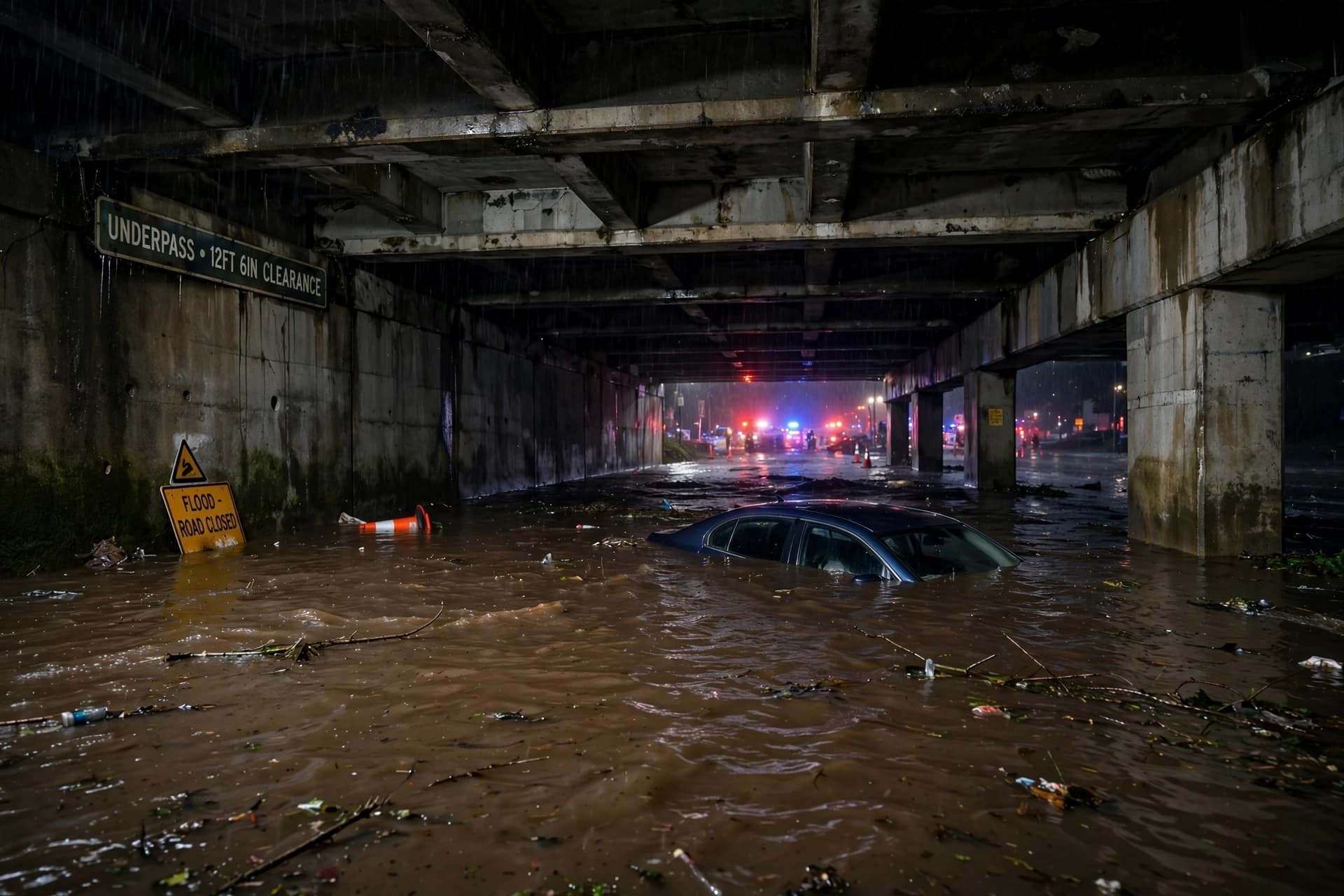
Water has a way of finding the lowest ground, the forgotten corners, the places where the city’s drainage was never quite enough. On Thursday afternoon, as Melbourne received half its usual October rainfall in a single day, that water found a bridge on York Street in South Melbourne. Beneath it, a family of four sat in their car, surrounded by rising floodwater, waiting for help.
The rain had begun in earnest around two o’clock, and within three hours, twenty-seven millimeters had fallen across the city. Stormwater systems, designed for ordinary storms, struggled under the weight of it. Roads became rivers. Tow trucks were called to retrieve submerged vehicles. And beneath the York Street bridge, the water pooled in a place where no one should have been driving, let alone sitting still.
Police were called shortly before 3:30 p.m. to rescue the occupants of two cars trapped beneath the bridge. One contained the family of four. The other, nearby, held a single occupant. Emergency crews also responded to a truck and van caught in floodwaters at the Elwood canal. Across the city, VICSES received about 130 calls for help as the deluge overwhelmed drainage systems in inner Melbourne and surrounding suburbs.
The scene beneath the bridge was one of those moments when the ordinary infrastructure of a city reveals its limits. Bridges are built for traffic, not for floods. Underpasses are designed to pass beneath, not to fill with water. Yet when the rain comes faster than the drains can carry it, the lowest point becomes a trap. That the family found themselves there, in a car, in rising water, is a reminder of how quickly normal conditions can turn dangerous.
VicEmergency issued a flood watch across Gippsland, Central Victoria, and the North East, warning that rising catchments—the Yarra, Macalister, and Latrobe rivers among them—could experience minor to moderate flooding. The storm system had swept across South Australia before intensifying over northern Victoria, with Gippsland forecast to receive the heaviest rainfall on Friday. Areas south and east of the ranges, including Sale, Bairnsdale, and the Latrobe Valley, were told to prepare for more.
For Melbourne, the forecast offered little relief. Persistent showers were expected through Friday and Saturday. VICSES advised residents across affected regions to prepare for fast-rising waters, to stay off the roads where possible, and never to drive, walk, or ride through floodwaters—a warning that bears repeating precisely because it is so often ignored. The water beneath a bridge may look shallow, but it can deepen in minutes, and a car can become a boat, and a boat can become a trap.
The York Street bridge incident ended without reported serious injuries, but it could have ended differently. Flash flooding is not a gradual thing. It arrives with a suddenness that leaves little room for hesitation or second-guessing. The family beneath the bridge was fortunate. Others in the path of this weather system may not be. The rain is expected to continue, and the catchments are still rising.
For those in the affected areas, the advice is simple and worth taking seriously: avoid floodwaters, prepare for more rain, and check on neighbors who may be more vulnerable. The city will dry out eventually, as it always does. But until then, the water will continue to seek the lowest places, and the lowest places will continue to be where people sometimes find themselves, unexpectedly, waiting for help to arrive.
AI Image Disclaimer: The images accompanying this article were generated by artificial intelligence and do not represent actual locations or individuals.
Sources: The Courier Mail, Australian Broadcasting Corporation
Published by Banx Network. This article is part of the Banx decentralized media programme, powered by the BXE token on the XRP Ledger.