In still water, time gathers differently.
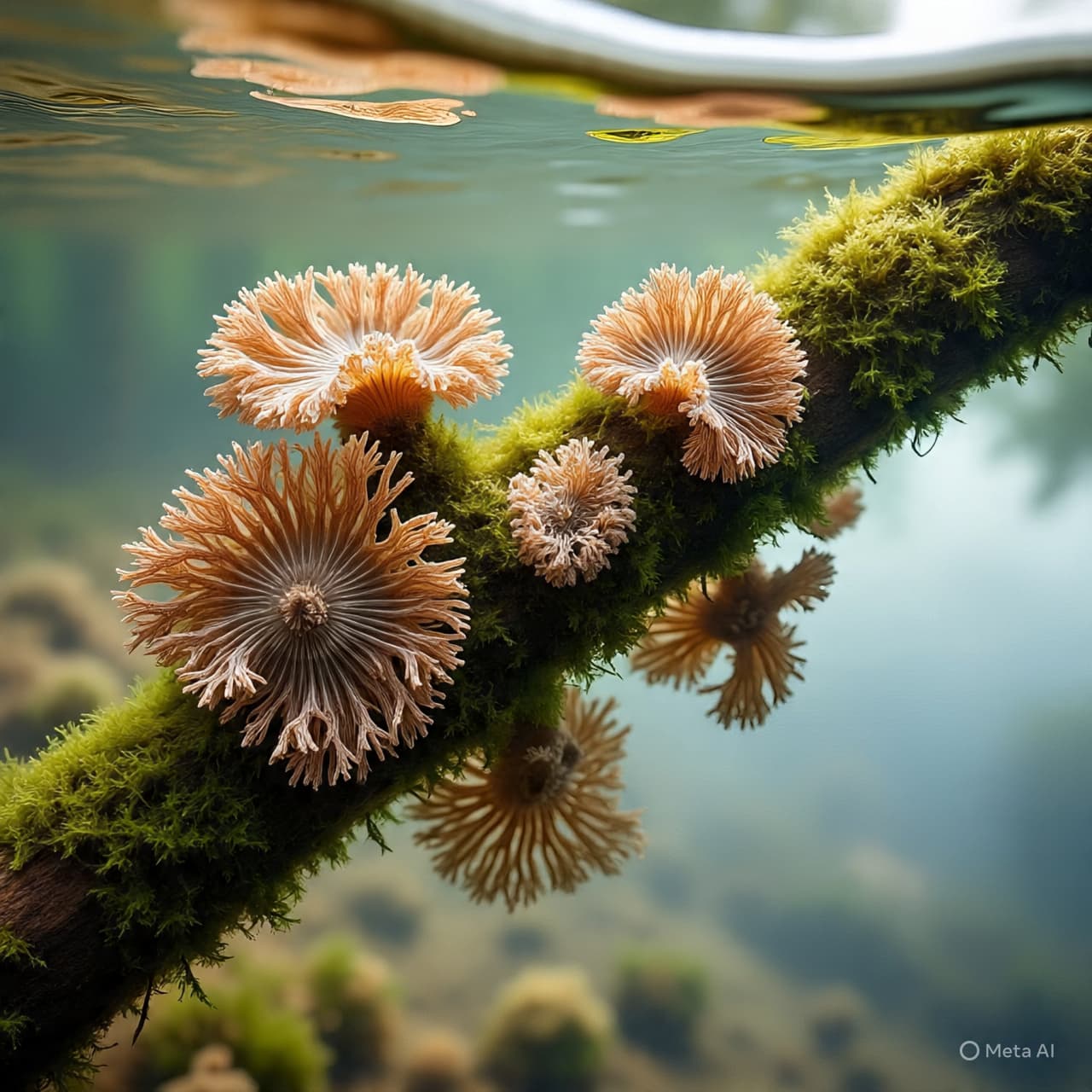
There are no sudden shifts, no sharp edges to mark the passing of change. Instead, everything unfolds in quiet continuities—layers of form and function carried forward, altered only slightly with each generation. Beneath the surface, where light softens and movement slows, small colonial organisms attach themselves to submerged branches and stones, their presence almost indistinguishable from the environment they inhabit.
These are the phylactolaemate bryozoans, a group of freshwater invertebrates whose lives are structured not as individuals alone, but as colonies—clusters of interconnected units that grow, divide, and persist over time. Their forms are delicate, often gelatinous or branching, shaped as much by their surroundings as by their internal design.
To observe them directly is to see only the present.
But recent research has taken a different approach, one that moves backward as much as it looks outward. Through the study of morphological character evolution and ancestral state reconstruction, scientists are attempting to understand how these organisms came to take their current forms—what features emerged, which were retained, and how patterns of change have unfolded across evolutionary time.
It is, in a sense, a reconstruction of memory.
By comparing physical traits across multiple species—structures related to feeding, reproduction, and colony formation—researchers can identify shared characteristics and variations. These observations are then mapped onto phylogenetic trees, diagrams that represent evolutionary relationships, allowing scientists to infer what ancestral forms may have looked like.
The process is not exact. It relies on probabilities, on patterns that suggest rather than confirm. And yet, within these patterns, a coherence begins to appear.
Certain traits seem to persist across lineages, suggesting early origins that have remained relatively stable. Others vary more widely, indicating adaptations to different environmental conditions or ecological roles. In the case of phylactolaemate bryozoans, particular attention has been given to structures involved in reproduction—such as statoblasts, specialized units that allow colonies to survive unfavorable conditions and disperse to new locations.
These features, though small, carry significant weight in evolutionary terms.
Their shapes, compositions, and mechanisms of release provide clues about how species have responded to changing environments over time. By reconstructing ancestral states, researchers can begin to trace the emergence of these traits, identifying when they may have first appeared and how they have diversified.
There is a quiet complexity in this work.
Unlike more visible organisms, bryozoans leave a limited fossil record, especially in freshwater environments where preservation is less common. This makes direct evidence of their evolutionary history sparse, increasing the importance of comparative morphology and genetic analysis. The past must be inferred, assembled from fragments that exist in the present.
And yet, the results suggest continuity rather than rupture.
The evolution of these organisms appears to follow gradual pathways, with changes accumulating over long periods rather than emerging suddenly. Colony structures shift, feeding mechanisms refine, reproductive strategies adapt—but always within a framework that remains recognizable across time.
It is evolution not as a series of dramatic transformations, but as a slow adjustment to the conditions of existence.
In this sense, the study of phylactolaemate bryozoans offers a different perspective on life’s history—one that emphasizes persistence as much as change. Their forms, though subtle, carry traces of earlier configurations, echoes of ancestral states that continue to shape their present.
Researchers report that morphological analyses combined with phylogenetic reconstruction have provided new insights into the evolutionary history of phylactolaemate bryozoans. The findings help clarify how key traits developed and diversified, contributing to a broader understanding of freshwater invertebrate evolution.
AI Image Disclaimer
These images are AI-generated and are intended as scientific illustrations, not real-life photographs.
Source Check: Zoological Journal of the Linnean Society, Journal of Morphology, Nature, ScienceDirect, Royal Society Publishing
Published by Banx Network. This article is part of the Banx decentralized media programme, powered by the BXE token on the XRP Ledger.