Rivers often carry stories quietly. Beneath their reflective surfaces, life unfolds in patient rhythms—eggs drifting in reeds, shadows moving through clear water, generations rising and fading with the seasons. Evolution, too, tends to follow a familiar melody: diversity creates resilience, variation opens doors, and reproduction mixes traits so that species may adapt to the shifting world around them.
Yet sometimes nature composes a different tune.
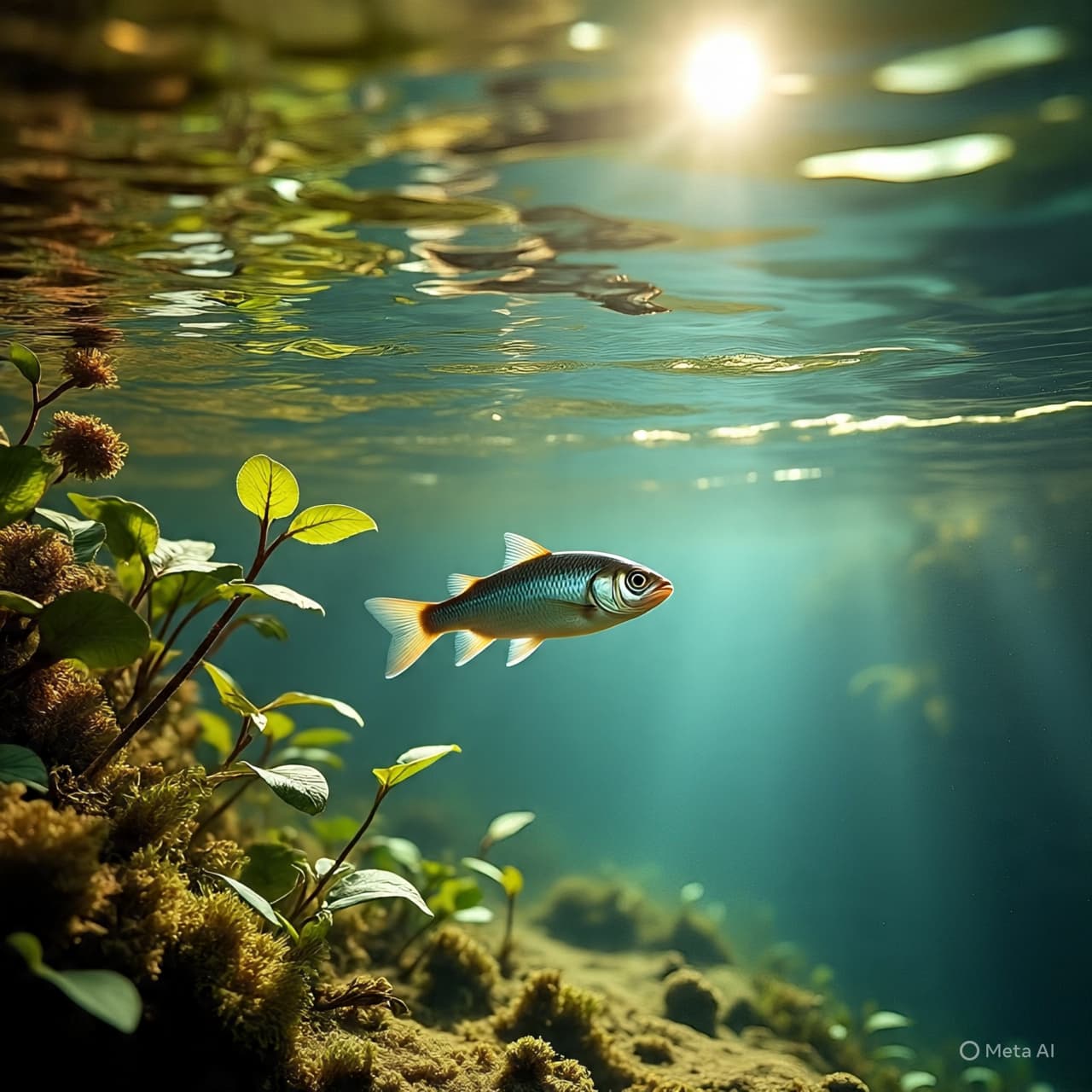
In the freshwater streams of northern Mexico and parts of southern Texas lives a small silver fish known as the Amazon molly. At first glance it appears unremarkable, one among many tiny fish gliding through warm, slow currents. But hidden within its lineage is a biological curiosity that has puzzled scientists for decades: every individual of the species is female.
No males exist within the species. None have ever been found.
In most forms of life, reproduction depends on the meeting of two genetic contributions, a process that shuffles traits and strengthens a species’ ability to adapt. Without that exchange, a population would normally face an evolutionary dead end. A species that simply replicates itself again and again should, in theory, accumulate harmful mutations and gradually disappear.
And yet the Amazon molly has persisted for roughly 100,000 years.
Its secret lies in a peculiar strategy known as gynogenesis, a form of reproduction that seems almost like biological copy-and-paste. Female Amazon mollies must still interact with males—but not with males of their own species. Instead, they borrow the presence of males from closely related fish species living in the same waters. When a male mates with an Amazon molly, his sperm triggers the development of the eggs, but his DNA is typically excluded from the process.
The offspring that emerge are, in essence, genetic copies of their mother.
For years, scientists wondered how such a system could survive for so long. Clonal reproduction, after all, offers little genetic variation, leaving species vulnerable to disease, environmental change, and evolutionary stagnation.
Recent genetic research has begun to reveal why the story may be more complex than it first appears. Studies of the Amazon molly’s genome suggest that while the fish largely clones itself, its genetic structure contains an unusual level of stability and diversity preserved from the original hybridization that created the species. Long ago, two different fish species interbred, producing a hybrid lineage that eventually became the Amazon molly.
That hybrid origin appears to have endowed the species with a robust genetic foundation, one capable of enduring through thousands of generations of near-identical reproduction.
Scientists have also discovered subtle genetic mechanisms that help prevent harmful mutations from accumulating too quickly. In some cases, fragments of genetic material may occasionally slip into the genome from the males involved in reproduction, introducing rare bursts of variation that refresh the lineage just enough to maintain viability.
In a way, the species survives by walking a narrow evolutionary path—mostly copying itself, yet occasionally borrowing small pieces of diversity from the world around it.
What emerges from this story is a reminder that evolution does not always follow strict expectations. While diversity remains the dominant strategy of life, the Amazon molly demonstrates that nature sometimes finds quieter, more unusual routes to persistence.
Today, the fish continues to inhabit the same warm rivers where it has lived for millennia, moving through reeds and shallow currents much as its ancestors did long before. Researchers continue studying its genome to better understand how clonal species resist extinction.
For now, the Amazon molly remains a living example of how survival can sometimes be written not through endless variation, but through the careful repetition of a successful design.
AI Image Disclaimer Illustrations were produced with AI and serve as conceptual depictions.
Sources Scientific American Smithsonian Magazine National Geographic Nature The New York Times
Published by Banx Network. This article is part of the Banx decentralized media programme, powered by the BXE token on the XRP Ledger.