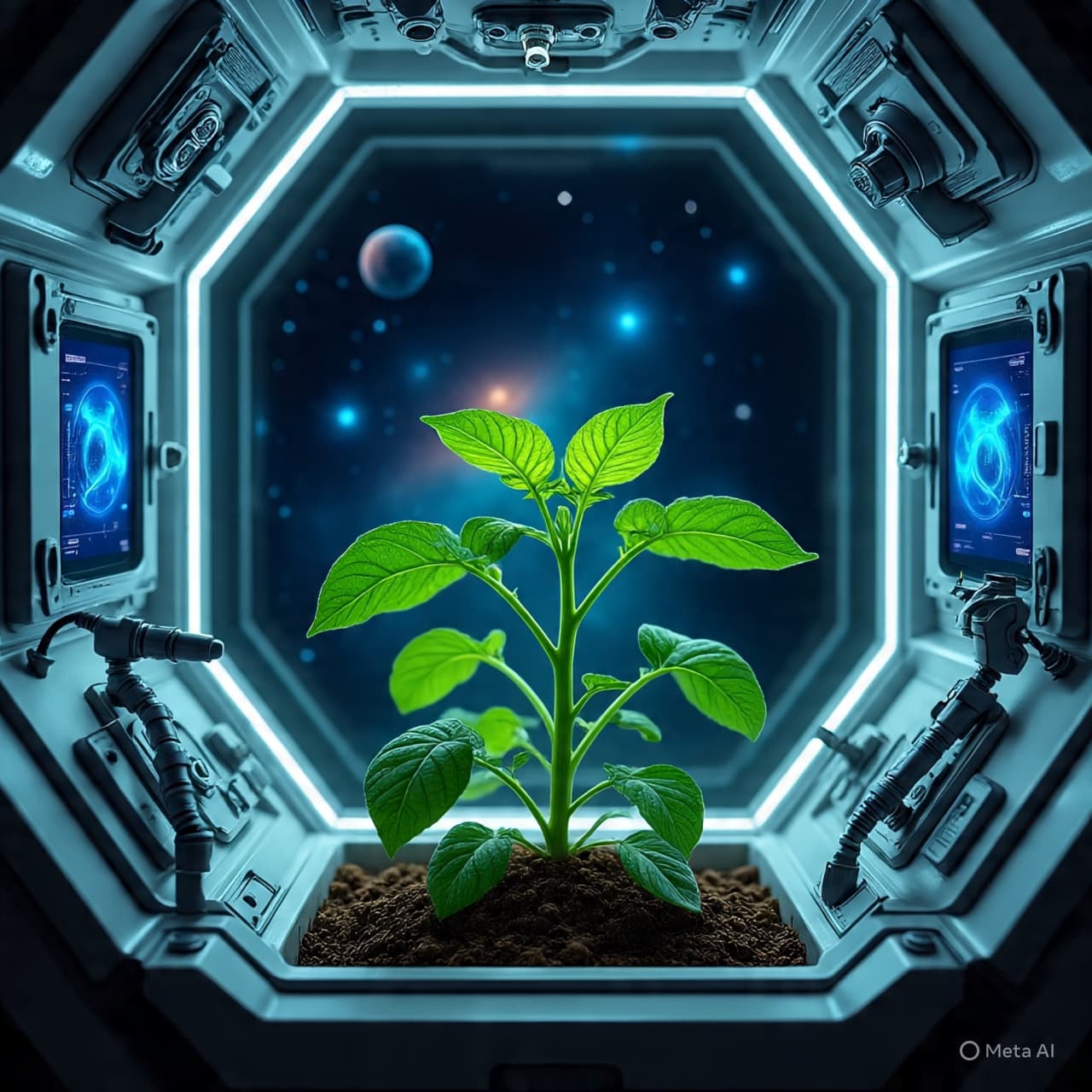
There is something disarming about growth in an unfamiliar place. A leaf where no soil should be, a root where gravity offers no guidance. It invites curiosity at first, then something quieter—an awareness that even the most ordinary forms can feel altered when removed from their usual ground.
In the controlled interior of the International Space Station, such moments are not unusual. Plants have long been part of the station’s experiments, cultivated under artificial light, their progress carefully observed. The intention is measured and practical: to understand how life adapts beyond Earth, how future missions might sustain themselves, how something as simple as food can be grown where there is no natural field.
Among these efforts, a familiar crop has drawn renewed attention—a potato. Grown as part of ongoing plant research in microgravity, it represents continuity more than novelty. Potatoes, after all, have been studied extensively for space agriculture due to their resilience and nutritional value. They are not the first plants to grow beyond Earth, nor the most complex. They are chosen precisely because they are dependable.
Yet, when images and fragments of this work began circulating more widely, the response beyond the laboratory took on a different tone. Online discussions shifted quickly from curiosity to unease. Words like “terrifying” appeared, not as scientific description but as reaction—an expression of how unfamiliar contexts can reshape perception.
It is not the potato itself that unsettles. It is what it represents when removed from its ordinary setting. Growth without soil, life sustained in artificial cycles, the quiet suggestion that human systems can recreate conditions once thought inseparable from Earth. In these interpretations, the experiment becomes symbolic, a point where imagination moves faster than explanation.
The scientific reality remains grounded. Plant experiments aboard the station, including those conducted through systems like Veggie and the Advanced Plant Habitat, are designed to test how crops respond to microgravity, radiation, and controlled environments. Researchers measure growth rates, nutrient uptake, and structural changes, building a clearer understanding of how agriculture might function during long-duration missions. Potatoes, alongside leafy greens and other plants, are part of this broader inquiry.
There is also a continuity to these efforts that stretches back years. Astronauts have already grown and consumed lettuce in orbit, marking incremental steps toward sustainable food systems in space. Each experiment builds on the last, not as a leap, but as a progression—careful, monitored, and deliberate.
The reaction, however, reveals something less about the experiment and more about the distance between observation and interpretation. In a world where images travel quickly and context arrives slowly, meaning can shift. What is routine within a laboratory can feel unfamiliar, even unsettling, when viewed without its framework.
And so, the small plant continues to grow, as intended. It follows light, absorbs nutrients, and responds to an environment carefully designed for its survival. Around it, instruments record, systems regulate, and researchers observe.
NASA confirms that plant growth experiments aboard the International Space Station, including crops such as potatoes, are part of ongoing research into space agriculture. These studies aim to support future long-duration missions by understanding how food can be cultivated in microgravity. Public reactions online have varied, but the experiments remain consistent with established scientific objectives.
AI Image Disclaimer
Illustrations were created using AI tools and are not real photographs.
Sources
NASA Space.com Scientific American Smithsonian Magazine The Verge
Published by Banx Network. This article is part of the Banx decentralized media programme, powered by the BXE token on the XRP Ledger.