There is a particular kind of political campaign that does not begin with a podium or a promise but with a truck dispensing free ice cream to high school students. Alvin Tedjo's run for mayor of Mississauga started as a long shot—a first-term councillor, forty-three years old, facing an incumbent and a former mayor who between them had dominated the city's politics for decades. An August poll placed him fourth, with just twelve percent support . By election night, he had won 39.2 percent of the vote, defeating Carolyn Parrish and Bonnie Crombie by margins that surprised almost everyone, including his own team .
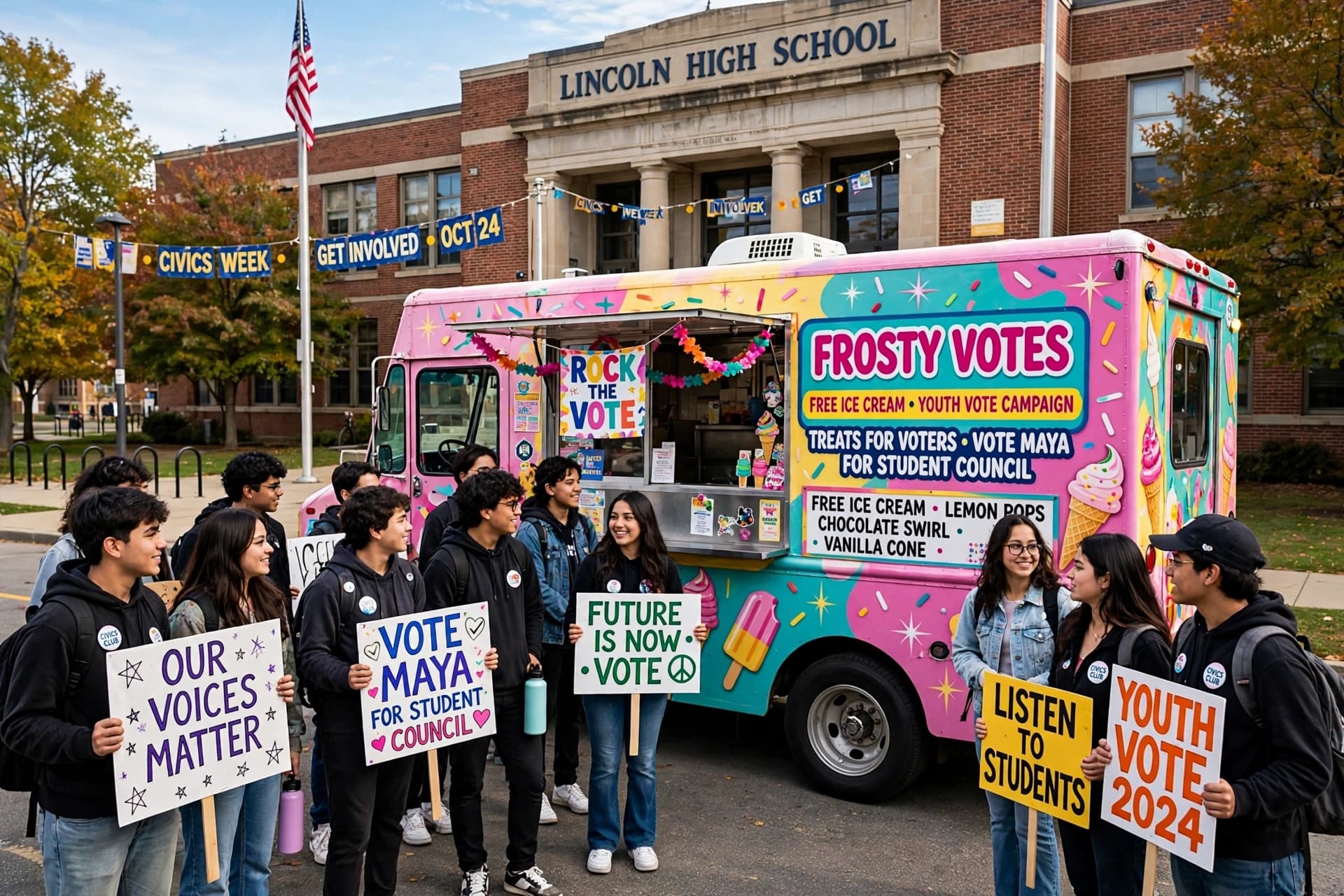
The ice cream was not an accident. Tedjo's campaign understood early that the traditional tools of municipal politics—door-knocking, phone calls, mailers—were not reaching the voters they needed. So they built a social media strategy that treated attention as the first scarce resource. A contest invited local high schools to compete for a free ice cream truck, and students responded in force, flooding social media with videos and tagging their schools . The truck arrived at Stephen Lewis Secondary School, and Tedjo himself stood in line, helping to manage the crowd. The message was not subtle: here was a candidate who understood that politics, at its best, could be something other than tedious.
But the ice cream was only the surface. Tedjo's campaign spent more than $103,000 on Meta ads, compared with roughly $66,000 for Crombie and $10,500 for Parrish . On election day alone, they ran about fifty-two different ads across platforms. The content was deliberately unpolished: Tedjo interviewing himself, his daughter offering an endorsement, him drinking durian smoothie, buying a Costco hot dog and linking its $1.50 price to his promise to freeze property taxes . His communications director described the approach as "cookies and vegetables"—use something engaging to draw people in, then let them encounter the policy .
The policy substance was not absent, even if it was often delivered with a smile. Tedjo campaigned on freezing the city portion of property taxes for two years, on affordability and municipal spending, on bus rapid transit lanes that could be implemented quickly rather than mega-projects that would take decades . He spoke about the pressures facing young families and renters, the constituencies that municipal politics often overlooks. His victory speech framed the win as a generational shift: "People in this city are choosing change," he said, "and we're going to deliver that" .
The campaign also benefited from the misfortunes of his opponents. Parrish and Crombie spent much of the race attacking each other, and their debate performances were mocked online and on television, including a segment on "This Hour Has 22 Minutes" . The spectacle of two veterans trading blows created an opening, and Tedjo walked through it. He did not need to be the most experienced candidate in the race. He needed to be the alternative. As one supporter put it, "The polls really underestimated us, but we really smacked them" .
There is a temptation to read Tedjo's win as a story about social media alone, but that would miss the point. The ice cream and the hot dog and the self-interviews were not ends in themselves. They were mechanisms for being seen, for breaking through the noise that surrounds municipal politics and reaching people who had stopped paying attention. The "Ted Lasso" poster that appeared in his campaign material—referencing the fictional coach whose optimism and decency become a kind of quiet radicalism—captured something about the tone Tedjo was reaching for . He was not running against his opponents so much as running for a feeling: that city hall could be competent, responsive, and perhaps even a little bit joyful.
The work now begins. Tedjo will be sworn in later this month, and he will have to deliver on his promises—the tax freeze, the transit lanes, the sense that Mississauga is being run for the people who live in it, not just the people who have always run it . The campaign was remarkable, but campaigns end. What remains is the harder, quieter work of governing. The ice cream truck will not follow him to the mayor's office. The question is whether the energy it generated can be translated into something that lasts.
Image Disclaimer: This article's accompanying image was generated by AI and does not depict the actual campaign or individuals involved.
Sources: Toronto Star, CBC News, The Talk Media, Wikipedia
Published by Banx Network. This article is part of the Banx decentralized media programme, powered by the BXE token on the XRP Ledger.