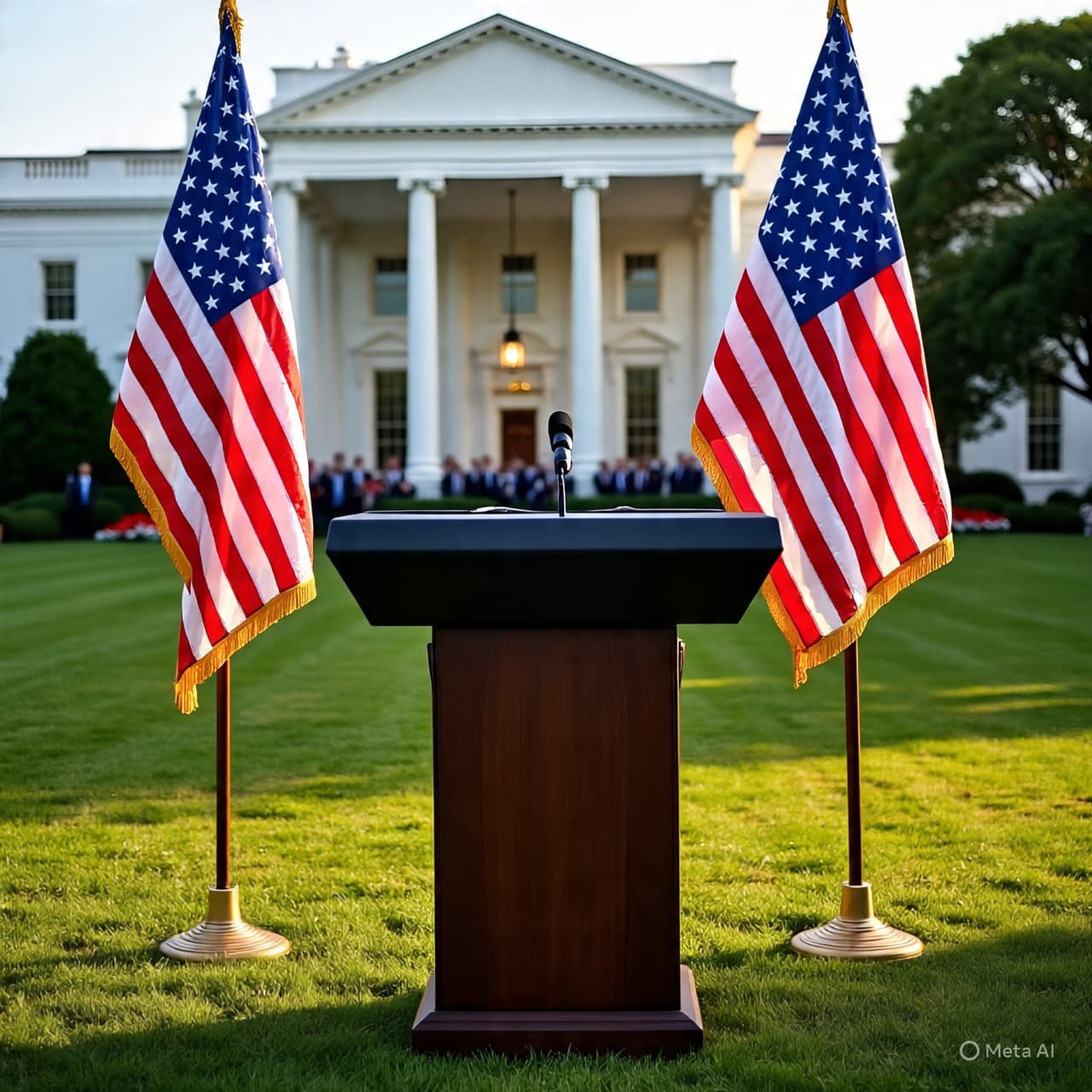
The afternoon light in Washington falls softly against the columns of the White House, as if history itself prefers to move in half-shadow. Cameras gather on the lawn, their lenses fixed on a podium where words, once spoken, will travel quickly across oceans. Beyond the Potomac, autumn air drifts in, carrying with it the familiar cadence of briefing-room declarations and the unfamiliar tension of a widening conflict.
President Donald Trump stepped forward this week to outline what he described as four objectives behind coordinated U.S.–Israeli strikes targeting sites in Iran. The remarks, delivered in measured tones, sought to frame the military action not as open-ended escalation but as a defined effort with specific aims.
The first objective, he said, was to degrade Iran’s nuclear capabilities—particularly infrastructure associated with uranium enrichment and weapons development. For years, Washington and Israel have viewed Iran’s nuclear trajectory as a central security concern. Facilities long monitored by the International Atomic Energy Agency have stood at the heart of diplomatic negotiations and intelligence assessments alike. Trump argued that targeted strikes were intended to slow or halt technical progress he described as destabilizing.
Second, he pointed to deterrence. By demonstrating readiness to act, the administration aims to signal resolve not only to Tehran but to regional actors aligned with it. In this framing, the strikes serve as both message and method—a reminder that certain thresholds, once crossed, would prompt tangible response. The language of deterrence has deep roots in U.S. foreign policy, echoing across decades of strategic doctrine.
The third objective, according to the president, involves protecting American and allied forces stationed across the region. U.S. military personnel remain deployed in several Middle Eastern countries, often within range of Iranian missiles or proxy groups. Recent exchanges—rocket fire, drone incursions, maritime confrontations—have heightened concerns about force protection. The administration has described the strikes as preemptive steps to reduce threats against these installations.
Finally, Trump emphasized the goal of preventing a broader regional war. This assertion, perhaps the most paradoxical, rests on the belief that decisive limited action can forestall prolonged conflict. Critics question whether such calculations hold in practice, warning of retaliatory cycles. Supporters argue that ambiguity invites greater risk. Between these positions lies a landscape shaped by history and human judgment.
Iranian officials have condemned the strikes as violations of sovereignty, vowing consequences while also signaling that their response will be calibrated. Israeli leaders have framed the operation as necessary self-defense. European governments have called for restraint on all sides, urging a return to diplomatic channels even as events on the ground continue to evolve.
In energy markets, prices have responded with cautious volatility, reflecting investor concern over potential disruptions in the Persian Gulf. In Vienna, IAEA officials await clearer access to assess physical damage at targeted facilities. In the region’s cities—Tehran, Tel Aviv, Baghdad—ordinary routines continue under a sky newly charged with uncertainty.
Back in Washington, the president’s four objectives now enter the wider arena of public debate. Lawmakers weigh classified briefings against constituent concerns. Analysts parse language for clues about duration and scope. Military planners review contingency maps drawn in precise lines that rarely capture the unpredictability of human reaction.
For now, no formal declaration of war has been issued. Diplomatic channels, though strained, remain open. The administration insists that its goals are limited and strategic, not expansive. Whether those aims will be achieved—or whether they will redraw the region’s fragile balance—remains an open question.
As evening settles once more over the capital, the monuments stand unchanged, their stone faces indifferent to the tremors of policy. Yet the consequences of decisions taken in bright afternoon light may echo far beyond this season. Four objectives have been set into the record. The unfolding days will determine how firmly they shape the path ahead.
AI Image Disclaimer Visuals are AI-generated and serve as conceptual representations.
Sources Reuters Associated Press BBC News The New York Times International Atomic Energy Agency
Published by Banx Network. This article is part of the Banx decentralized media programme, powered by the BXE token on the XRP Ledger.