
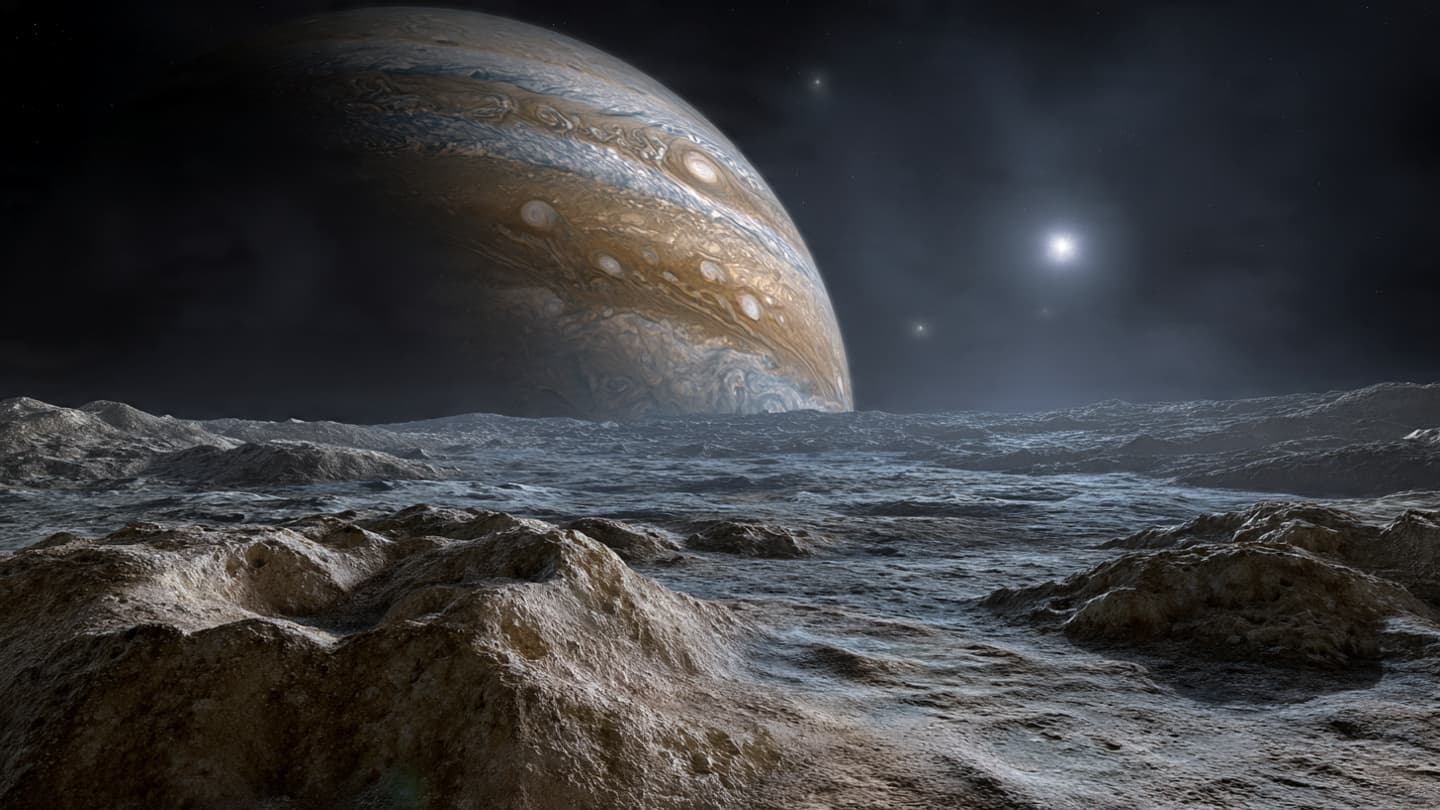
Far beyond Earth’s weather and noise, where sunlight weakens into a pale glow across deep space, Jupiter continues turning in immense silence. Around the giant planet, its lesser-known moons drift like scattered stones caught within gravity’s endless tide. This week, one of those distant worlds briefly moved into sharper focus as NASA’s Juno mission revealed a striking new image of Thebe, a small moon rarely seen in such detail.
The newly released image was captured by the Juno spacecraft during a close flyby of Jupiter’s moon system. Thebe, an irregularly shaped satellite orbiting near the planet, appeared rugged and shadowed against the darkness of space, its cratered surface reflecting faint sunlight. Scientists described the image as one of the clearest views yet obtained of the moon.
Thebe was first discovered in 1979 by Voyager 1 and named after a mythological figure linked to Zeus, the Greek counterpart of Jupiter. Compared with larger Jovian moons such as Europa or Ganymede, Thebe receives far less public attention, largely because of its smaller size and unusual appearance.
Researchers say images gathered by Juno help scientists better understand the formation and evolution of Jupiter’s extensive moon system. The spacecraft’s instruments continue collecting information about surface composition, radiation exposure, and orbital behavior within one of the solar system’s most complex planetary environments.
Since arriving at Jupiter in 2016, Juno has transformed scientific understanding of the gas giant. Originally designed to study the planet’s atmosphere, magnetic field, and internal structure, the mission has also produced detailed imagery of storms, auroras, and moons orbiting within Jupiter’s immense gravitational field.
The latest image of Thebe was enhanced through citizen science collaboration, with image processors adjusting brightness and detail using raw spacecraft data provided publicly by NASA. Such contributions have become an increasingly important part of modern space exploration outreach.
Scientists note that moons like Thebe may appear quiet and lifeless, yet they preserve clues about the early solar system. Their scarred surfaces act almost like ancient records, marked by collisions and cosmic forces stretching back billions of years.
For many observers on Earth, the image carried a quieter emotional effect beyond its scientific value. In a universe filled with distances difficult to comprehend, even a small rocky moon orbiting a distant planet can remind humanity of how much still waits unseen in the dark between the stars.
NASA says the Juno mission continues operating successfully and is expected to provide additional observations of Jupiter and its surrounding moons during future orbital passes.
AI Image Disclaimer: Some accompanying visuals may include AI-enhanced representations inspired by scientific imagery.
Sources: NASA, Space.com, Live Science, SciTechDaily
Published by Banx Network. This article is part of the Banx decentralized media programme, powered by the BXE token on the XRP Ledger.



