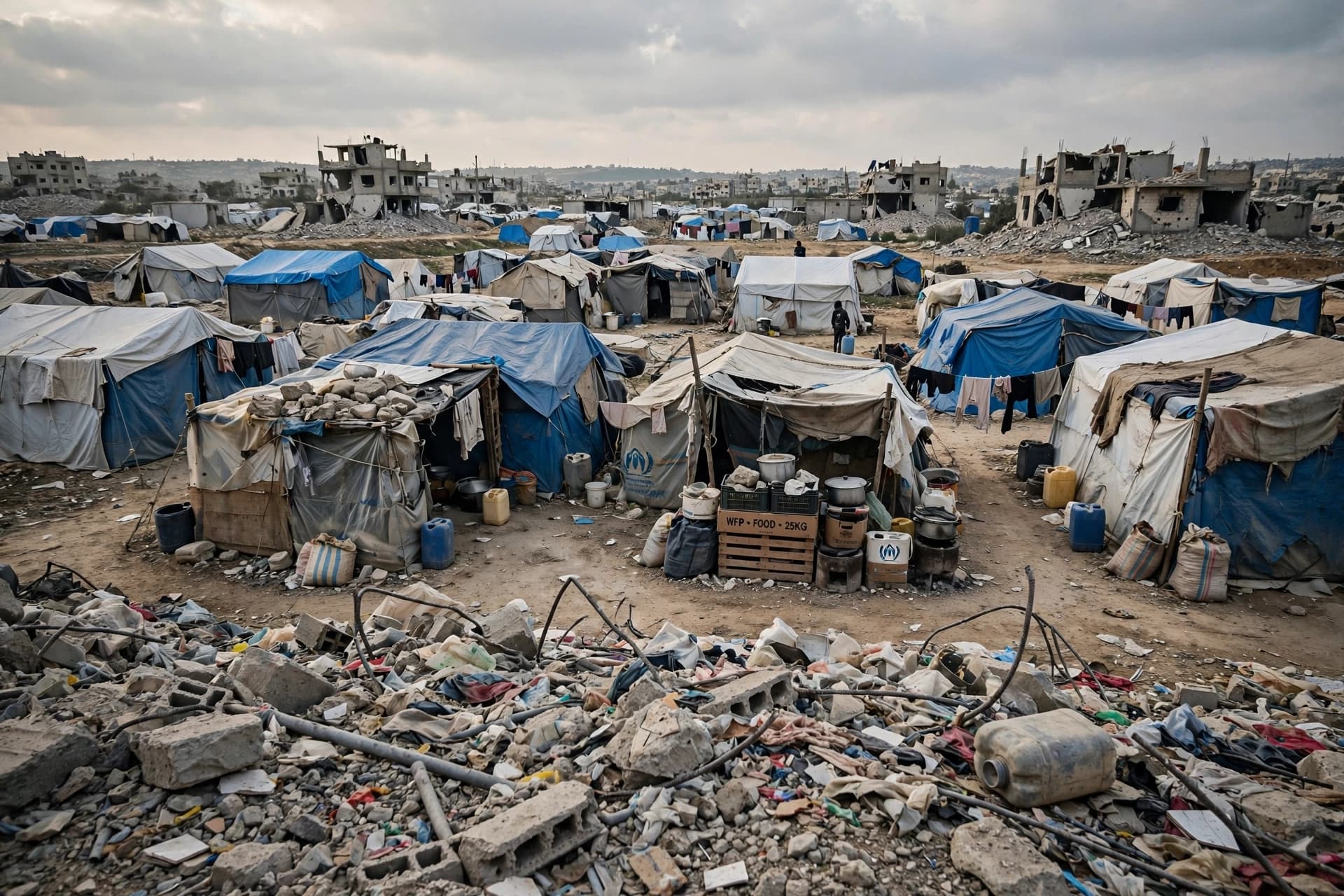
There is a particular kind of exhaustion that comes not from battle, but from the long, grinding pause between battles—a stillness that is not peace, but merely the absence of the loudest violence. In Gaza, nearly a year after a ceasefire was declared, Palestinians describe their days as neither war nor peace, but something in between: a slow erosion of life in the ruins of what came before.
Ahmed Ishtaiwi, a 43-year-old driver and mechanic, lives in a tent near Deir al-Balah with his two daughters. Their former home in Beit Lahiya is uninhabitable and unreachable. Among his most valued possessions are six cheap plastic chairs. "When I sit on those chairs, I remember sitting in the garden at home, having breakfast and drinking tea," he said. "They remind me of my life there" .
The ceasefire that took effect in October 2025 has not restored normal life. The United Kingdom's country policy note on the humanitarian situation in Gaza, updated in September 2026, describes conditions so severe that they amount to "torture or inhuman or degrading treatment" under international human rights standards . Between 54% and 65% of Gaza's territory remains under Israeli military control, concentrating the population into a fraction of the strip and pushing density two to three times higher than pre-conflict levels .
The statistics paint a picture of systemic collapse. Unemployment stands at roughly 81%. The economy has contracted to about 18% of its pre-conflict size. The number of Gazans living in poverty has risen from approximately 64% before the war to nearly 100% . Between 77% and 92% of housing units have been damaged or destroyed. Most wastewater treatment plants are inoperable. Water production in July 2026 was about six liters per person per day—40% of pre-conflict levels and well below the World Health Organization's recommended minimum of 15 liters .
For families like that of Layan al-Jbour, a 15-year-old from Khan Younis, the tent they share in al-Mawasi is a constant reminder of what was lost. "When I tidy the tent, I remember our home and how I used to tidy it," she said. "I remember my room and how I used to make my bed." The only thing she took from her home was her schoolbag. "It is the most precious thing I own now" .
The health situation remains critical. The UN humanitarian coordinator reported that infectious diseases are widespread amid overcrowded displacement sites and inadequate water, sanitation, and hygiene conditions, while shortages of medical supplies and fuel are compounded by funding shortfalls . About 279,000 people are sheltering in 400 flood-prone displacement sites, and over 2,300 are in unsafe buildings requiring demolition .
For Saleh Kilani, 70, from Beit Lahiya, the loss extends beyond the physical. A farmer who once pressed about 60 containers of olive oil each year, he now describes life before the conflict as "very distant." "We never used to think twice about seeing orange and peach trees, green fields, grapes and figs," he said. "Now when we see them, we are surprised" . The ceasefire has brought a reduction in the loudest violence, but it has not brought back the life that existed before.
AI Image Disclaimer: The images accompanying this article are generated by artificial intelligence and are intended for illustrative purposes only.
Sources: The Guardian, GOV.UK, ReliefWeb, United Nations, CBC News, Xinhua
Published by Banx Network. This article is part of the Banx decentralized media programme, powered by the BXE token on the XRP Ledger.