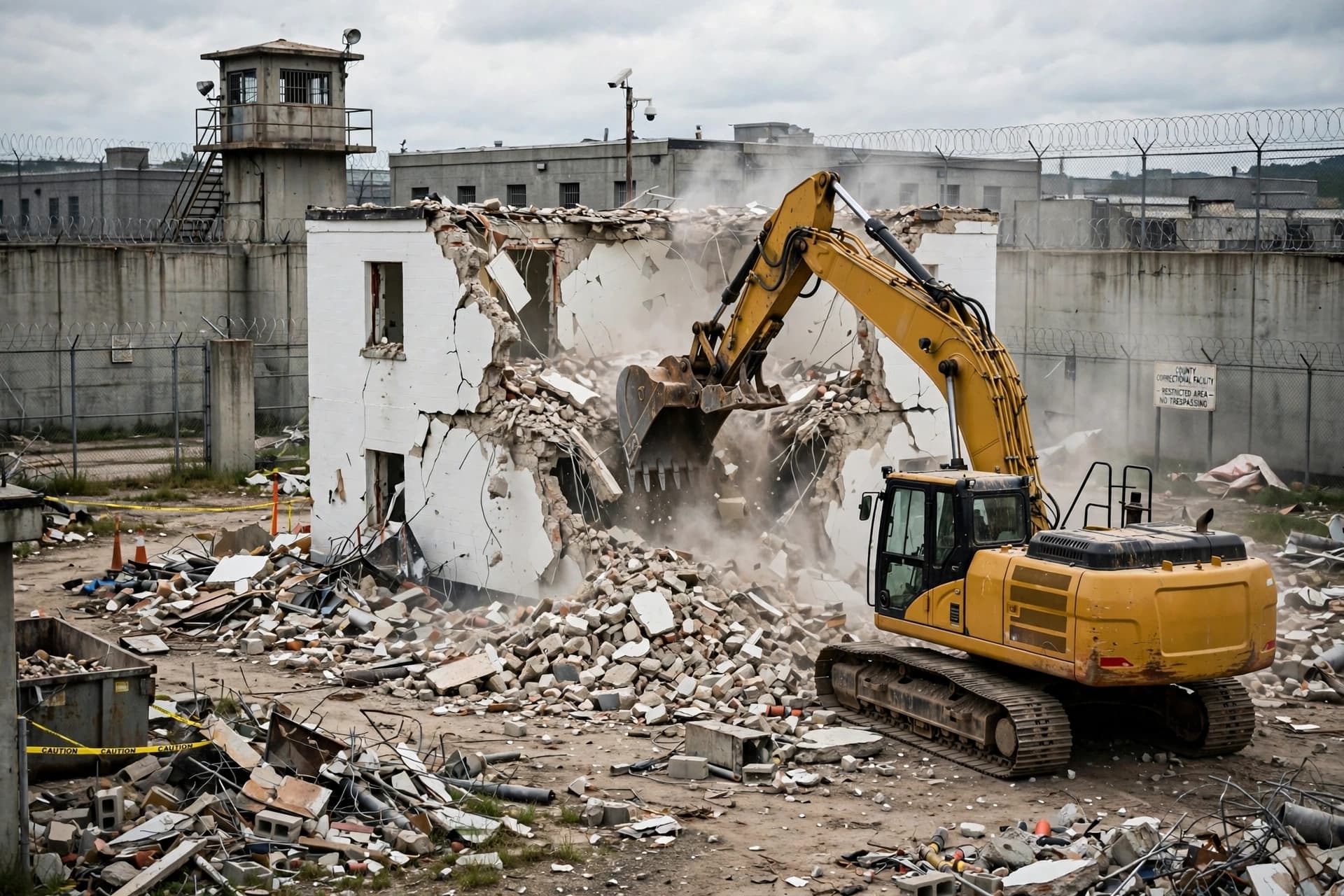
There is a quiet contradiction at the heart of any prison: it is meant to be a place where privilege is stripped away, where the law renders everyone equal in the narrow space of a cell. Yet in Indonesia, that equality has long been a fragile promise, eroded by the weight of money and connection. On Wednesday, an excavator tore through the walls of that contradiction at Cibinong Prison, leaving only rubble where a cluster of luxury residences once stood.
The demolition followed a surprise inspection on September 23 by Indonesia's national Ombudsman, which found inmates apparently living outside their regular prison blocks in unusually well-equipped residences. Inspectors had initially sought to enter the regular cell blocks but were refused entry despite presenting an official assignment letter. They instead investigated a fenced-off area about 100 meters away and found more than 10 residential units resembling homestays, terraced houses, and villas.
Inside, investigators documented air conditioners, big-screen televisions, refrigerators, sofas, and dining areas. They also found a gym, a golf simulator under construction, and luxury vehicles in the complex. Footage from the demolition showed officers removing mattresses, sofas, cupboards, refrigerators, and televisions before the excavator began its work. One occupant told inspectors he was an inmate. The Ombudsman later said some residences housed several inmates and others just one, while one inmate acknowledged paying to stay there. Investigators have yet to establish how much was paid or to whom.
On September 26, five senior prison officials, including the warden and head of prison security, were suspended. At a parliamentary hearing two days later, Corrections director-general Mashudi maintained that the buildings were official residences for prison staff but acknowledged that 13 of 16 were not registered in the government's state asset system. Of those 13, 10 were identified as outside the ministry's assets and demolished on Wednesday.
The Ministry of Immigration and Corrections classified the case as a serious disciplinary violation that could lead to sanctions ranging from demotion to dismissal. "The preliminary conclusion is that there was an abuse of authority," ministry Inspector-General Rudi Setiawan told a press conference at the prison. Investigators were also examining the procurement of a gym and a room intended for a golf simulator. Rudi said the simulator had not been completed, with only carpeting installed.
The Ombudsman expressed regret over the demolition, arguing that the buildings should have been preserved as evidence. "That should have been evidence of a suspected criminal act," Commissioner Fikri Yasin said. "So the demolition is an effort to eliminate evidence". He noted that the destruction actually confirmed the findings of the surprise inspection but said administrative sanctions alone were not enough. There must be legal accountability, not just the removal and suspension of prison officials, he argued.
The Cibinong facility holds over 1,800 inmates, making it one of the most heavily populated prisons on Java Island. The discovery of the luxury compound has drawn renewed scrutiny of Indonesia's prisons, which have faced prior allegations that wealthy or well-connected inmates can obtain preferential treatment through bribery. The ministry is expected to present further findings to Parliament on October 5.
AI Image Disclaimer: The accompanying images in this report were created with artificial intelligence and are intended for conceptual representation only.
Sources: BBC, The Star, Republika, AP News, iNews
Published by Banx Network. This article is part of the Banx decentralized media programme, powered by the BXE token on the XRP Ledger.