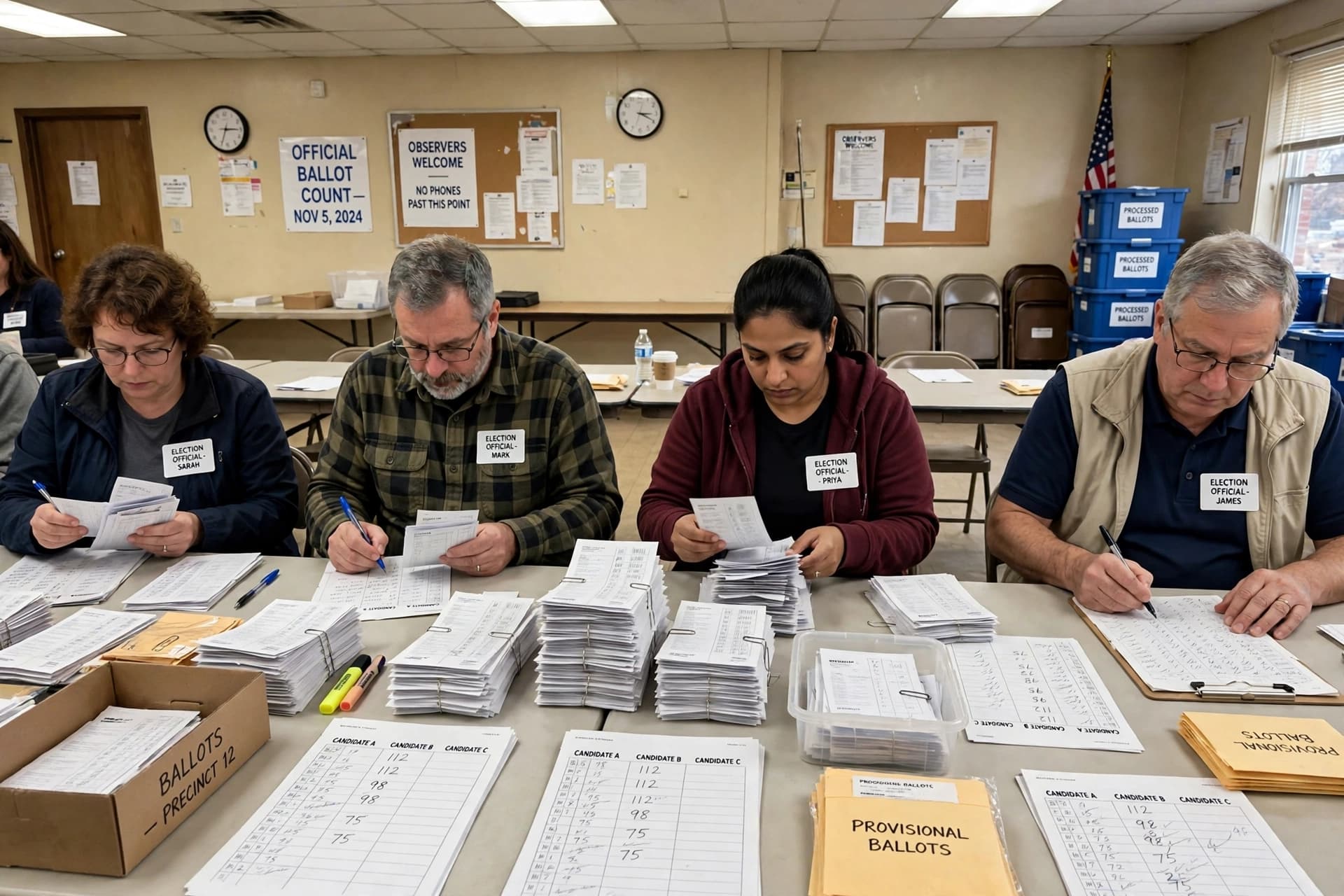
There is a particular irony in the machinery of democracy: the tools meant to make voting efficient can become the very things that complicate it when time refuses to cooperate. In British Columbia, with final voting day arriving Saturday, Elections BC has confirmed that ballots cast on election day will be tallied by hand—a departure from 2024, when electronic tabulators counted paper ballots for the first time in a provincial general election . The reason offered is not malfunction or mistrust, but something more mundane: "short time frames and complex operational logistics of a snap election" .
The snap election, called on short notice, left the agency with insufficient runway to deploy and test the tabulator system across all voting places. Advance ballots and those cast at district electoral offices will still be counted electronically, and those results are expected to report first after polls close at 8 p.m. . But the bulk of election-day votes—the ones that traditionally define the narrative of a province's political direction—will be counted the old way, by hands moving paper from pile to pile.
The practical consequence is a slower night. In 2024, electronic tabulation allowed the first preliminary results to appear within five minutes of polls closing, with 59 percent of results reported within half an hour . In past elections, the first numbers typically emerged around 45 minutes after closing. This year, that rhythm will be disrupted, and the province will wait a little longer for the picture to sharpen. Absentee and mail-in ballots will not even be touched until the final count, scheduled for November 6 to 10 .
Advance voting numbers released Thursday suggest a different kind of shift. More than 891,000 advance votes were cast from Friday to Wednesday, representing about 24 percent of registered voters. That is down more than 11 percent compared to 2024, when advance turnout spiked 49 percent over the previous election . Whether this reflects fatigue, weather, or simply the unpredictability of a snap campaign is a question the final numbers may answer.
On the campaign trail, the final hours carried the familiar theater of endorsement and rally. The B.C. Conservatives gathered in Surrey on Thursday night, where mayor-elect Doug McCallum endorsed Lorne Doerkson as the province's next premier. Former premier Christy Clark and former Surrey mayors Linda Hepner and Dianne Watts stood alongside him . McCallum, at 82, is about to begin his third separate stint as Surrey's mayor, having defeated incumbent Brenda Locke in the October 17 municipal elections . The presence of so many figures from Surrey's past suggested a desire to project continuity, even as the party sought to present itself as the agent of change.
For voters, the hand count is unlikely to alter the act of casting a ballot. It may, however, alter the experience of watching results arrive. In an era accustomed to instant data, the slow accumulation of numbers counted by human hands is a reminder that democracy, for all its technology, still depends on physical acts: a paper marked, a box sealed, a count witnessed. Elections BC has not suggested any concern about accuracy, only about pace.
The polls close Saturday at 8 p.m. The first electronic results from advance voting will arrive shortly after. The hand count will follow, at its own speed, through the evening and into the night. British Columbia will wait, as it has before, for the paper to speak.
---
AI Image Disclaimer: The imagery in this article is AI-generated and serves only as visual illustration.
Sources: CityNews Vancouver, CBC News, The Canadian Press, The Record
Published by Banx Network. This article is part of the Banx decentralized media programme, powered by the BXE token on the XRP Ledger.